Suspended Sentence for 1st and 2nd Trials, 'Trespassing Crime' Recognized
Supreme Court "Building Manager's Peace Must Not Be Disturbed"
[Asia Economy Reporter Heo Kyung-jun] The Supreme Court has ruled that if a theft is committed by entering an unmanned store with always-allowed access through normal entry methods, the crime of trespassing cannot be applied.
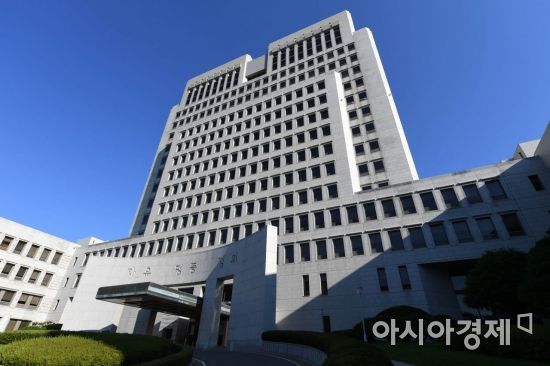
The Supreme Court's First Division (Presiding Justice Kim Seon-su) overturned the original ruling that sentenced Mr. A to 1 year and 10 months in prison with a 2-year probation and remanded the case to the Seoul Northern District Court on the 5th. Mr. A was on trial for charges including nighttime trespassing and theft.
Mr. A and his sibling Mr. B were prosecuted for repeatedly entering unmanned stores in October 2021 and stealing cash by detaching the front panel of unmanned cash registers.
They were also charged with stealing 150,000 won in cash from another unmanned store's cash register in the same month. Charges of nighttime trespassing and special property damage were also applied. Additionally, there were charges including unpaid taxi fares, mobile phone fraud, and mobile phone theft.
In the trial, the key issue was whether the peaceful state of the building managers could be considered disturbed when entering an unmanned store with always-allowed access through normal methods for the purpose of theft.
The first trial court found both siblings guilty of all charges and sentenced Mr. A to 1 year and 10 months in prison. Mr. B was sentenced to 1 year in prison. The appellate court dismissed Mr. A's appeal and, considering the settlement circumstances, sentenced Mr. B to 1 year in prison with a 2-year probation.
However, the Supreme Court's judgment differed. Among the various charges, the Supreme Court found that the original ruling, which recognized nighttime trespassing theft and joint residential trespassing on the premise of establishing the crime of trespassing, misinterpreted the law.
The court stated, "Simply entering a residence against the occupant's subjective intention alone cannot be immediately judged as trespassing," and added, "Trespassing should be judged based on whether the peaceful state is actually disturbed, not on whether it is against the occupant's intention."
Furthermore, the court ruled, "Entering an unmanned store with always-allowed access through normal entry methods cannot be seen as disturbing the peaceful state of the building managers," and "Even if the defendant's entry was for criminal purposes, the crime of trespassing cannot be established."
© The Asia Business Daily(www.asiae.co.kr). All rights reserved.
![Clutching a Stolen Dior Bag, Saying "I Hate Being Poor but Real"... The Grotesque Con of a "Human Knockoff" [Slate]](https://cwcontent.asiae.co.kr/asiaresize/183/2026021902243444107_1771435474.jpg)















