Seoul City, '2022 Seoul City Elderly Survey'
[Asia Economy Reporter Kiho Sung] The Seoul Metropolitan Government announced the results of the "2022 Seoul Elderly Survey" on the 6th, which will be used to develop customized policy agendas for an aging society.
This survey was conducted through face-to-face interviews over two months starting from June last year, targeting 3,010 residents of Seoul born in 1957 or earlier. Additionally, questions related to material deprivation and housing conditions were added to understand the actual living conditions of Seoul's elderly after COVID-19. Through the results of this survey, we can glimpse the characteristics of the elderly who have changed as the baby boomer generation enters the 'elderly' category and how social distancing policies have affected the lives of Seoul's elderly.
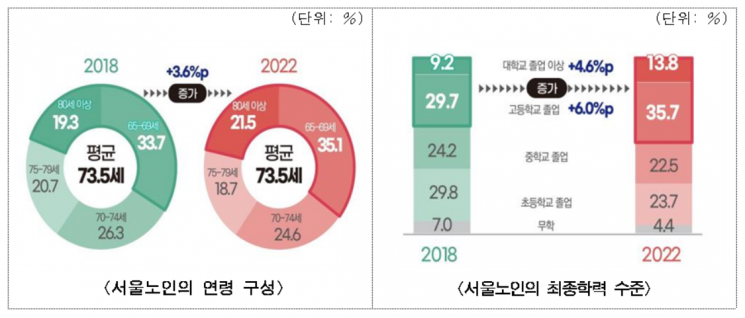
First, the average age of Seoul's elderly is 73.5 years, with those aged 65-69 accounting for the largest proportion at 35.1%, followed by 70-74 years at 24.6%, 75-79 years at 18.7%, and 80 years or older at 21.5%. The highest level of education is high school graduation at 35.7%, middle school graduation at 22.5%, elementary school graduation at 23.7%, and university graduation or higher at 13.8%.
The average monthly household income is 2.721 million KRW, with 23.2% earning 4 million KRW or more, 22.8% earning 2-2.99 million KRW, 22.7% earning 1-1.99 million KRW, 17.5% earning 3-3.99 million KRW, and 13.8% earning less than 1 million KRW.
One in three elderly people in Seoul lives in the Northeast area (32.7%) or Southwest area (30.0%), women (55.7%) outnumber men (44.3%), 67.2% have spouses, and 21.9% live alone.
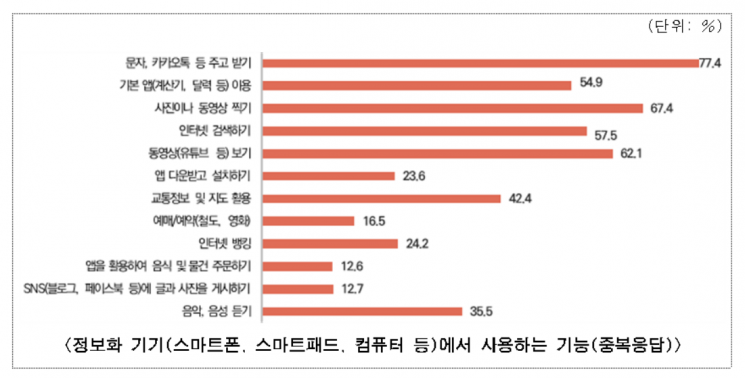
83.7% of Seoul's elderly use smartphones, and one in four cited the internet as the most frequently used information medium to obtain necessary information. The proportion of elderly people engaged in work activities has increased, with the percentage of managers, professionals, office workers, and skilled workers rising in both current and past occupations, while the proportion of simple laborers, service workers, and sales workers has decreased.
Compared to 2018, before the COVID-19 pandemic, the usage rate of indoor facilities by Seoul's elderly has decreased, while the desire to use most community facilities has increased. In particular, outdoor spaces showed the greatest increase in both usage rate and desire to use.
The survey covered the status and needs in the following areas: ▲old-age life, ▲health status, ▲living environment, ▲work activities, ▲leisure, culture, and volunteer activities, ▲respect and protection, and ▲living conditions.
Besides nursing hospitals and clinics, the community facilities most frequently used by Seoul's elderly are outdoor spaces such as parks, playgrounds, riversides, and mountains (79.8%). The average number of chronic diseases lasting more than three months is 1.9, and the self-assessed health status is 'average' (3.3 out of 5 points).
The main modes of transportation used when going out are bus (28.7%), subway (27.8%), walking (26.5%), and private car (12.9%). The average duration of employment at the current job for elderly workers is 15.3 years, working an average of 5 days per week, with an average monthly labor income of 1.944 million KRW.
The average age that Seoul's elderly consider as the threshold for being elderly is 72.6 years. 31.4% prefer cremation followed by columbarium burial as a funeral method, while 28.3% have not yet decided. 53.4% wish to live at home even if mobility becomes difficult, but 35.9% hope to live in elderly care facilities that provide convenience services such as care and meals. 96.4% of respondents live above ground, and 33.4% reside in housing built between 20 and 30 years ago.
The raw data and basic analysis report of this survey will be made available by the Seoul Welfare Foundation. They can be used for policy development, academic research, and various other purposes.
Kim Sanghan, Director of Welfare Policy at Seoul City, said, "The Seoul Elderly Survey, conducted every two years, is designed to examine the living conditions of the elderly in areas such as health, environment, employment, and leisure." He added, "The survey results will be used as basic data for establishing policies to respond to a super-aged society, and we will continue efforts to improve the quality of life for Seoul's elderly."
© The Asia Business Daily(www.asiae.co.kr). All rights reserved.
![Clutching a Stolen Dior Bag, Saying "I Hate Being Poor but Real"... The Grotesque Con of a "Human Knockoff" [Slate]](https://cwcontent.asiae.co.kr/asiaresize/183/2026021902243444107_1771435474.jpg)
















