Energy Infrastructure Established for Over 120,000 Rental Housing Units in 5 Years
[Asia Economy Reporter Noh Kyung-jo] Amid recent consecutive increases in heating and electricity costs, Korea Land and Housing Corporation (LH) is taking steps to reduce household burdens by expanding power demand management projects for rental housing and increasing eco-friendly power production.
According to LH on the 5th, over the next five years (2023?2027), energy infrastructure will be established to expand power demand management projects for 118,000 rental housing units.
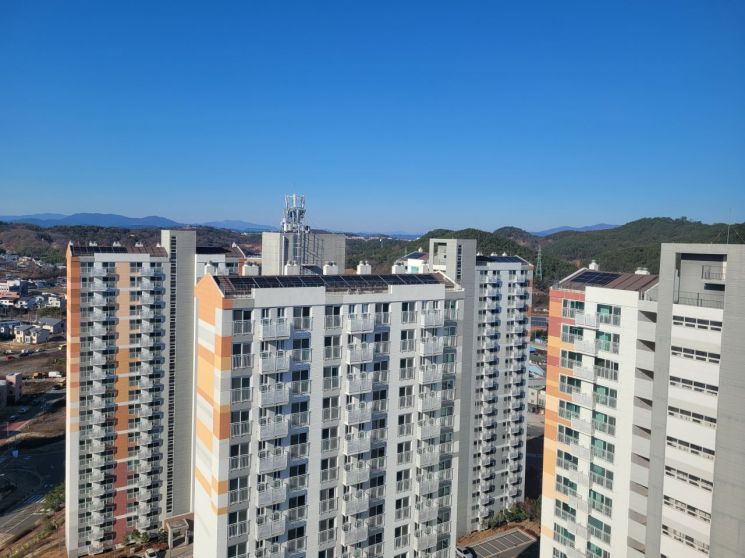 Solar panels are installed on the rooftop of a rental housing unit by Korea Land and Housing Corporation (LH). / Photo by LH
The power demand management project is a system that reduces electricity usage in response to demand reduction requests from entities such as the Korea Power Exchange when fine dust concentration is 'bad' or higher, electricity market prices rise, or there is a power supply crisis. Instead, emergency generators are operated to produce electricity independently, and the reduced electricity usage is compensated financially later. Depending on the savings performance per household, the burden of management fees is reduced.
In the Incheon area, 46 complexes with 67,000 households have been gradually implementing the project since last year, and LH expects an annual benefit of 66,000 to 106,000 KRW per household.
To implement the project, energy infrastructure must be established. Accordingly, LH plans to build emergency generator facilities (capacity of three small combined heat and power plants) in newly constructed complexes to produce 103 MW of electricity independently and install smart meters. One small combined heat and power plant (30 MW) produces enough electricity for 150,000 households (with an average electricity usage of 300 kWh per household) for one month. For existing buildings, solar power generation facilities will be installed on rooftops, and old meters will be replaced with smart meters. Additionally, electric vehicle chargers will be installed at about 2% of the total parking spaces to reduce residents' electricity bills and enhance convenience.
LH also plans to actively discover customized energy services for each complex. The 'LH Energy Integrated Platform,' established in March last year, is part of this effort. This platform collects data related to energy facilities and consumption to predict energy demand and production. Facility information for each complex, which was manually managed through emergency generators and meters, is computerized, enabling continuous remote management of energy resources. Currently, power data from 523 complexes out of 963 LH-built rental housing complexes are being collected.
Lee Tak-hoon, Head of LH Public Housing Business Division, said, "Through big data, we can analyze residents' consumption patterns and induce reasonable energy consumption for residents by building an integrated database (DB). We will strive to ensure that residents can enjoy practical benefits through customized energy welfare services during a time when difficulties are increasing due to rising management fees caused by energy price adjustments."
© The Asia Business Daily(www.asiae.co.kr). All rights reserved.
![Clutching a Stolen Dior Bag, Saying "I Hate Being Poor but Real"... The Grotesque Con of a "Human Knockoff" [Slate]](https://cwcontent.asiae.co.kr/asiaresize/183/2026021902243444107_1771435474.jpg)















