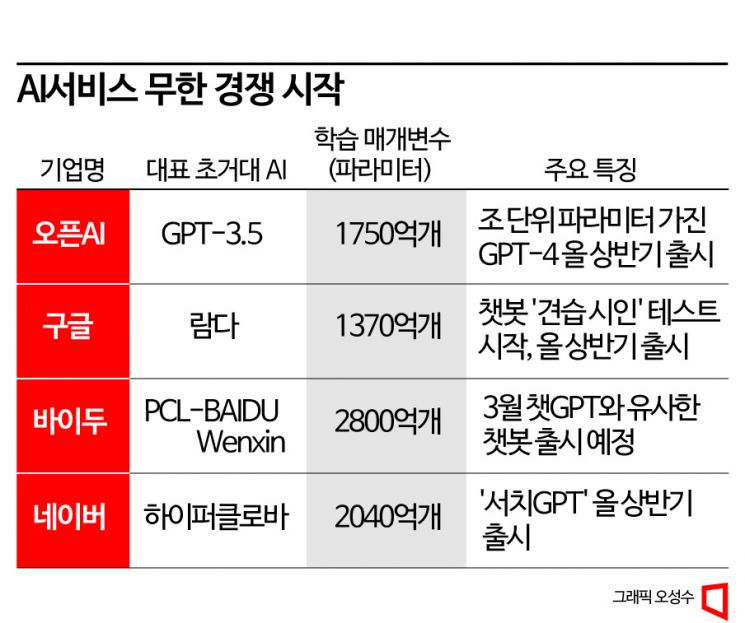
[Asia Economy reporters Seungjin Lee and Yuri Choi] Riding the ChatGPT craze sparked by OpenAI, Naver is also joining the race. Microsoft (MS) has announced plans to integrate ChatGPT into its search engine, Bing. This marks a direct challenge to Google’s dominance in the search engine market. It is the beginning of a major transformation in the search engine industry. Naver will also compete by launching a new AI-powered search service.
Naver to Launch ‘Search AI’ in the First Half of This Year
On the 3rd, during the earnings conference call, Naver CEO Suyeon Choi stated, “We are preparing countermeasures for new search trends such as generative artificial intelligence (AI).” She added, “Our goal is to introduce ‘Search GPT,’ an enhanced search experience unique to Naver, within the first half of this year.”
CEO Choi expressed confidence, saying, “Naver is not only the operator with the largest amount of the highest quality search data in Korean, but also South Korea’s top AI technology development company boasting world-class technology in ultra-large AI models.”
Naver’s upcoming ‘Search AI’ will be able to solve problems that are difficult to address with traditional search. For example, for queries requiring summarized answers such as Seoul subway fares, it will provide summarized responses based on highly reliable and up-to-date content data along with sources. For searches needing advice, like ‘how to buy a laptop cheaply,’ it will offer answers utilizing a variety of content.
Google Tests AI Chatbot... Global Competition Heats Up
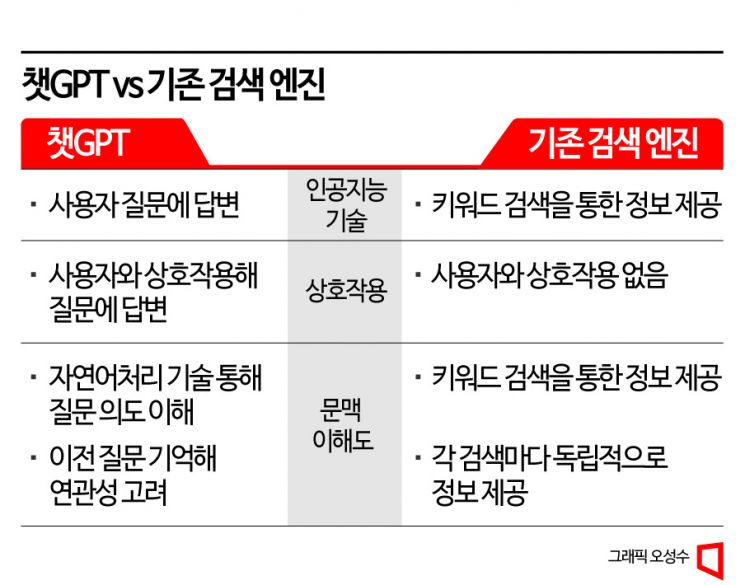
Google has issued a ‘code red’ in response to the emergence of ChatGPT. There is a sense of crisis that ChatGPT, which answers any question immediately, could eventually replace Google Search in the long term. MS plans to apply it not only to the Bing search engine but also to various products such as Excel.
Google has also hastened to launch new AI services. Sundar Pichai, Google’s CEO, said during the earnings conference call on the 2nd (local time), “Within the next few weeks or months, we will release AI-based language programs like ‘LaMDA,’ Google’s AI-based extensive language model.”
China’s largest search engine, Baidu, is scheduled to launch an AI chatbot in March. Baidu has invested billions of dollars in AI research and development. It is expected that Baidu will enable users to obtain conversational search results similar to OpenAI’s ChatGPT through its chatbot service.
Statista analyzed that Google holds 84% of the total search market. It is followed by MS with 8.9%, Yahoo with 2.6%, and Yandex with 1.5%. However, the changes that the ChatGPT craze will bring to the search market are unpredictable. ChatGPT surpassed 1 million users within five days of its launch and currently has 10 million daily users.

Challenges Remain Including AI Ethics Issues
Although Google, Naver, and others are rushing to introduce new services amid intensifying AI competition, there are still issues to be resolved. The most representative is AI ethics. During the process of learning vast amounts of information, AI can also learn discrimination and hate speech.
In South Korea, the AI chatbot ‘Iruda,’ which learned hate speech and had its service suspended in 2021, is a representative case. MS discontinued its chatbot ‘Tay’ less than a day after launch in 2016 because it made statements hateful to certain races.
Monetization models are also a concern. OpenAI announced that it would offer a paid version of ChatGPT for a monthly fee of $20 (about 24,000 KRW). If many similar services flood the market, users may resist paying for usage.
Regarding this, CEO Choi explained during the conference call, “Although interest in ChatGPT is currently high, there are many issues to review in terms of cost efficiency. Naver’s ultra-large AI ‘HyperCLOVA’ continues to develop, and the paid B2B (business-to-business) market is also opening, so we expect to explore monetization through investment in Search GPT.”
© The Asia Business Daily(www.asiae.co.kr). All rights reserved.



















