"Labor-Management Agreement on Shortening Prescribed Working Hours Is Not an Illegal Act"
[Asia Economy Yeongnam Reporting Headquarters Reporter Kim Yong-woo] 'Is it a tangerine or a tangja across the river?'
In taxi wage claim lawsuits, known as the so-called ‘Tangja rulings’ due to differing judgments in each court, recent overturned rulings have once again divided the taxi industry between hope and despair.
The key issue in the trials was whether the agreed reduction in taxi drivers’ ‘prescribed working hours’ by labor and management was a scheme to evade the Minimum Wage Act.
On the 1st, in a lawsuit filed by taxi drivers demanding the unpaid ‘minimum wage’ for the reduced hours, the Busan District Court Seobu Branch dismissed the plaintiff’s claim.
According to the taxi industry and courts, the Civil Division 1 of the Busan District Court Seobu Branch dismissed the wage refund lawsuit filed by 248 taxi drivers against a taxi company in Busan.
On the same day, there were eight similar trials only at the Seobu Branch, and all wage refund claims filed by a total of about 450 taxi drivers against six corporate taxi companies were dismissed.
Earlier, on the 20th of last month, a ruling with the same intent was issued by the Busan District Court.
The Civil Division 5 of the Busan District Court dismissed the taxi drivers’ wage claims, stating, “Based solely on the evidence submitted by the workers, it is insufficient to recognize the agreement to reduce prescribed working hours as an evasion act (circumvention act) intended to avoid minimum wage compliance, and thus it is not invalid as an illegal act.”
The court also judged, “Since drivers can earn more from excess transportation income corresponding to the reduced prescribed working hours, it cannot be concluded that the agreement to reduce prescribed working hours disadvantaged the drivers.”
Last year, some taxi companies faced a crisis in the taxi industry as they either closed or went on full suspension due to the direct hit from COVID-19 and worsening conditions. The taxi lawsuits, which had been fought with the threat of closure over wage claims, have recently encountered a new trend with consecutive dismissals.
According to the Busan Taxi Transportation Business Association, there are about 400 ongoing labor-management lawsuits related to ‘unpaid minimum wages’ in Busan alone, involving 3,382 plaintiffs who are workers and 94 defendant companies.
The total amount of the lawsuits reaches 42.45 billion KRW, and the taxi industry has appealed since July last year through relay one-person protests in front of the court, stating, “The taxi industry is facing the brink of bankruptcy due to the impact of COVID-19 and an unrealistic taxi fare system, as well as lawsuits.”
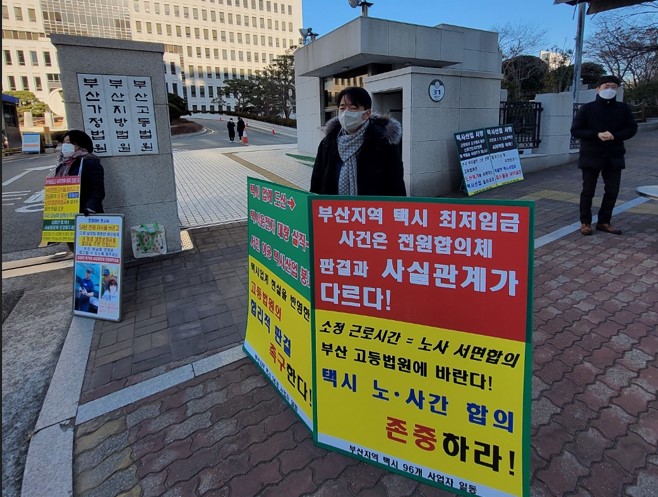 A representative of a member company of the Busan Taxi Transportation Business Association is holding a solo protest in front of the Busan District Court.
The spark for the lawsuits was the 2019 Supreme Court plenary session ruling. The agreed reduction of prescribed working hours between labor and management was judged as a ‘circumvention’ act cleverly designed to reduce fixed wages and evade the Minimum Wage Act, and thus was declared invalid. Subsequently, taxi drivers affiliated with corporate taxi companies and retirees filed lawsuits demanding the unpaid minimum wages corresponding to the ‘reduced’ hours.
At that time, the Supreme Court plenary session viewed that ‘taxi companies reduced prescribed working hours to evade the Minimum Wage Act,’ and as lower courts followed this, similar cases in Seoul, Busan, and other places resulted in different rulings in each court, leading to the so-called ‘Tangja trial’ controversy.
In two recent trials held in Busan, a shift in the trend was signaled, indicating that the plaintiff taxi drivers must prove that the labor-management agreement was an illegal act.
Until now, labor and management in the taxi industry had unclear working hours and minimum wage settings due to the nature of the job being performed outside the company premises. Since the application of the Minimum Wage Act in July 2009, with special provisions, labor and management have set the basic salary and deposit amount based on the agreed prescribed working hours.
Prescribed working hours refer to the time mutually agreed upon by the employer and employee for wage calculation in occupations where working hours cannot be measured within the workplace. Taxi drivers’ working hours are a representative example of prescribed working hours.
According to the Minimum Wage Act, even if the employer tries to set longer prescribed working hours, taxi drivers as workers did not welcome this.
The longer the prescribed working hours, the higher the fixed salary, but fixed salary includes various taxes and social insurance premiums, which are indirect costs, and the deposit paid to the company increases more than the fixed salary increase. Therefore, drivers, who consider excess transportation income as their real earnings, did not favor such a wage structure.
Jang Seong-ho, director of the Busan Taxi Transportation Business Association, said about this ruling, “It was recognized that the reduction of prescribed working hours was not intended to evade minimum wage compliance because fare increases and additional excess transportation income could be earned.”
Director Jang said, “Through the long lawsuits with different rulings in each court depending on the judge’s disposition, the trust relationship between taxi labor and management has already collapsed. The taxi industry is already pushed to the edge, hoping for even a small relief like ‘urinating on frozen feet’ just to survive one more day,” adding, “We want to get out of the lawsuits quickly as it is already hard enough to focus on management.”
© The Asia Business Daily(www.asiae.co.kr). All rights reserved.
![Clutching a Stolen Dior Bag, Saying "I Hate Being Poor but Real"... The Grotesque Con of a "Human Knockoff" [Slate]](https://cwcontent.asiae.co.kr/asiaresize/183/2026021902243444107_1771435474.jpg)















