'2022 Small Business Finance Status Using Guarantees'
Debt per Person 140 Million Won
Sales Decline and Worsening Funds Lead to Reliance on Loans
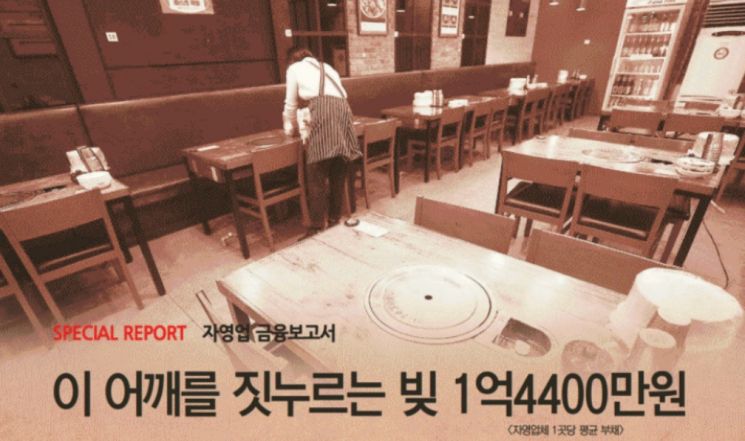
[Asia Economy Reporter Sim Nayoung] During the pandemic, self-employed individuals became synonymous with 'debt.' This is why policies like loan maturity extensions, interest repayment deferrals, and even debt relief through the New Start Fund have been introduced. According to Statistics Korea, there were 5,632,000 self-employed people nationwide last year, accounting for 20.1% of all employed persons. How much debt are the self-employed, who open their shops and wait for customers in every alley today, carrying? Why did they incur such debt? Will they ever be able to repay it?
Kang Daeseon (49), who runs a franchise pork intestines restaurant, said, "January sales were 23 million KRW, but it’s so miserable." This month’s expenses include 9.6 million KRW for ingredients, 2.2 million KRW for rent, 4.1 million KRW for labor costs, 3 million KRW for alcohol and delivery fees, 1.3 million KRW for flag advertising, 1 million KRW for utilities, and 1.2 million KRW for taxes. Card fees and delivery app commissions are not even included, but the calculator already shows 22.4 million KRW. Kang said, "This month’s profit is zero," and "I have a loan of 100 million KRW, and I’m going crazy," lowering his head.
"In this business, free pizza delivery is the gospel. You have to run a review event with '1+1' and give out three coupons to get orders." Cha Geunseong (45), who runs a pizza shop in Jungnang-gu, Seoul, concluded this after being a one-person boss for 10 years. "After raising Baemin One Delivery (Baedal Minjok’s single-store delivery) delivery fees by 1,000 KRW and cutting some Yogiyo discounts, last month’s sales were halved," he said. "I put up six Baemin flags (nearby store location ads, 88,000 KRW per flag), but since I don’t charge delivery fees, profits are at rock bottom," he sighed.
30% of Debtors Have Debt Over 100 Million KRW
According to the '2022 Financial Status Report on Small Business Owners Using Guarantees' (survey of 3,101 small business owners) released by the Korea Credit Guarantee Fund on the 3rd, the average debt per business was 144.07 million KRW. The largest group was those with 50 million to 100 million KRW (32.3%), followed by 20 million to 50 million KRW (23.8%). A significant number also had debts in the 100 million to 200 million KRW (18.2%) and 200 million to 400 million KRW (10.3%) ranges.
Four out of ten small business owners said their debt increased over time. 41.0% of businesses reported increased debt compared to a year ago. 33.4% said it was the same, and only 2.56% said it decreased.
The main reason for increased loans was poor sales (59.7%). Regardless of wholesale, retail, service, or manufacturing industries, performance declined, leading to more borrowing. A hat wholesaler at Dongdaemun Market in Seoul said, "This winter, I’m trying to survive by taking bank loans just to pay rent," adding, "When the weather warms up, people will go out more, and hats will sell better than now." 'Rising costs' were also cited by 36.7% as a cause of increased debt, mainly by those in food and lodging businesses. Last year’s soaring inflation caused food prices to rise sharply.
Worsening Financial Conditions This Year, But No Plans to Close Due to Initial Costs
Sales are down, debt is up, and interest rates are rising, worsening financial conditions. Last year, most small business owners reported their financial situation as 'worsened' (67.2%). Responses indicating 'unchanged' (19.5%) or 'improved' (13.4%) were relatively fewer. The report predicted, "This year, 52.4% expect their financial situation to worsen compared to last year," forecasting that small business owners’ financial conditions will deteriorate over time.
Although there is no hope in sight, most have no intention of closing their shops. 83.2% of self-employed individuals said they plan to continue operating their current businesses. Reasons include 'not wanting to waste startup costs' and 'not having money to close down.' Kim Kyungjin (51), who opened a snack bar in Incheon two years ago, is unable to pay three months’ rent and cannot renew the lease with the landlord. Kim said, "I invested about 180 million KRW including interior and deposit, so I can’t give up the shop," and "I’m looking into government-guaranteed loans and savings banks, hoping to negotiate by paying overdue rent with interest." The average startup capital per business was 121.54 million KRW.
Even if they decide to close, demolition costs of tens of thousands of KRW per pyeong (3.3 square meters), existing loan repayments, and taxes create a heavy burden, preventing execution. The Korea Credit Guarantee Fund stated, "The average closure cost for self-employed people is 19.89 million KRW (as of the first half of last year), so support is needed for closure costs including restoration expenses during the closure process."
© The Asia Business Daily(www.asiae.co.kr). All rights reserved.
![Clutching a Stolen Dior Bag, Saying "I Hate Being Poor but Real"... The Grotesque Con of a "Human Knockoff" [Slate]](https://cwcontent.asiae.co.kr/asiaresize/183/2026021902243444107_1771435474.jpg)















