The Bank of Korea announced on the 3rd that over the past decade, wage premiums have increased in high-wage industries and decreased in low-wage industries, leading to a widening gap in wage premiums across industries.
In its analysis titled "Expansion of Wage Gaps Between Industries" released that day, the Bank of Korea explained, "Recently, discussions have emerged suggesting that industrial effects such as the widening wage gap between industries and changes in the employment share by industry are major factors contributing to the expansion of wage inequality."
According to the Bank of Korea, wage dispersion has shown a gradual upward trend since the financial crisis, which is attributed to the expansion of dispersion between industries despite a reduction in dispersion within industries.
In other words, although wage inequality within the same industry has decreased, overall wage inequality has increased due to the widening wage gap between industries (wage factor) and changes in the employment share by industry (employment factor).
The increase in wage dispersion between industries was led by certain industries at both ends of the wage distribution.
High-wage industries, in order of contribution, were found to be electronic components manufacturing, research and development, financial and insurance services, finance, and professional services. Conversely, low-wage industries included social welfare services, other personal services, educational services, restaurants and bars, and business support services.
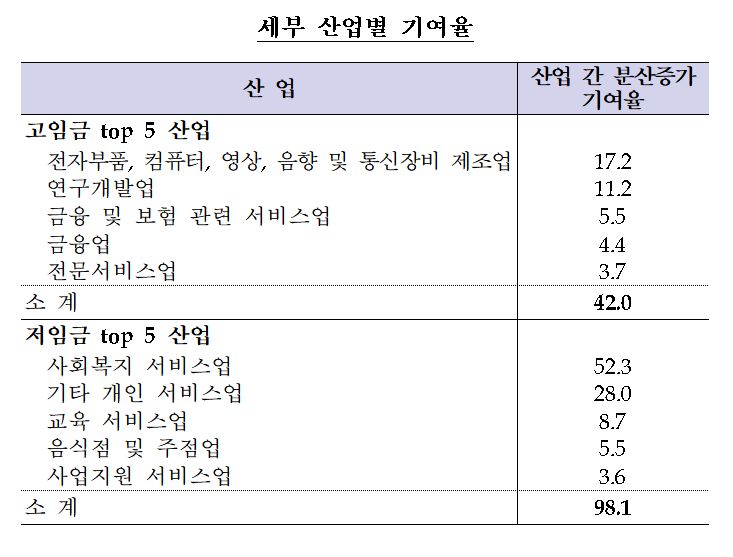
The Bank of Korea explained that the widening wage gap between these industries has increased inequality.
Workers with the same conditions such as gender, education, age, experience, and occupation earned 40% more in electronic components manufacturing than in social welfare services during 2009?2012, but this premium increased to 54% during 2018?2021.
Among high-wage industries, the wage premium in research and development rose the most sharply (17%), followed by electronic components manufacturing and finance. In low-wage industries, other personal services saw a significant decline, turning negative, while social welfare and educational services also showed decreases.
There was a tendency for high-wage workers to cluster in high-wage industries and low-wage workers to cluster in low-wage industries, which acted as a factor expanding the wage gap between industries.
The Bank of Korea pointed out, "It is necessary to be aware that if the sorting and segregation of workers between industries become excessively severe in this process, the wage gap between industries may widen further in the long term, and labor mobility between industries could be constrained."
© The Asia Business Daily(www.asiae.co.kr). All rights reserved.

















