Emergency Economic Ministers' Meeting at Government Seoul Office, Jongno-gu, Seoul
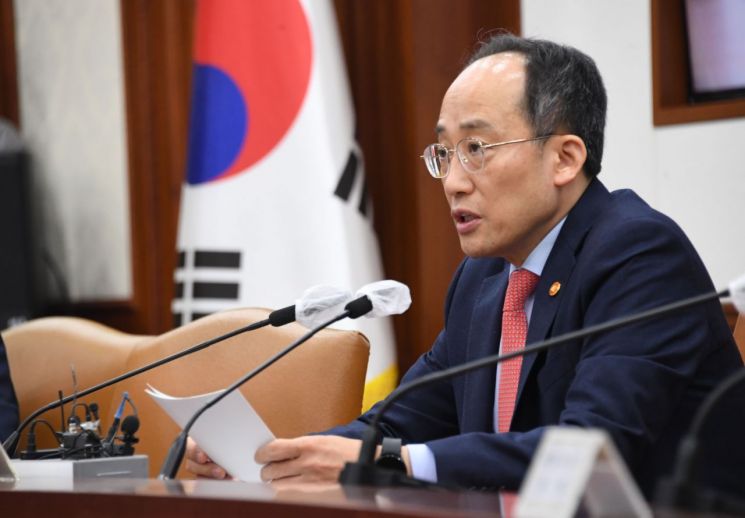 Deputy Prime Minister and Minister of Economy and Finance Choo Kyung-ho is delivering opening remarks at the Emergency Economic Ministers' Meeting held on the 3rd at the Government Seoul Office in Jongno-gu, Seoul.
[Asia Economy Sejong=Reporter Song Seung-seop] Deputy Prime Minister and Minister of Economy and Finance Choo Kyung-ho emphasized, “We will establish a ministerial-level Export and Investment Countermeasures Meeting to review export and investment conditions by industry every two weeks and prepare countermeasures, thereby concentrating the policy capabilities of economic ministries.”
On the 3rd, Deputy Prime Minister Choo held an emergency economic ministers’ meeting at the Government Complex Seoul in Jongno-gu, Seoul, stating, “Economic conditions such as exports and investment are expected to be quite difficult until the first half of the year.” At the meeting, support measures by manufacturing industry sector were discussed, and plans were made to sequentially prepare and announce export and investment support measures for major industries going forward.
Deputy Prime Minister Choo explained, “We will designate first-level officials from each ministry as export and investment officers to strengthen the accountability of the relevant ministries,” adding, “All public officials in economic ministries will become salespeople to thoroughly manage exports and investments by industry and product.” The joint 24-hour economic situation monitoring team, which has been operating since October last year, will be “expanded and reorganized,” and an emergency export and investment countermeasures team involving relevant ministries by industry will be immediately activated.
Regarding the inflation level of 5.2% last month, he said, “It rose slightly compared to the previous month due to electricity rate hikes and product price adjustments at the beginning of the year, but it is at a level consistent with initial expectations.” He analyzed, “In the first half of the year, the inflation rate is expected to remain high around 5% in the first quarter, then the upward pressure will somewhat ease in the second quarter, and it will gradually stabilize toward the second half.”
Deputy Prime Minister Choo added, “We will strengthen individual consultations with local governments to keep local public utility fees, which are currently under discussion for increases, as stable as possible,” and mentioned, “We will expand the differential range in the distribution of fiscal incentives linked to local governments’ efforts to stabilize public utility fees.”
He also announced, “To prevent price instability of agricultural, livestock, and fishery products caused by cold waves during the winter, we will select items with rapidly rising prices on a weekly basis and provide focused 20% discount support.” He further stated, “For mackerel, whose prices continue to rise, we will increase the quota for tariff-rate quotas by 20,000 tons, and if price instability continues for chicken, we will promptly introduce an additional 10,000 tons of tariff-rate quota.” In addition, stockpiled quantities of items with supply concerns will be actively released.
Meanwhile, regarding processed foods, he said, “They still pose a burden on household expenses,” and added, “We will continue industry consultations to stabilize prices.”
© The Asia Business Daily(www.asiae.co.kr). All rights reserved.
![Clutching a Stolen Dior Bag, Saying "I Hate Being Poor but Real"... The Grotesque Con of a "Human Knockoff" [Slate]](https://cwcontent.asiae.co.kr/asiaresize/183/2026021902243444107_1771435474.jpg)















