"Half of Bathhouses Closed During 3 Years of Corona"
"Gas Bill 4 Million Won... Increased by 1.5 Million Won in One Year"
[Asia Economy Reporter Park Hyun-joo] "Whether one person or 100 people come to the bathhouse, the water always needs to be heated. With demand not recovering and gas prices rising, we are taking a direct hit."
Lee Young-ho, head of the Gangdong·Songpa branch of the Korea Bathhouse Association, recently revealed that the bathhouse industry is facing a crisis due to increases in heating and other public utility costs. This is another blow to the bathhouse industry, which was already struggling due to a drop in visitors caused by social distancing measures during the COVID-19 pandemic.
On the 31st of last month, on YTN's "News Rider," Lee explained, "Sales were almost cut in half last year and the year before. From the second half of last year, it seemed like business was recovering to about 60-70% of normal levels, but with gas and electricity prices rising in this situation, it has become difficult to manage."
According to Lee, before the spread of COVID-19, there were 78 bathhouse businesses in Seoul’s Gangdong and Songpa districts. After three years of the pandemic, only 44 remain. This means that about half of the bathhouses in this area closed during the pandemic.
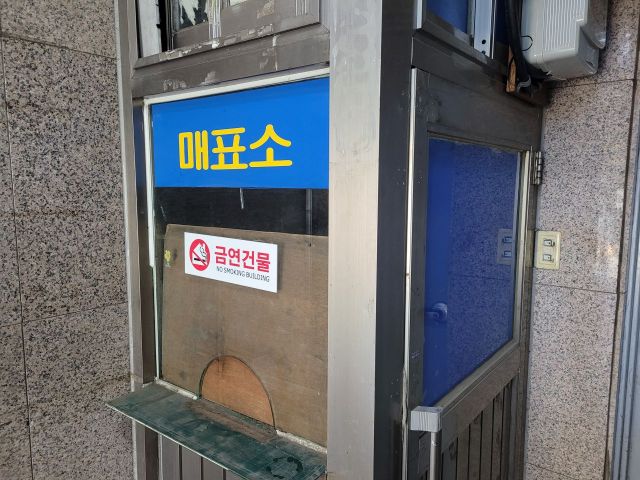 Ticket booth of a closed bathhouse in the Dongdaemun-gu area of Seoul.
 Photo by Gong Byung-sun mydillon@
In fact, according to local administrative licensing data from the Ministry of the Interior and Safety, from March 2020, when the COVID-19 pandemic began, until last month, 960 bathhouse-related businesses?including bathhouses, saunas, and jjimjilbangs?have closed. Bathhouses require significant initial investment in facilities such as baths and jjimjilbangs, so once they close, reopening is difficult.
Although social distancing was fully lifted in April last year, operating costs such as gas and water fees for bathhouses have risen this year, making business still difficult. Gas fees for bathhouses (commercial use 2) increased three times last year. In particular, in October last year, the rate rose from 15.60 won per megajoule (MJ) by 17.4% to 18.32 won.
Water fees for bathhouses in Seoul, which were 360 to 420 won per cubic meter (㎥) depending on usage in 2020, were raised to 440 won regardless of usage starting last year. From this year, the fee will increase to 500 won per ㎥.
Lee said, "In January last year, the gas bill was about 2.5 million won, but in January this year (for December last year), it was a little over 4 million won. They say gas prices will increase by more than 10 won, and in this situation, it is hard for us to cope," he appealed.
Bathhouse operators are wearing worried expressions. According to an urgent survey on heating cost increases conducted by the Korea Federation of Micro Enterprise on the 2nd, 90% of bathhouse workers responded that the rise in heating costs is "very burdensome." Forty percent of bathhouse owners said heating costs increased by more than 50% compared to last year, which is twice the average for other industries (20.3%).
The Korea Federation of Micro Enterprise is demanding heating cost support measures for small business owners. The federation urged, "There is an urgent need for government and local governments to provide heating support for small business owners through contingency funds as soon as possible."
© The Asia Business Daily(www.asiae.co.kr). All rights reserved.
![Clutching a Stolen Dior Bag, Saying "I Hate Being Poor but Real"... The Grotesque Con of a "Human Knockoff" [Slate]](https://cwcontent.asiae.co.kr/asiaresize/183/2026021902243444107_1771435474.jpg)















