Goryeo Dynasty Buddhist Statue Taken to Japan by Wako Raiders
Korean Court Rules "Japanese Ownership... Must Return"
Japanese Media: "Shift in Trend from 'Anything Anti-Japan Is Good'"
The ownership of a Goryeo-era gilt-bronze Avalokitesvara statue, which was taken to Japan during the Japanese pirate raids and later brought back to Korea by a Korean thief, has been ruled to belong to the Japanese side. Japanese media evaluated this by saying, "The atmosphere in Korea, where anti-Japanese sentiment was considered innocent, is changing."
On the 2nd, the Yomiuri Shimbun reported, "Korean courts have repeatedly issued rulings that have caused friction in Korea-Japan relations over historical issues such as former comfort women and forced labor compensation lawsuits," adding, "This ruling indicates a change in the trend that anything anti-Japanese was allowed." It also noted, "The outcome of the appeal trial is being closely watched."
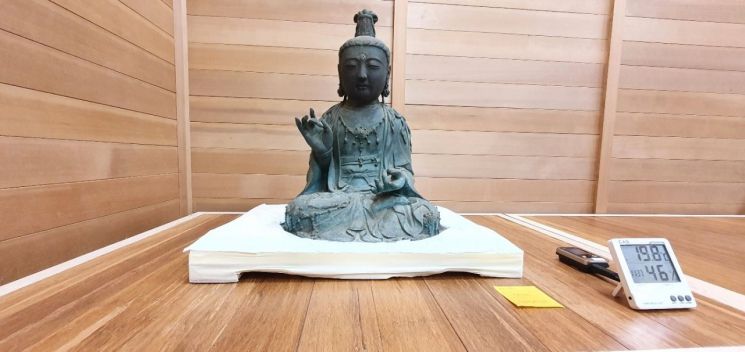 The appellate court ruled that the Goryeo Dynasty gilt-bronze seated Avalokitesvara Bodhisattva statue (Buddha statue), which was brought into the country by a thief after being in Japan, should be returned to Japan. The photo shows the gilt-bronze seated Avalokitesvara Bodhisattva statue (Buddha statue) in the storage of the National Research Institute of Cultural Heritage in Daejeon. [Image source=Yonhap News]
Earlier, on the 1st, a court ruling was made ordering the return of the Goryeo-era gilt-bronze Avalokitesvara statue, which was brought into Korea by a thief from Japan in 2012, back to Japan. This overturned the first-instance ruling that ownership belonged to Buseoksa Temple in Seosan, Chungnam.
Buseoksa Temple had argued that the statue, being a cultural asset plundered by Japanese pirates, should be returned to Korea. However, the Daejeon High Court interpreted that the past and present Buseoksa Temple cannot be regarded as the same religious organization, and that the Japanese temple, which has owned the statue for nearly 60 years, acquired ownership under Japanese civil law.
Regarding the ruling, the Sankei Shimbun evaluated, "In a situation where negotiations to resolve the forced labor compensation issue, the biggest issue between Korea and Japan, are nearing their final stages, the Korean judiciary has avoided a situation that would pour cold water on the improving relations."
The Mainichi Shimbun interpreted, "The Korean Ministry of Foreign Affairs is watching without issuing a statement," suggesting, "It seems they want to avoid the statue return issue becoming a major problem between Korea and Japan."
The gilt-bronze seated Avalokitesvara statue is 50.5 cm tall and weighs 38.6 kg. In October 2012, a domestic theft group stole the statue from Kannonji Temple on Tsushima Island, Japan, and brought it into Korea.
The statue was made around 1330 during the reign of King Chungsun of Goryeo to be enshrined at Buseoksa Temple in Seosan. It is presumed to have been taken to Tsushima Island, Japan, during the Japanese pirate invasions of Goryeo in the 1370s.
Hirokazu Matsuno, Chief Cabinet Secretary and spokesperson for the Japanese government, stated the day before, "We will request the Korean government to ensure the statue is returned promptly."
© The Asia Business Daily(www.asiae.co.kr). All rights reserved.
![Clutching a Stolen Dior Bag, Saying "I Hate Being Poor but Real"... The Grotesque Con of a "Human Knockoff" [Slate]](https://cwcontent.asiae.co.kr/asiaresize/183/2026021902243444107_1771435474.jpg)















