Medical Expenses Burden... Extreme Choices During Illness
Some File for Bankruptcy to Break the Cycle of Debt Inheritance
The number of elderly people who choose to live alone or ultimately take their own lives to avoid becoming a burden to their children is increasing. They have judged that it is better to decide their own fate rather than live relying on their children. This tendency has become even stronger among elderly people who have fallen into poverty, illness, and isolation amid the COVID-19 pandemic and economic crisis.
"Even if I am sick, I will suffer alone"... Extreme choices during illness
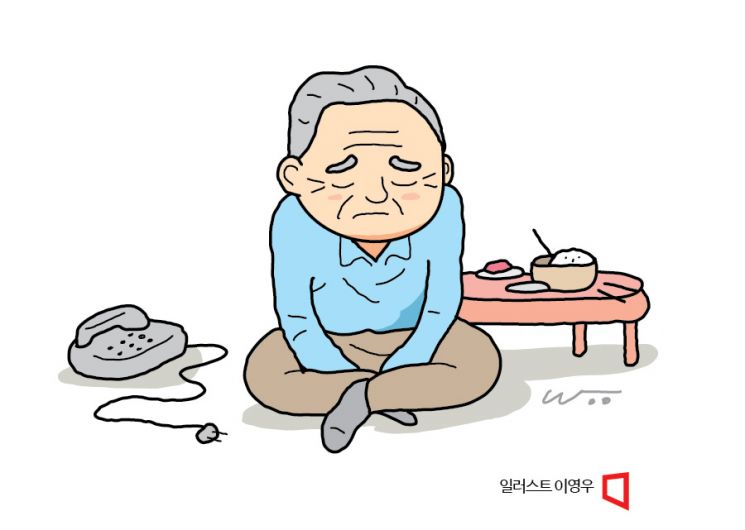
Elderly people choose 'death' to avoid informing their children about their illness or burdening them with medical and caregiving expenses. In Jeonbuk, an elderly man who attempted an extreme act after killing his sick wife was caught by the police.
According to Jeonju Wansan Police Station, the will written by Mr. A, in his 80s, contained the message, "I do not want to be a burden to my remaining children." Mr. A was confirmed to be battling terminal cancer, and his wife had been physically impaired due to a stroke that occurred several years ago.
In 2018, an elderly couple was found dead in a villa in Nam-gu, Busan. The husband had been unable to move due to bladder cancer for 10 years, and the wife had attempted to take her own life two years prior.
The elderly couple habitually said, "We do not want to be a burden to our children," and the medical examiner's opinion suggested death by poisoning.
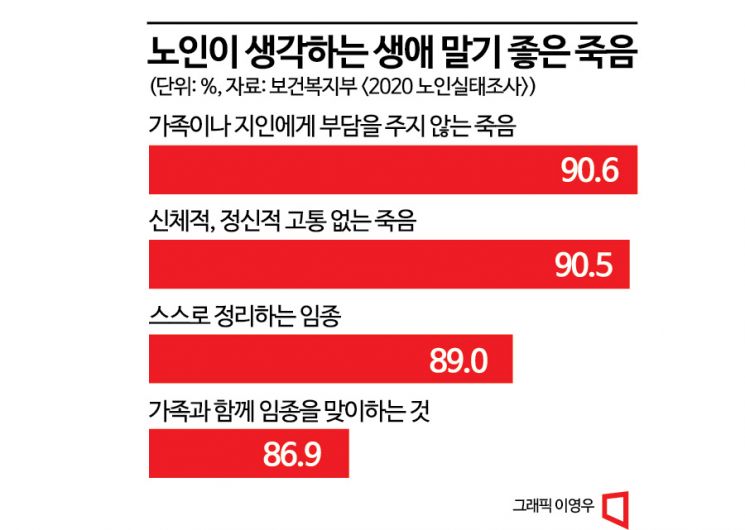
According to the 2020 Elderly Status Survey, regarding 'a good death at the end of life as perceived by the elderly,' 90.6% chose 'a death that does not burden family or acquaintances' as the top priority. This was followed by 'a death without physical or mental pain' at 90.5%, and 'a death where one arranges their own affairs' at 89%.
Regarding suicide, 2.1% of respondents said they had thought about suicide after the age of 60. The reasons were ▲health (23.7%) ▲economic difficulties (23%) ▲loneliness (18.4%) in that order.
The Elderly Status Survey is conducted every three years by the Ministry of Health and Welfare, interviewing elderly people aged 65 and over nationwide to investigate family and social relationships, health and economic status, values, and more.
Cut off contact with children... Rather live alone
The number of elderly people who have completely cut off contact with their children is also increasing. Currently, 8 out of 10 elderly people in South Korea live alone or only with their spouse. According to the 2020 Elderly Status Survey, the percentage of respondents who said they wanted to live with their children was 32.5% in 2008 but dropped to 12.8% in 2020. The rate of interacting with children at least once a week also decreased from 44% in 2008 to 16.9% in 2020.
Elderly people living alone seek work to avoid relying on their children, such as not receiving pocket money. However, finding stable and guaranteed jobs is not easy for the elderly. The elderly population is the most severely affected by the economic crisis. Usually, income decreases around retirement age of 60, while expenses such as nursing and medical costs increase. Most jobs available to the elderly after retirement are simple labor and low-wage positions, but even these are hard to find amid the current economic crisis.
To avoid asking their children for help, economic independence is necessary, but ultimately, they cannot cope with increasing expenses and end up bankrupt. According to the Seoul Bankruptcy Court in 2021, the number of elderly people aged 60 and over who filed for bankruptcy in 2020 was 2,715, the highest since the court was established in March 2017. The number of bankruptcy filings by those aged 60 and over rose from 2,058 in 2018 to 2,373 in 2019, and 2,715 in 2020. Through bankruptcy, they break the 'inheritance of debt.'
As tragedies among the elderly repeat, voices are growing for the state to directly intervene and manage caregiving. In the face of accelerating aging and economic crisis, caregiving policies by the government are needed so that not only the elderly but also middle-aged people do not fear "becoming a burden to their children due to illness." The National Human Rights Commission recommended to the Ministry of Health and Welfare in 2021 to "expand the social responsibility of caregiving and establish legal grounds and management systems for caregiving personnel."
© The Asia Business Daily(www.asiae.co.kr). All rights reserved.
![Clutching a Stolen Dior Bag, Saying "I Hate Being Poor but Real"... The Grotesque Con of a "Human Knockoff" [Slate]](https://cwcontent.asiae.co.kr/asiaresize/183/2026021902243444107_1771435474.jpg)
















