Bosses Without Employees... Highest in 14 Years
High Labor Costs and Part-Time Job Shortages Lead to Robot Adoption
Kiosks Take Orders, Robots Cook
With soaring prices and consecutive increases in public utility fees such as electricity and gas, the worries of self-employed business owners are deepening. Combined with the burden of rising labor costs due to minimum wage hikes, some self-employed individuals lament that "the more we operate, the more we lose." As a result, some businesses are using kiosks (unmanned terminals) or serving robots instead of part-time workers to reduce labor costs.
Following Kiosks and Serving Robots, 'Robot Chefs' Appear
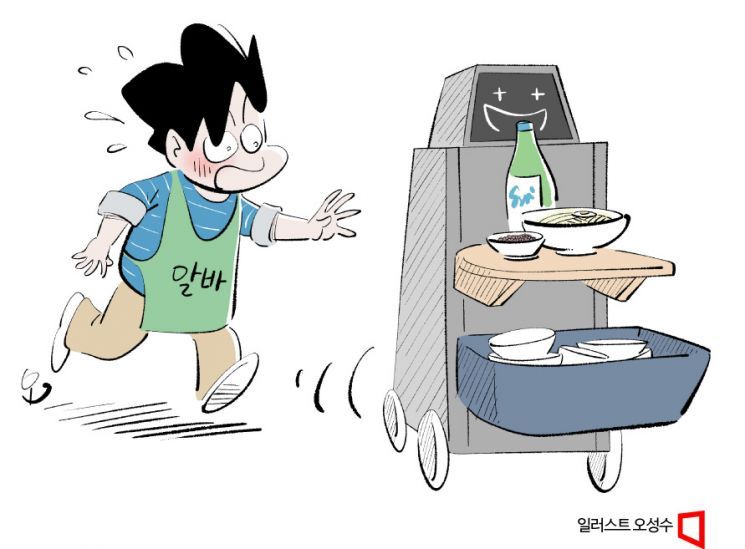
Recently, more stores are introducing kiosks and robots to address high labor costs and labor shortages. Customers order food through kiosks, and serving robots deliver the completed dishes. Rental fees for kiosks average around 100,000 KRW per month, depending on the contract period. Serving robots also have monthly rental fees ranging from 500,000 to 1,000,000 KRW, which is significantly cheaper than labor costs.
The introduction of 'robot chefs' that cook instead of humans is also increasing. In fact, a robot created by a startup is reported to be able to fry up to 50 chickens per hour. The monthly rental fee for this robot is 1,100,000 KRW. One advantage of this robot is that people do not have to stand in front of hot fryers continuously and can focus on other tasks.
Consequently, even in the largest self-employed community, "Apeunikka Sajangida" (Because It Hurts, I'm the Boss), some members are considering adopting robots. A netizen who revealed they run a restaurant said, "I am always stressed about hiring employees while running the store. Once an employee quits, it is hard to find a replacement, and labor costs pile up, so I am considering serving robots."
The Trend of Increasing 'Solo Bosses'... Expected to Grow Further
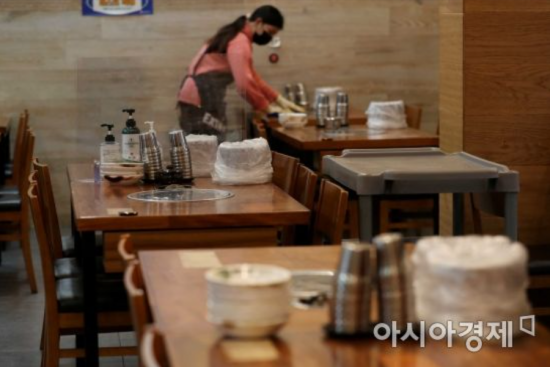
Given this situation, the number of 'solo bosses' who work alone without employees is also increasing. According to the 'December 2022 and Annual Employment Trends' released by Statistics Korea last month, the number of self-employed individuals without employees, or 'solo bosses,' was counted at 4,267,000. This is the highest in 14 years since the 2008 global financial crisis.
The number of 'solo bosses' has steadily increased as follows: ▲3,987,000 in 2018 ▲4,068,000 in 2019 ▲4,159,000 in 2020 ▲4,206,000 in 2021 ▲4,267,000 in 2022. Analysts attribute this to the nearly 30% increase in minimum wage over two years in 2018 and 2019, which dealt a direct blow to small-scale self-employed businesses, as well as the significant contraction of face-to-face service industries such as dining out after the spread of COVID-19 in 2020.
The number of self-employed individuals working alone is expected to increase further. This is because more self-employed businesses without employees are anticipated due to the adoption of kiosks, increased use of delivery apps, and the spread of serving robots.
Professor Eunhee Lee of Inha University's Department of Consumer Studies said, "Using robots or kiosks can reduce labor costs for stores. Therefore, the number of stores utilizing these technologies is expected to increase further." She added, "However, in unmanned stores operated without owners, some customers may commit crimes such as theft, so alternatives to prevent this are also necessary."
© The Asia Business Daily(www.asiae.co.kr). All rights reserved.


















