[Asia Economy Reporter Lee Gwan-ju] A study has found that the incidence rate of encephalitis in South Korea decreased during the COVID-19 pandemic. In particular, the incidence rate of pediatric encephalitis significantly declined.
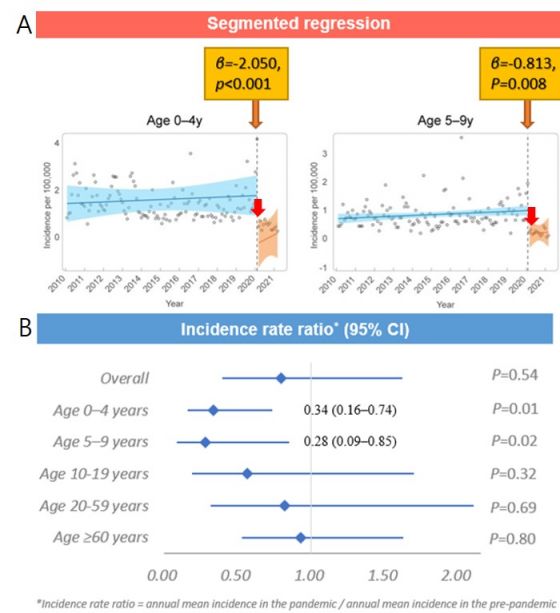 The incidence rate of encephalitis significantly decreased immediately after the COVID-19 pandemic in the age groups 0-4 and 5-9 years old (see graphic above). The incidence rate ratio of encephalitis before and after the COVID-19 pandemic was 0.34 and 0.28 in the 0-4 and 5-9 pediatric groups, respectively, indicating about a 70% reduction in encephalitis incidence. [Data provided by Yonsei Medical Center]
The research team, including Professors Ahn Jong-gyun and Baek Ji-yeon from the Department of Pediatric Infectious Immunology at Yonsei University Severance Hospital, Professors Kang Hoon-chul and Kim Se-hee from the Department of Pediatric Neurology, and Professors Jeong In-kyung and Han Min-kyung from the Department of Biomedical Systems Informatics at the College of Medicine, announced on the 2nd that these findings were published in the latest issue of the international journal Journal of Medical Virology.
Encephalitis refers to an inflammatory disease of the brain parenchyma. It is classified according to its cause into infectious, vasculitic, neoplastic, and chemical encephalitis. Among these, infectious encephalitis caused by viruses or bacteria is the most frequent.
The research team conducted a study on a total of 43,656 hospitalized patients who were diagnosed with encephalitis-related conditions according to the ICD-10 diagnostic system, based on claims data from the Health Insurance Review and Assessment Service. They divided the subjects into pre-pandemic (40,187 patients, January 2010 to January 2020) and pandemic periods (3,468 patients, February 2020 to February 2021) and analyzed the incidence rates of encephalitis through regression analysis for each period.

As a result, the incidence rate of encephalitis, which had shown an increasing trend before the pandemic, showed a decreasing trend during the pandemic. The incidence rate ratios of encephalitis in children aged 0-4 and 5-9 were 0.34 and 0.28, respectively, indicating about a 70% reduction in encephalitis cases during the pandemic. Additionally, when comparing ICU admission rates and mortality rates before and after the pandemic among encephalitis inpatients, the mortality rate decreased from 11% to 9%, and the ICU admission rate dropped from 59% to 39%.
Professor Ahn explained, "This nationwide study is the first to analyze all encephalitis patients in South Korea without limiting to specific causes such as viral encephalitis or specific groups like children. We confirmed that the incidence rate of encephalitis in South Korea decreased during the COVID-19 pandemic, with a particularly marked decline in children under 9 years old."
© The Asia Business Daily(www.asiae.co.kr). All rights reserved.
![Clutching a Stolen Dior Bag, Saying "I Hate Being Poor but Real"... The Grotesque Con of a "Human Knockoff" [Slate]](https://cwcontent.asiae.co.kr/asiaresize/183/2026021902243444107_1771435474.jpg)
















