Record-breaking performance last year... Strong refining margins expected this year
Price pressure from sanctions on Russia and China's reopening
[Asia Economy Reporter Hwang Yoon-joo] Refining stocks have continued their upward trend this year. This reflects expectations that the strong market conditions, including rising refining margins, will continue following record-breaking performance last year.
According to the Korea Exchange on the 6th, over the past month (January 2 to February 2), S-Oil's stock price rose 6.5% from 82,800 KRW to 88,100 KRW. SK Innovation increased by 10.0% (155,000 KRW → 170,600 KRW), and GS rose 4.6% (42,600 KRW → 44,600 KRW).
The driving force behind the rise in refining stocks is the expectation of a strong market outlook. Although China is expected to increase petroleum product exports this year, leading to a short-term supply expansion, refining margins are anticipated to remain strong due to ongoing circumstances similar to last year, such as sanctions against Russia.
Yoon Seok-sik, a researcher at Hanwha Investment & Securities, stated, "While sanctions on Russian petroleum products continue, demand has increased due to the easing of China's COVID-19 restrictions, but China's petroleum product exports have also risen, so the refining market is expected to remain strong." He added, "The high natural gas prices relative to crude oil are a factor that exacerbates the tight supply-demand balance."
Among the four major refiners, S-Oil, which was the first to announce its earnings, reported a consolidated operating profit of 3.4081 trillion KRW last year, a 59.2% increase compared to the previous year. Sales rose 54.6% to 42.446 trillion KRW. Both operating profit and sales recorded all-time highs. S-Oil explained, "This is due to the rise in product selling prices following the increase in international oil prices and the increase in inventory valuation gains of products such as gasoline."
Regarding the earnings surprise of refiners, there are calls in the political sphere for imposing a 'windfall tax (excess profit tax).' The rationale is that since they benefited from the sharp rise in international oil and petroleum product prices amid the Russia-Ukraine war, profits should be shared. The United States also publicized the introduction of a windfall tax ahead of last year's midterm elections. When it was expected that the total profits of major U.S. energy companies, including ExxonMobil, would reach $200 billion (approximately 247 trillion KRW) last year, President Joe Biden fueled the discussion. In fact, ExxonMobil recorded a net profit of $55.7 billion (about 68.8 trillion KRW) last year, the largest profit in its history. This surpassed the profit sizes of major pharmaceutical companies like Pfizer as well as leading companies in finance and information technology (IT) sectors.
However, S-Oil posted an operating loss of 157.5 billion KRW in the fourth quarter of last year. This was affected by inventory valuation losses on crude oil purchased at higher prices when international oil prices fell to their lowest level of the year in December (inventory valuation losses are reflected for crude oil). SK Innovation, GS Caltex, and Hyundai Oilbank, which are about to announce their earnings, are expected to have similar situations. Although annual earnings surged, it is estimated that they posted operating losses in the fourth quarter due to the decline in international oil prices.
The securities industry views the possibility of further declines in international oil prices this year as limited. Choi Go-woon, a researcher at Korea Investment & Securities, said, "Oil prices have already rebounded, and refining margins have been rising since January this year," adding, "Considering the U.S. strategic petroleum reserve purchase policy and China's reopening effects, upward pressure is expected to increase."
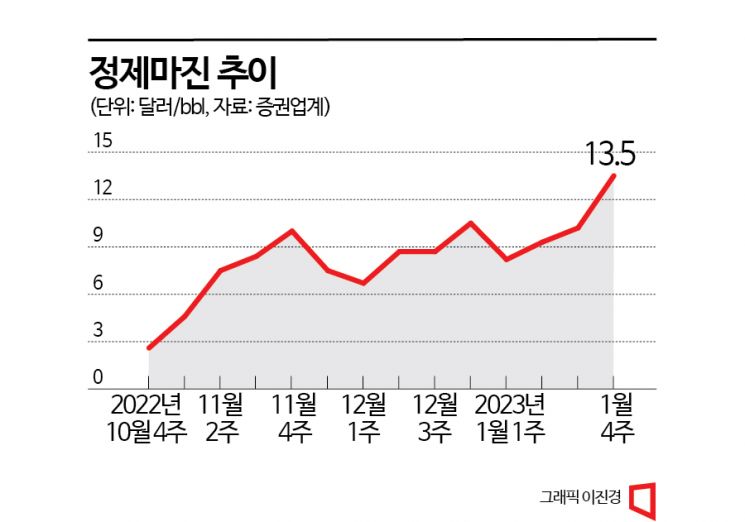
According to refiners and the securities industry, Asia's refining margin in the fourth week of January reached $13.5 per barrel, the highest in five months since the first week of July last year ($16.1). With margins increasing mainly for gasoline and diesel, there is analysis that this year refiners' inventory valuation losses on petroleum products will ease and earnings will rebound.
© The Asia Business Daily(www.asiae.co.kr). All rights reserved.
![Clutching a Stolen Dior Bag, Saying "I Hate Being Poor but Real"... The Grotesque Con of a "Human Knockoff" [Slate]](https://cwcontent.asiae.co.kr/asiaresize/183/2026021902243444107_1771435474.jpg)











