Small Issuance Under 50 Billion KRW... High Interest Rates of 6-10%
Issued by Leading Companies Like Emart and Pamhanong
[Asia Economy Reporter Lim Jeong-su] Companies such as Isu Construction and Lotte GRS, which find it difficult to issue public corporate bonds, have raised small amounts of funds in the private bond market. This is because they are unable to secure sufficient investment demand for bonds due to low credit ratings and other reasons. Even with small amounts, if demand is confirmed in the market, they are issuing private bonds while bearing high interest rates.
According to the investment banking (IB) industry on the 2nd, private bonds issued by general companies (excluding financial companies) during January amounted to a total of 1.7 trillion KRW. This is about 600 billion KRW more compared to the 1.1 trillion KRW worth of private bonds issued by general companies during the same period last year.
Among these, the largest single issuance was a 400 billion KRW private bond issued by TY Holdings to the global private equity fund Kohlberg Kravis Roberts (KKR). Apart from LG Display and Dreamverhill Hoecheon Jeilcha, which issued private bonds in the range of 100 billion to 300 billion KRW, most of the fundraising was done in small amounts under 100 billion KRW.
On the 31st, Isu Construction, a construction company affiliated with the Isu Group, issued a small private bond worth 10 billion KRW. The maturity is one year, and the issuance interest rate was set at a whopping 9%. They had issued private bonds at around 6% last year, so the funding cost rose by about 2.5 percentage points within a year. Lotte GRS issued 20 billion KRW of floating rate notes (FRN) privately, bearing a high interest rate of 8.50%, with the intention to lower the rate once market interest rates stabilize downward.
Doosan Enerbility, affiliated with the Doosan Group, also issued private bonds worth 15 billion KRW on the same day. The maturity is one year and six months, with an issuance interest rate of 6.30%. Doosan Enerbility has been securing funds by issuing private bonds for several years as it has been unable to issue public bonds. Considering that the private bond funding rate was in the low 4% range in the first half of last year, bond interest rates have risen by more than 2 percentage points in about 10 months.
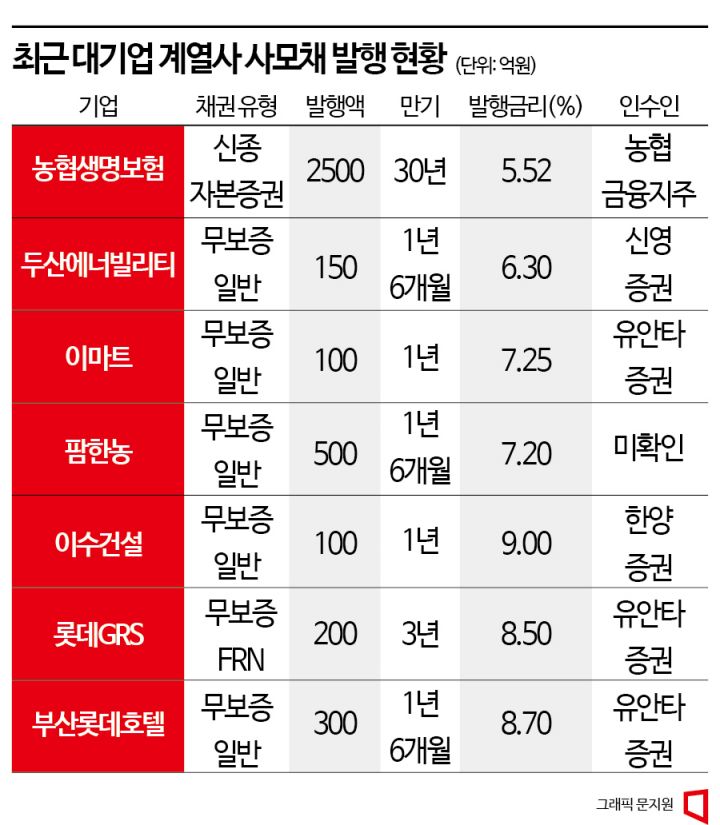
Farm Hannong, affiliated with the LG Group, issued private bonds worth 50 billion KRW with a maturity of one year and six months at 7.20%. Emart, a leading domestic distribution company, issued private bonds worth 10 billion KRW with a one-year maturity at 7.25%. Farm Hannong is a 100% subsidiary of LG Chem and is considered a high-quality company with excellent credit. Emart also has a credit rating of AA and recently succeeded in issuing medium-term public bonds at around 4%.
There is widespread skepticism about Farm Hannong and Emart, which have the ability to raise funds through public bonds, issuing short-term private bonds at high interest rates in the 7% range. An IB industry official said, "When issuing private bonds, unlike public bonds, there is no demand forecasting process, and interest rates are decided through private contracts with one or fewer than 50 investors," adding, "Sometimes private bonds are issued by selecting specific underwriters who require higher interest rates."
NongHyup Life Insurance, an insurance company affiliated with NongHyup Financial Group, privately issued 250 billion KRW worth of hybrid capital securities. Due to difficulty in securing demand for public bonds, the holding company NH Financial Group fully underwrote the issuance. The maturity is 30 years (effective maturity 5 years), with an interest rate of 5.524%. Thanks to the holding company, NongHyup Life Insurance was able to defend against a decline in the insurer's risk-based capital (RBC) ratio. NH Financial Group effectively increased NongHyup Life Insurance's capital, acting as a kind of capital injection.
Small and medium-sized securities firms mainly underwrote private bonds issued by companies. Yuanta Securities underwrote private bonds issued by Emart, Lotte GRS, and Busan Lotte Hotel. ShinYoung Securities, which has frequently underwritten Doosan Group corporate bonds, underwrote Doosan Enerbility's private bonds, and Hanyang Securities, which has good networking with construction companies through project financing (PF), underwrote Isu Construction's private bonds.
Small and medium-sized enterprises mostly secured liquidity by privately issuing convertible bonds (CB), bonds with warrants (BW), and exchangeable bonds (EB). LabGenomics (40 billion KRW), Urban Lithium (35 billion KRW), SD Biotechnologies (20 billion KRW), Tech L (20 billion KRW), and Kukbo (22 billion KRW) issued private CBs.
The IB industry expects private bond issuance by companies to continue for the time being. In a situation where the corporate bond market is highly polarized, companies with credit issues have no choice but to secure liquidity by using commercial paper (CP) and private bonds instead of public bonds.
An industry official said, "Private bonds allow flexible fundraising without the burden of submitting securities registration statements or demand forecasting, but it is difficult to secure large-scale investment demand and the negotiation power on interest rates can be relatively disadvantageous."
© The Asia Business Daily(www.asiae.co.kr). All rights reserved.
![Clutching a Stolen Dior Bag, Saying "I Hate Being Poor but Real"... The Grotesque Con of a "Human Knockoff" [Slate]](https://cwcontent.asiae.co.kr/asiaresize/183/2026021902243444107_1771435474.jpg)











