Sichuan Province Lifts Birth Restrictions Amid Population Decline Shock
Childcare Services Previously Limited to 'Married' Now Supported
Chinese Youth Say "It's Because of Housing Prices and Education Costs..."
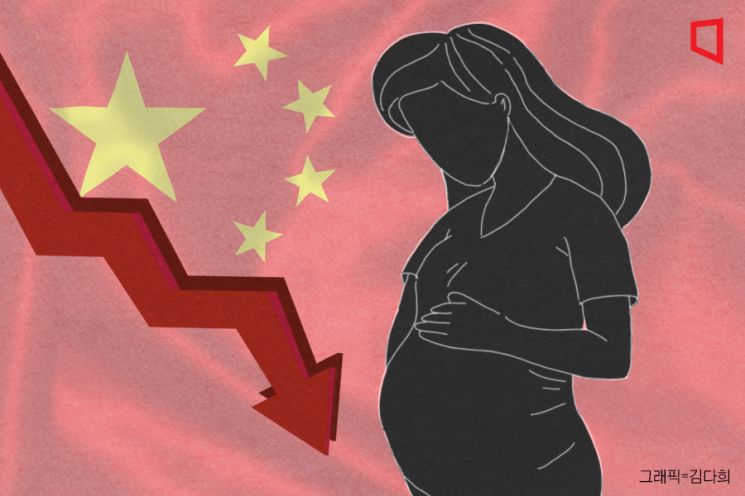
As China's population declines for the first time in 61 years, raising the likelihood of a steep demographic cliff, the Sichuan provincial government has abruptly abolished birth restriction policies.
On the 30th, the Sichuan Provincial Health Commission announced that starting from the 15th of next month, "married couples can have an unlimited number of children, unmarried mothers who were previously prohibited from registering births will now be allowed to have children, and equal benefits will be granted."
Until now, Sichuan only allowed married couples to register up to two children, but the restriction on the number of children eligible for birth registration has been removed. The Sichuan Health Commission explained that this is "to promote balanced population development in the long term."
Currently, when children are registered with local Chinese authorities, parents can receive paid parental leave and maternity medical benefits. However, a 'marriage certificate' must be submitted during this process. In effect, unmarried individuals with children were unable to access childcare-related services.
This is the first time China has abolished birth restrictions, which appears to be due to the sharp decline in the Chinese population.
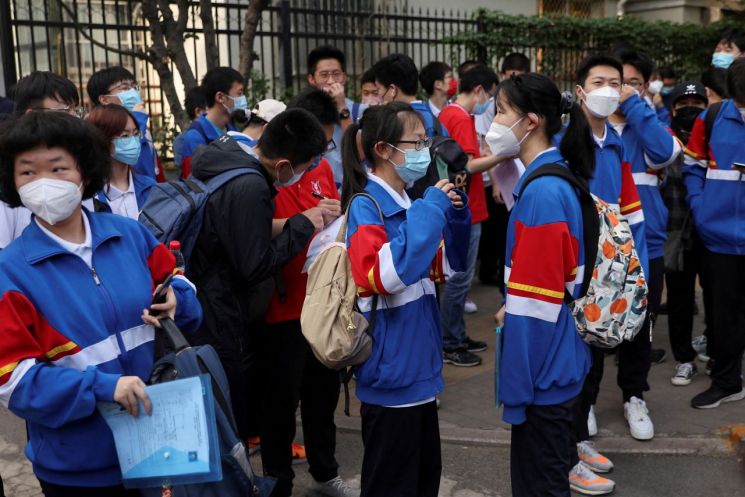 Chinese students waiting to enter the examination hall to take the Gaokao (National College Entrance Examination).
 [Photo by Reuters Yonhap News]
According to the National Bureau of Statistics of China on the 17th, as of 2022, China's population was 1.41175 billion, a decrease of 850,000 from the previous year. This is the first decline since 1961, when tens of millions died during the Great Leap Forward. The United Nations had predicted China's population would peak in 2031 and then decline, but the population decrease has started 10 years earlier than expected.
Meanwhile, amid this situation, wealthy Chinese who are tired of the zero-COVID policy are leaving China, and overseas students are reluctant to return. This has raised concerns that the population decline will not only affect demographics but also economic growth.
Some argue that the increase in births outside of marriage is socially desirable and that birth restrictions are not the fundamental cause of low birth rates. The main reasons young Chinese are avoiding marriage and childbirth are cited as rising housing prices, living expenses, and education costs.
Following Sichuan's bold measures, other local governments may follow suit. China adopted the 'one-child per household' policy in 1979 to control population, but facing a population decline crisis, it introduced the 'two-child per household' policy in 2016 and the 'three-child per household' policy in 2021.
© The Asia Business Daily(www.asiae.co.kr). All rights reserved.
![Clutching a Stolen Dior Bag, Saying "I Hate Being Poor but Real"... The Grotesque Con of a "Human Knockoff" [Slate]](https://cwcontent.asiae.co.kr/asiaresize/183/2026021902243444107_1771435474.jpg)
















