KDI Presents 'The Current Status and Policy Tasks of the Middle Class'
[Asia Economy Sejong=Reporter Lee Junhyung] The Korea Development Institute (KDI), a government-funded research institute, has analyzed that educational reform is necessary to restore the 'class ladder.'
KDI announced this in the KDI Focus report titled 'The Current Status of the Middle Class in Our Country and Policy Tasks,' released on the 31st. Lee Youngwook, a KDI research fellow who authored the report, stated, "The proportion of people who perceive themselves as middle class has steadily increased since 2013," but "subjective perceptions of the possibility of class mobility have significantly decreased." According to the 'Social Survey' conducted biennially by Statistics Korea, the percentage of respondents who answered 'high' to the question about the likelihood that their children's generation will have a higher socioeconomic status decreased from 41.7% in 2011 to 30.3% in 2021.
Income mobility is also on the decline. According to the KDI report, the annual market income changed by 30.4% compared to the base year in 2011, but the rate of change dropped to 26.2% in 2015. The research fellow explained, "From 2016 to 2020, a continuous decline in income mobility was observed," adding, "Income changes two years after the base year show somewhat higher income mobility than changes one year after, but the downward trend remains consistent."
Lee emphasized that government policies have not led to substantial improvements in class mobility. While the proportion of the middle class was maintained through expanded government transfer expenditures, expectations for upward class mobility did not increase. He stated, "Expanding the middle class solely through government transfer expenditures raises concerns about sustainability and clearly has limitations in fostering expectations for upward mobility."
There was also a call for measures to raise labor income. Lee noted, "Examining factors influencing class mobility to the middle class shows that creating good jobs and increasing additional earners within households may be important factors," adding, "Especially among the working-age population, labor income constitutes most of household income, so creating many quality jobs is the most crucial." He continued, "Securing additional earners in low-income households is a major pathway to increasing household income," and emphasized, "Policy support is required to actively resolve employment difficulties faced by those who are employable but unable to participate in the labor market."
Lee also mentioned the necessity of 'educational reform.' He said, "Rebuilding the role of education to enhance class mobility is also important," and added, "Reforms are needed to strengthen public education, reduce the burden of private education expenses on the middle class, and make education a ladder for class mobility rather than a channel for class inheritance."
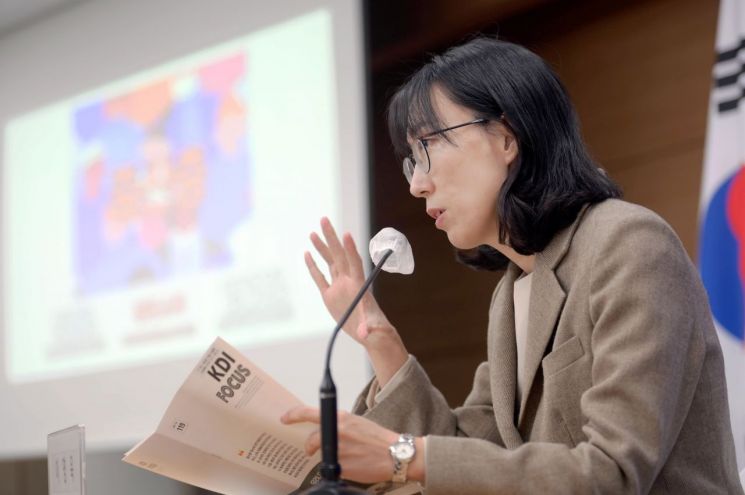 Lee Young-wook, Head of the Fiscal and Social Policy Research Department at the Korea Development Institute (KDI), is presenting "The Current Status and Policy Tasks of the Middle Class in Our Country" at the Government Complex Sejong on the 31st.
 [Photo by Korea Development Institute (KDI)]
© The Asia Business Daily(www.asiae.co.kr). All rights reserved.
![Clutching a Stolen Dior Bag, Saying "I Hate Being Poor but Real"... The Grotesque Con of a "Human Knockoff" [Slate]](https://cwcontent.asiae.co.kr/asiaresize/183/2026021902243444107_1771435474.jpg)















