Memory Cold Wave Causes Last Year's 4Q Performance to Plummet
DS Division Operating Profit Drops 96.94%
No Production Cuts, but Technical Reduction Possible
[Asia Economy Reporters Kim Pyeonghwa and Kwon Haeyoung] Samsung Electronics' operating profit in the fourth quarter of last year decreased by 69% compared to the same period the previous year, largely due to the significant slump in the performance of the Device Solutions (DS) division, which is responsible for the semiconductor business. Samsung Electronics froze amid the semiconductor downturn that swept through last year.
On the 31st, Samsung Electronics announced that its consolidated operating profit for the fourth quarter of last year was 4.31 trillion KRW, down 68.93% from 13.87 trillion KRW in the same period last year. Sales for the same period decreased by 8% to 70.46 trillion KRW. In particular, the DS division, which handles the semiconductor business, posted an operating profit of 270 billion KRW in the fourth quarter of last year, a sharp drop of 96.94% from 8.83 trillion KRW in the same period last year. It can be said that it practically did not make a profit. Considering that semiconductor prices have continued to fall, Samsung Electronics is currently evaluated to be operating at a loss in the semiconductor business. It is a situation where production cuts are inevitable.
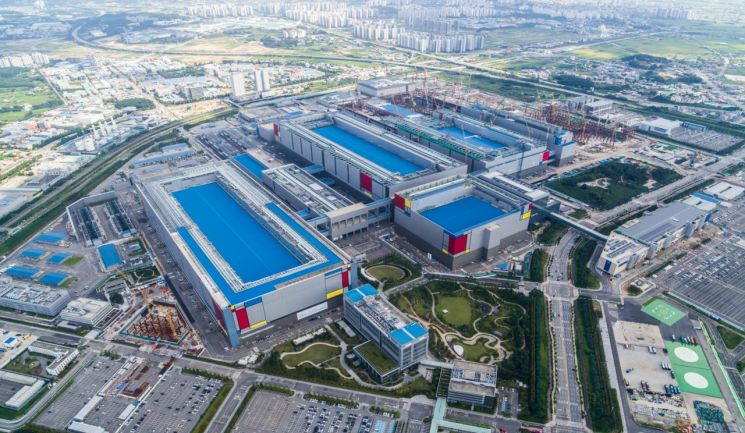
However, since October last year, Samsung Electronics has maintained the stance of “not making artificial production cuts.” At the investment briefing held after the earnings announcement on the 31st, the company stated, “We plan to continue investing to respond to medium- to long-term demand,” and “This year’s capital expenditure (CAPEX) will be at a level similar to last year.” As the number one memory business operator with high cost competitiveness, Samsung expressed confidence that it can endure without production cuts. This is a different move from competitors such as SK Hynix and the US-based Micron, who officially announced production cuts last year.
However, the term “artificial production cuts” is somewhat of a play on words. Saying that they will not make artificial production cuts implies that they can make “natural production cuts” that are not artificial. For example, production cuts can be made by delaying new expansions, reallocating lines, and expanding fine processes. In the industry, such natural production cuts are called technical production cuts. KB Securities recently predicted in a report that Samsung is making such natural production cuts and that their effects may appear in the first half of the year.
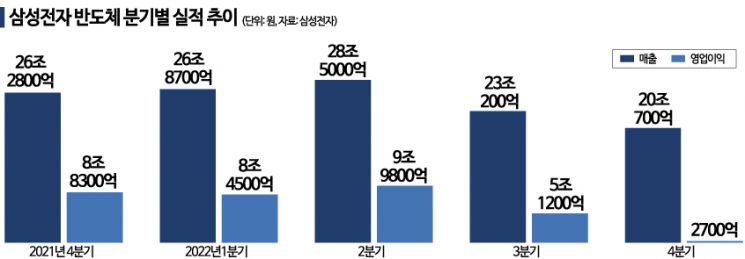
However, it is uncertain whether technical production cuts are a sufficient solution to withstand this memory downturn. On the 29th (local time), Bloomberg News assessed that the semiconductor market is facing the worst recession ever. Due to oversupply, inventory has surged more than threefold compared to before, accumulating the largest ever supply volume equivalent to 3 to 4 months.
Price declines are continuing as well. Market research firm TrendForce expects DRAM and NAND prices to fall by 20% and 10%, respectively, in the first quarter compared to the previous quarter. Prices for these two products dropped by more than 20% in the fourth quarter of last year. Yet, they have not yet hit bottom.
In the past, Samsung overcame crises during memory downturns through such natural production cuts and used recessions as a stepping stone for growth. After the DRAM Great Depression in 1996, Samsung diversified DRAM supply to endure the recession. Although PC DRAM, the main product, saw prices fall to about one-tenth, Samsung reduced its production. Instead, it increased production of server, graphics, and gaming DRAM, whose prices fell by about one-third. At the same time, Samsung accelerated product development, launching about 20 different products annually. While other companies focusing only on PC DRAM production went bankrupt due to deteriorating profitability, Samsung Electronics survived.
Of course, unlike in the past, there are opinions that this semiconductor downturn is not easy to overcome with technical production cuts or supply diversification. Former Samsung Electronics President Lim Hyung-kyu said, “At that time, we had cost competitiveness and a solid customer base with diverse products, so we could fully operate production lines while producing products less affected by price drops.” However, he added, “Now, with higher technology levels, it is difficult to quickly release advanced products as before, and there is no front-end industry that can rapidly increase memory market demand like during past booms.” Semiconductor companies are watching tensely to see if Samsung can get through this semiconductor downturn without true production cuts involving factory shutdowns.
© The Asia Business Daily(www.asiae.co.kr). All rights reserved.
![Clutching a Stolen Dior Bag, Saying "I Hate Being Poor but Real"... The Grotesque Con of a "Human Knockoff" [Slate]](https://cwcontent.asiae.co.kr/asiaresize/183/2026021902243444107_1771435474.jpg)
















