"President Yoon's Consistent Position
No Separate Discussion Is Meaningless"
Logic That Mandatory Purchase Worsens the Gap
[Asia Economy Reporter Baek Kyunghwan] President Yoon Seok-yeol is expected to exercise his veto power against the amendment to the Grain Management Act that mandates the government to compulsorily purchase surplus rice production. The Presidential Office stated that since the amendment was submitted to the National Assembly plenary session through a ruling party-only vote on the previous day (30th), "(President Yoon) will respond with the consistent stance he has shown so far." For now, they plan to observe the consultation process between the ruling and opposition party floor leaders.
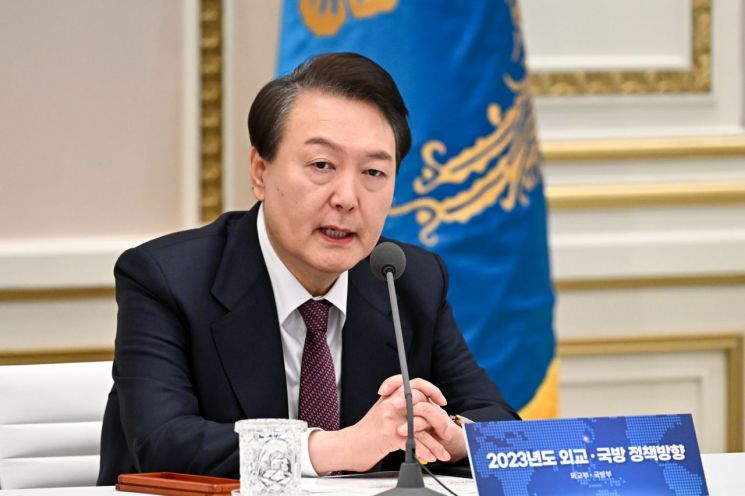
On the 31st, a senior official from the Presidential Office said about the Grain Management Act amendment, which bypassed the Legislation and Judiciary Committee's review and was directly submitted to the plenary session the previous day, "There is no official position," but added, "At this point, it is meaningless for the president and his aides to hold separate discussions." This implies that the situation is unlikely to change, given President Yoon's repeated opposition to the bill.
The core of the Grain Management Act amendment pushed by the opposition is to mandate the government to purchase rice if production exceeds demand by more than 3% or if the harvest season price falls by more than 5% compared to the previous year. On the other hand, the ruling party maintains the position that special privileges only for rice farmers are unfair to farmers cultivating other crops. Joo Ho-young, floor leader of the People Power Party, warned at an emergency committee meeting held at the National Assembly, "If this law passes, we will have no choice but to recommend the president exercise his veto power."
The atmosphere in the Presidential Office is similar. The senior official explained, "We respect the National Assembly's process," but added, "President Yoon has consistently emphasized principles, delivering a clear stance on vetoes during doorstepping and ministry briefings." It is also reported that the presidential aides did not separately report the National Assembly situation to the president the previous day.
In October last year, during a doorstepping on his way to work, President Yoon effectively rejected the Grain Management Act, which had passed the National Assembly standing committee at the time, saying, "I hope the National Assembly conducts in-depth discussions." He elaborated, "The Grain Management Act amendment passed the standing committee, but it should be left to government discretion. Gradually reducing the supply-demand gap can prevent waste of finances and agricultural products," adding, "It does not help farmers."
This reflects the logic that mandating purchases by law would widen the gap and that surplus supply would eventually have to be discarded. The Presidential Office and the ruling party also consistently argue that, given the serious waste of agricultural finances, investing in rural development is the priority now.
Earlier this month, during the Ministry of Agriculture, Food and Rural Affairs briefing, President Yoon expressed the view that "Since it is reasonable for the government to intervene to some extent to stabilize prices and provide predictability for our farmers' production, the Grain Management Act's unlimited purchase policy is ultimately undesirable for our agriculture." The main point is that the current method of the government purchasing all rice produced regardless of market absorption capacity is not helpful at all.
The Presidential Office said it will continue to monitor the National Assembly situation. Although the amendment has passed the Legislation and Judiciary Committee, the plenary session agenda is decided by the Speaker after consultation between the ruling and opposition party floor leaders. However, it seems difficult to narrow differences between the parties even if negotiations occur. Moreover, if President Yoon exercises his veto, it will be difficult for the Democratic Party to forcibly pass the Grain Management Act amendment again through the National Assembly reconsideration process. Even though the Democratic Party is the majority, it is hard to secure the 'two-thirds majority of attending members' required for reconsideration alone.
© The Asia Business Daily(www.asiae.co.kr). All rights reserved.

















