[Asia Economy Reporter Donghyun Choi] #. Electric bicycle manufacturer Company A wanted to develop a high-output product suitable for uphill and rough terrain that women and the elderly could easily ride. However, it faced difficulties due to regulations limiting the rated output of electric bicycle motors to 350W or less. Company C participated in the Jeonnam e-Mobility Special Zone and demonstrated the safety of high-output electric bicycles. Based on this, the regulation limiting electric bicycle motor output was relaxed to 500W or less. The high-output electric bicycle was launched on the 1st of last month.
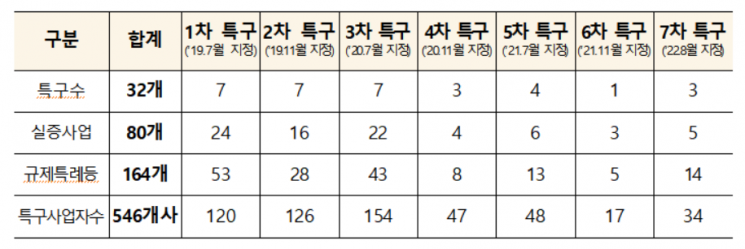
The Ministry of SMEs and Startups announced on the 31st that, as a result of operating regulatory free zones since 2019, out of 80 projects promoted in 32 special zones as of the end of last year, 8 projects completed the revision of 17 regulatory laws through on-site demonstrations and temporary permits and concluded their projects. Regulatory free zones refer to designated areas outside the metropolitan area where various regulations are exempted to freely demonstrate new technologies.
Over four years, investment attraction within the special zones reached 4.0114 trillion KRW, growing at an average annual rate of 70.1%, and sales increased to 106.9 billion KRW, rising 36.2% annually. During this period, 3,794 new jobs were also created. Additionally, companies filed 523 patents and succeeded in domestic production of 11 core components that had previously depended on imports.
The Chungbuk Smart Safety Control Special Zone newly established the "Detailed Standards for Wireless-based Smart Safety Cut-off and Control Technology for Gas Appliances," and its designation as a special zone was lifted in November last year, earlier than the originally planned project period. Based on on-site demonstrations, 13 projects, including the "Standard for Securing Distance of Pressure Vessels in Medium and Large Commercial Vehicles Using Liquefied Natural Gas (LNG)" and the "Expansion of Hydrogen Refueling Targets to Include Hydrogen Refueling Quantity Inspection Equipment," were granted temporary permits to allow prioritization of commercialization even before regulatory improvements.
In the case of the Daegu Mobile Collaborative Robot Special Zone, many companies faced difficulties expanding domestic business and entering global markets due to regulations. Relevant ministries decided to develop safety guidelines for mobile collaborative robots and establish and review KS standards within this year, granting temporary permits to these companies on the 1st of last month. This made it possible to acquire the world's first national standard for mobile collaborative robots, accelerating early global market entry and commercialization of mobile collaborative robots.
At the 2023 International Consumer Electronics Show (CES), four companies participating in the special zones won six innovation awards for technologies such as 3D map-based autonomous flight control and next-generation electric vehicle charging infrastructure. Furthermore, the zones are leading regional innovation by attracting 105 new companies related to designated new technologies and establishing 27 new growth manufacturing infrastructure facilities.
As of the end of last year, 284 companies relocated into the special zones. Among them, 105 are new companies that are not obligated to relocate. Clusterization centered on the special zones is progressing, with 70 non-zone businesses attracted to the first designated zones scheduled to end this year.
Regarding employment, the number of employees increased by 3,794 (an average annual growth of 5.1%) from 7,609 at the initial designation of the special zones to 11,403 at the end of last year. Of the new jobs, 3,389 (89.3%) are regular positions, indicating good job quality. An additional 645 employees are planned to be hired by the end of this year.
Minister Lee Young of the Ministry of SMEs and Startups stated, “Through regulatory free zones, we confirmed that regulatory innovation is a driving force for realizing the local era,” and added, “We will promote the advancement of regulatory free zones to play a key role in the transition to the local era, one of the government’s national agenda items.”
© The Asia Business Daily(www.asiae.co.kr). All rights reserved.
![Clutching a Stolen Dior Bag, Saying "I Hate Being Poor but Real"... The Grotesque Con of a "Human Knockoff" [Slate]](https://cwcontent.asiae.co.kr/asiaresize/183/2026021902243444107_1771435474.jpg)















