Selected for Defense Technology Promotion Institute Project
Development of Core Materials for 1000-Horsepower Class Aircraft Engine
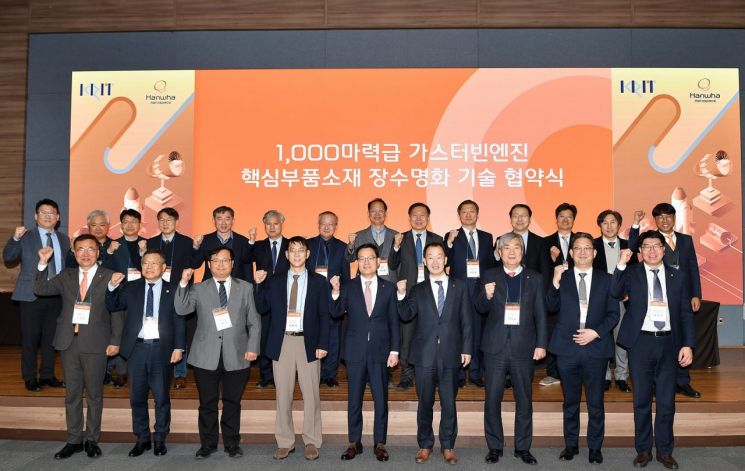 On the 30th in Changwon, Gyeongnam, Son Jae-il, CEO of Hanwha Aerospace (center), Kim Yong-dae, Head of the Helicopter Business Division at the Defense Acquisition Program Administration (center left), Ryu Myung-hyun, Director of the Industry and Trade Bureau of Gyeongnam Province (center right), and other officials participated in the "1,000 Horsepower Class Gas Turbine Engine Core Component Material Longevity Technology Agreement Ceremony for Unmanned Aerial Vehicles" and took a commemorative photo. Photo by Hanwha Aerospace
[Asia Economy Reporter Donghoon Jung] Hanwha Aerospace is embarking on the development of core materials for gas turbine engines to be installed in next-generation unmanned aerial vehicles. The company aims to develop military UAV engines, for which technology transfer from overseas is highly restricted, and proactively secure defense technology for autonomous national defense.
On the 30th, Hanwha Aerospace announced on the 31st that it held a signing ceremony for the development of the "Long-life Technology for Core Component Materials of 1000-horsepower Gas Turbine Engines" at the Changwon Convention Center in Gyeongnam, together with the Korean Society for Aeronautical and Space Sciences, Korea Institute of Materials Science, Seoul National University, and others.
The event was attended by Son Jae-il, CEO of Hanwha Aerospace; Kim Yong-dae, Head of the Helicopter Business Division at the Defense Acquisition Program Administration; Ryu Myung-hyun, Director of Industry and Trade at Gyeongnam Province; Lee Sang-chul, President of the Korean Society for Aeronautical and Space Sciences; Lee Jae-hyun, President of the Korean Institute of Metals and Materials; and Lee Jung-hwan, Director of the Korea Institute of Materials Science.
The project, selected by the Defense Technology Promotion Research Institute, aims to invest 48.8 billion KRW by 2027 to develop materials such as titanium and nickel alloys used in six core components of the engine for the Unmanned Compound Combat Rotorcraft (UCCR) and to establish a database.
Currently, domestically developed aviation gas turbine engines are single-use engines mounted on guided weapons such as missiles, operated for less than 10 hours. This is the first time to develop component materials applicable to long-life gas turbine engines that can be used for more than 1000 hours.
Son Jae-il, CEO of Hanwha Aerospace, said, “Based on our capabilities of producing over 9,000 aviation gas turbine engines over 40 years, we will secure core technologies related to next-generation aircraft engines and do our best for the autonomous national defense of the Republic of Korea.”
© The Asia Business Daily(www.asiae.co.kr). All rights reserved.
![Clutching a Stolen Dior Bag, Saying "I Hate Being Poor but Real"... The Grotesque Con of a "Human Knockoff" [Slate]](https://cwcontent.asiae.co.kr/asiaresize/183/2026021902243444107_1771435474.jpg)















