Financial Services Commission's Work Report on the 30th... Focused Discussion on Financial Stability and Industry Promotion
President Yoon: "Banks Are a Public System More Important Than National Defense"
Stewardship Mentioned... Emphasizing Transparency and Soundness While Guarding Against Government-Controlled Finance
[Asia Economy Reporter Baek Kyunghwan] President Yoon Suk-yeol emphasized that "advancing and internationalizing the financial industry, as well as strengthening its competitiveness, is extremely important." He stated that through amendments to the Foreign Exchange Act and other measures, the internationalization of the financial market should be promoted, and financial products that can support startups and advanced industries should be created to diversify the industry. In particular, he called for the establishment of fair and transparent governance for financial companies without owners, saying, "Banks are a public good system."
On the afternoon of the 30th, President Yoon received a business report from the Financial Services Commission at the Blue House State Guest House and urged, "Please discuss policies to foster the financial industry so that it can generate high profits and provide many quality jobs for future generations."
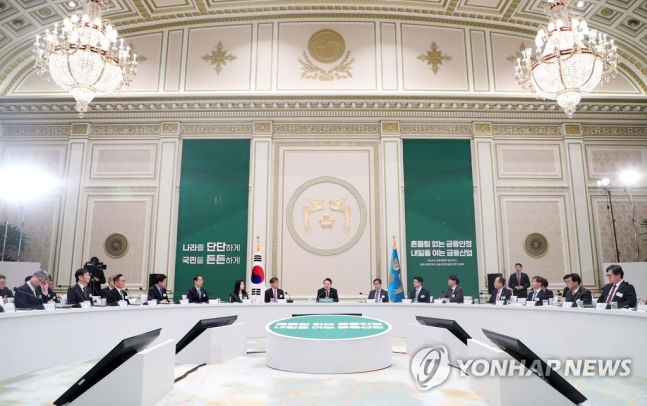 President Yoon Suk-yeol is speaking at the Financial Services Commission briefing held at the Blue House State Guesthouse on the afternoon of the 30th.
 [Photo by Yonhap News]
The report, held under the slogan "Unwavering Financial Stability, Financial Industry Opening Tomorrow," was attended by about 110 people, including Kim Joo-hyun, Chairman of the Financial Services Commission, Lee Bok-hyun, Governor of the Financial Supervisory Service, heads of related policy institutions, financial holding company chairpersons, and financial association heads.
In his opening remarks, President Yoon said, "Last year, prices rose significantly due to supply chain disruptions including crude oil, and the global high interest rates caused a double burden on the economy, making it very difficult." However, he added, "Many of you here experienced the IMF (International Monetary Fund·foreign exchange crisis) and the 2008 financial crisis as one body," and explained, "Although the public endured much hardship last year, we avoided catastrophe and relatively achieved macroeconomic stabilization, timely financial support for industries, and financial support measures for ordinary citizens."
The Financial Services Commission's business report was conducted solely, unlike previous joint sessions with multiple ministries. The meeting, held from 3 p.m. for about four hours, presented 12 major policy tasks including ▲ proactive response to financial market instability factors ▲ thorough management of real estate-related financial risks ▲ prevention of corporate insolvency expansion and blocking financial sector contagion ▲ expansion of future growth engines such as New Industry 4.0 ▲ support for struggling small business owners and SMEs ▲ alleviation of housing and financial difficulties due to interest rate hikes and housing price declines ▲ reduction of financial difficulties and repayment burdens for vulnerable groups in the high-interest era ▲ firm protection of citizens from financial crimes and fraud ▲ innovative finance expanding globally ▲ fostering new financial industries such as fintech ▲ advancement of capital markets in line with global standards ▲ promotion of consumer trust and convenience.
While receiving the business report, President Yoon said, "Last year, due to risk management, there was no capacity to focus on fostering the financial industry, but from this year, 'Change Thinking' is needed, meaning the development of direct financial markets for the advancement of the financial market." He also mentioned the corporate operation system in Boston during this process. President Yoon said, "In Boston, there are world-class pharmaceutical companies along with supporting law firms, accounting firms, consulting firms, and financial investment companies. To support growing companies and provide diverse financial services, we must also enhance the competitiveness of our financial industry," and added, "In this regard, I ask the Financial Services Commission to take the lead in advancing, internationalizing, and strengthening the competitiveness of the financial industry."
He also mentioned 'stewardship.' He emphasized that companies without owners and with dispersed ownership, which contributed to the public interest, should have minimal government management involvement but require joint efforts to establish fair and transparent governance. This emphasis on transparent and sound governance of ownerless financial holding companies aligns with President Yoon's previous calls last month at the Emergency Economic and Livelihood Meeting, where he warned against government-controlled finance while advocating for strengthened transparency in financial institution governance.
President Yoon's statement that "banks are a public good system even more important than national defense" was in the same context. He elaborated, "Therefore, banks operate under licensing rather than free establishment, and we have experience injecting massive public funds into banks during past crises for restructuring. This underscores the importance of fair and transparent governance of banks."
Following the business report, a discussion forum on "Financial Market Stability and Financial Industry Promotion" was held, where in-depth discussions took place among financial experts, private financial companies, and government officials on three topics: ▲ financial market stability ▲ support for the real economy and livelihood stabilization ▲ financial industry promotion.
President Yoon said, "In the past, financial stability was centered on monetary and fiscal policies, but now, as global finance is interconnected, a single financial risk can paralyze the entire national financial system frequently," and added, "Proactive and bold responses in risk decision-making processes are more important than anything else. I hope our financial authorities accumulate sufficient data on companies regularly to quickly select support targets."
Meanwhile, with the conclusion of the Financial Services Commission business report on this day, President Yoon completed face-to-face business reports from 18 ministries, 4 offices, and 4 commissions (the Korea Communications Commission and the Anti-Corruption and Civil Rights Commission were replaced by written reports), as well as some Blue House-level agencies. Unlike previous business reports where ministers had private meetings with President Yoon at the Yongsan Presidential Office, this time many ministries reported to the president and the public in a large-scale public reporting format.
© The Asia Business Daily(www.asiae.co.kr). All rights reserved.
![Clutching a Stolen Dior Bag, Saying "I Hate Being Poor but Real"... The Grotesque Con of a "Human Knockoff" [Slate]](https://cwcontent.asiae.co.kr/asiaresize/183/2026021902243444107_1771435474.jpg)















