Current Status and Improvement Directions of Ownership-Dispersed Companies' Governance Seminar
Kim Young-sik "Activating Stewardship Code Despite Criticism of Government Control"
"Pension Funds Should Not Act for Policy Purposes"
[Asia Economy Reporter Oh Soo-yeon] The National Pension Service has once again expressed its intention to actively exercise voting rights on the reappointment of executives in widely held companies. It emphasized that it will oppose the reappointment of CEOs who have damaged corporate value by utilizing the Stewardship Code (guidelines encouraging institutional investors to participate in corporate decision-making).
On the 30th, Kim Young-sik, a member of the People Power Party, held a seminar titled "Current Status and Improvement Directions of Corporate Governance in Widely Held Companies."
In his opening remarks, Representative Kim said, "Cases where unqualified individuals are reappointed as CEOs occur frequently," mentioning the controversy over KT CEO Koo Hyun-mo's segmented sponsorship. He added, "The National Pension Service and civic groups such as the People's Solidarity for Participatory Democracy pointed out problems in the reappointment decision process," and said, "In the short term, even if criticized as government intervention, I think this is an opportunity to activate the National Pension Service's Stewardship Code."
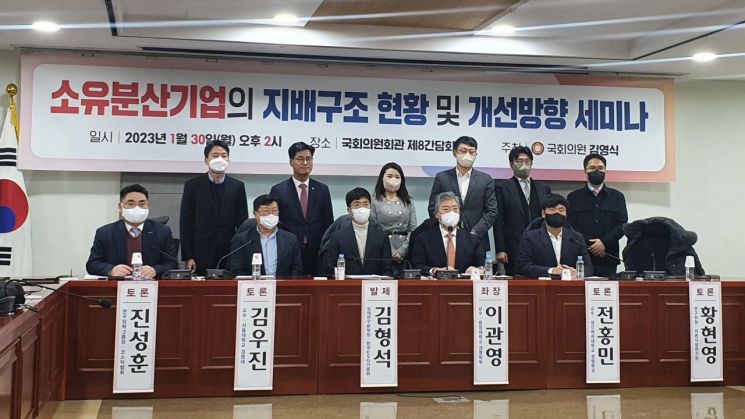 Participants of the 'Current Status and Improvement Directions of Corporate Governance in Ownership-Dispersed Companies Seminar' are taking a commemorative photo.
 [Photo by Oh Su-yeon]
Kim Hyung-seok, a research fellow at the Korea ESG Standards Institute's Policy Research Headquarters, presented on the topic "Current Status and Improvement Directions of Corporate Governance in Widely Held Companies."
Kim said, "When agents use extensive control to pursue private interests and inefficiently appropriate corporate resources, the rightful rights and interests that owners (shareholders) should be guaranteed are infringed upon," adding, "This also leads to a decline in the level of corporate governance." He further stated, "In particular, CEOs of widely held companies in Korea build entrenchments by utilizing controllable human and physical resources," and "there are cases where unqualified individuals continuously get reappointed as CEOs or chairpersons."
As solutions to these issues, Kim proposed ▲ active exercise of shareholder rights ▲ easing the standards for requesting shareholders' meetings and expanding electronic voting systems ▲ activating external monitoring functions centered on the capital market ▲ improving the independence and transparency of appointment procedures ▲ and introducing active qualification requirements for executives under the Commercial Act.
Kim emphasized, "Large companies must establish a nomination committee composed entirely of outside directors to enhance the independence of CEO and key executive appointments," and added, "In cases such as CEOs or chairpersons serving more than three consecutive terms, related laws should be amended to strengthen the shareholders' meeting resolution requirements to special resolutions."
The subsequent comprehensive discussion was chaired by Professor Lee Kwan-young of Chung-Ang University's Business Administration Department, with participants including Jin Sung-hoon, head of the KOSDAQ Association's Research Policy Group; Professor Kim Woo-jin of Seoul National University's Business School; Professor Jeon Hong-min of Sungshin Women's University's Business Administration Department; Hwang Hyun-young, research fellow at the Korea Capital Market Institute; Jeong Sung-doo, prosecutor at the Ministry of Justice's Commercial Law Division; Song Byung-kwan, head of the Financial Services Commission's Corporate Accounting Team; Kim Jung-hoon, team leader of the Financial Supervisory Service's Supervision Coordination Bureau; and Lee Dong-seop, head of the National Pension Service Fund Management Headquarters' Responsible Investment Office.
Representatives from the National Pension Service also attended the seminar and shared their views. Director Lee Dong-seop stated, "The decline in corporate governance levels is identified as a main factor of the Korea discount," adding, "There have been recent issues such as CEOs exerting influence over outside directors, compromising their independence and eliminating management oversight functions; establishing ineffective CEO succession plans; neglecting successor development; and self-reappointment. There are also cases where CEOs maintain their positions despite embezzlement, slush funds, bribery, incomplete sales, service disruptions, and various other fraudulent acts."
Director Lee said, "When exercising voting rights related to executive reappointments, we consider performance, but we oppose candidates who have a history of damaging corporate value or have been sanctioned under the Capital Markets Act for embezzlement, breach of trust, unfair support, or private gain extraction." This reaffirmed the stance to actively exercise the Stewardship Code.
Professor Jeon Hong-min also stated, "The National Pension Service should exercise the Stewardship Code," and suggested, "If it is difficult for the National Pension Service alone, there is also the option to integrate with public pensions such as the Teachers' Pension to create a Stewardship Code platform."
On the other hand, Professor Kim Woo-jin emphasized that pension funds should not intervene in CEO appointments. He said, "Although the National Pension Service holds voting rights, it should not act with political influence or policy objectives," pointing to the case of POSCO, where all CEOs resigned within a year after a regime change. Professor Kim stressed strengthening the independence of the board of directors for governance improvement, stating, "The board should be given the role of appointing, evaluating, and compensating the CEO. How can the management be checked if the board has no authority over compensation decisions?"
Research fellow Hwang Hyun-young said, "The owners of a company are the shareholders, and it should be left to the shareholders to decide whom to select as their agents," adding, "Unless there is a definitive court ruling on criminal allegations, there is no problem with shareholders making their choices." He continued, "In Japan, detailed information is shared not only for CEO appointments but for all director appointments. In Korea, shareholders do not know what happened before a CEO's reappointment," and concluded, "The problem is not long-term reappointment itself, but the reappointment of problematic representatives."
© The Asia Business Daily(www.asiae.co.kr). All rights reserved.
![Clutching a Stolen Dior Bag, Saying "I Hate Being Poor but Real"... The Grotesque Con of a "Human Knockoff" [Slate]](https://cwcontent.asiae.co.kr/asiaresize/183/2026021902243444107_1771435474.jpg)















