Japan's Net External Assets Rank First Worldwide for 31 Years
Increase in Direct Investment Ratio Among Total Assets
Low Liquidity Causes Difficulty in Yen Conversion
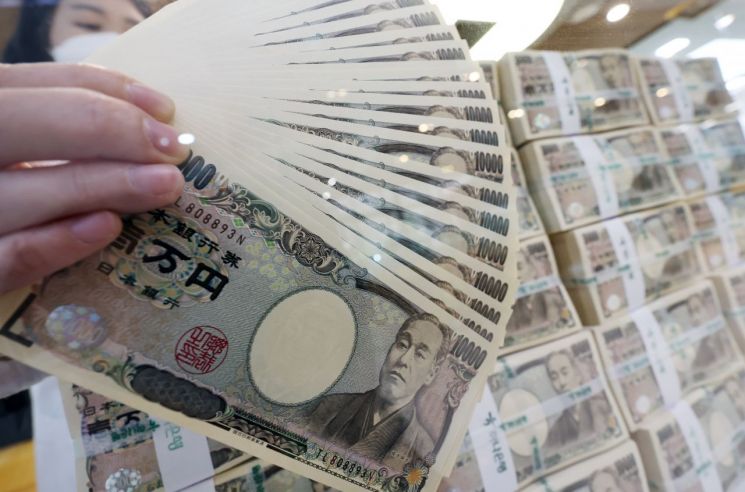
[Asia Economy Reporter Lee Ji-eun] Japan's net international assets have ranked first in the world for 31 consecutive years. However, as the proportion of direct investments with lower liquidity has increased, it appears to be less effective in boosting the value of the yen.
According to the Japanese Ministry of Finance on the 30th (local time), Japan's net international assets reached 459 trillion yen (4,349.2545 trillion KRW) as of the end of September last year, a 20% increase compared to the same month the previous year. Based on 2021, it recorded 411 trillion yen (4,070 trillion KRW), maintaining the world's number one position in net international assets for 31 consecutive years. This represents a 15.6% increase compared to the previous year.
The significant increase in Japan's net international assets is analyzed to be due to the larger amount when converted into yen. The yen's weakness makes the size appear larger.
The growing proportion of income from direct investments within total assets also influenced the increase in net international assets. Direct investment refers to income from overseas M&A (mergers and acquisitions) acquired companies or foreign subsidiaries where the equity stake is 10% or more.
However, despite the increase in net assets, it is pointed out that it has not exerted as much influence on the rise in yen value as before. Japan, which holds a massive amount of net international assets, has so far defended the yen's value decline by selling overseas assets even when foreign speculative forces massively sold yen. However, since the Russia-Ukraine war, the Japanese yen's value fell to its lowest level in 31 years, breaking through the 150 yen mark last year.
The increase in direct investment amount has had a significant impact by reducing the proportion of securities investment income, such as stocks and bonds, which can be immediately disposed of among overseas assets in emergencies.
Nihon Keizai explained, "As of September last year, direct investments accounted for 50% of Japan's net international assets, while securities investments accounted for only 20%. When owning overseas factories or subsidiaries, it is not easy to suddenly sell assets and convert them into yen."
This change in the composition of net international assets is leading to a decline in the status of the yen, which is considered a safe-haven currency. Typically, the currency of a country with large net international assets is evaluated as highly safe, but since net assets are not functioning properly, there is an assessment that the yen's value defense line has also encountered abnormalities.
In particular, concerns are emerging that the status of the yen as a quasi-key currency could be jeopardized as forecasts suggest the scale of net international assets may decrease. Nihon Keizai stated, "Last year, Japan recorded the largest trade deficit in history, but the current account balance was in surplus due to overseas investment income," adding, "There is a possibility that the trend of trade deficits will become established in the future, which will lead to a decrease in net international assets and reduce the pressure for yen value appreciation."
© The Asia Business Daily(www.asiae.co.kr). All rights reserved.
![Clutching a Stolen Dior Bag, Saying "I Hate Being Poor but Real"... The Grotesque Con of a "Human Knockoff" [Slate]](https://cwcontent.asiae.co.kr/asiaresize/183/2026021902243444107_1771435474.jpg)















