[Asia Economy Reporter Choi Seok-jin, Legal Affairs Specialist] The Supreme Court has ruled that school staff members who suffer direct disadvantages due to an order issued by the Superintendent of Education to the chairman and principal of a private school corporation to correct the salary steps of some staff members have standing to file a cancellation lawsuit.
The Supreme Court's Second Division (Presiding Justice Min Yoo-sook) announced on the 30th that it overturned the lower court's (second trial) dismissal of the cancellation lawsuit filed by eight private school employees, including Mr. A, against the Gangwon Province Superintendent of Education regarding the order to correct salary steps, and remanded the case to the Chuncheon District Court, the court of first instance.
The court ordered, "The lower court's judgment is overturned. The first trial court's judgment is canceled, and the case is remanded to the Chuncheon District Court."
In this case, since both the first and second trials dismissed the case on the grounds of lack of standing without ever ruling on the merits (whether the plaintiffs' interests were infringed and the superintendent's order should be canceled), the Supreme Court instructed that the case be reconsidered from the first trial.
Usually, when a case reaches the Supreme Court, the second trial court has already reviewed the merits once, so when the Supreme Court remands, it sends the case back to the second trial court. However, in cases like this where the dismissal was made at the first trial, remanding to the second trial court would effectively create a two-tier trial system, so the Supreme Court remands to the first trial court, a Supreme Court official explained.
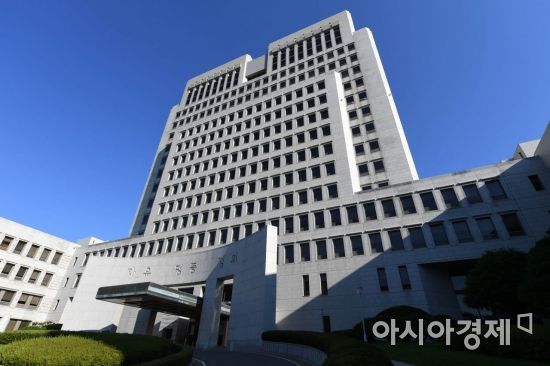
The court stated, "Each order in this case requires the school corporations to re-determine the salary steps of their administrative staff and to recover any overpaid wages within a five-year period. As a result, the plaintiffs suffer direct and concrete damages such as actual salary reductions or the obligation to return wages already paid. Therefore, the plaintiffs have an individual, direct, and concrete interest in contesting each order in this case." The court added, "Nevertheless, the lower court dismissed the case on the grounds that the plaintiffs lacked standing to contest these orders. This constitutes a legal error regarding the doctrine of standing in cancellation lawsuits that affected the judgment, warranting reversal and remand."
In August 2020, the Gangwon Province Superintendent of Education issued a corrective order to the chairman and principal of the private schools to which the plaintiffs belonged, stating that the salary step conversion rate for similar experience was excessively applied when determining the salary steps of administrative staff, and ordered the recovery of related wages within a five-year period. In September of the same year, an additional order was issued to re-determine the salary steps based on the corrected steps and to submit the results of the corrective measures.
Following the superintendent's orders, the plaintiffs were required to return wages ranging from approximately 3.7 million to 17.3 million Korean won, prompting them to file a lawsuit seeking cancellation of the orders against the superintendent.
However, both the first and second trials dismissed the plaintiffs' claims without ruling on the merits.
The defendant superintendent argued as a preliminary defense that "the plaintiffs are not the direct parties to the orders in question and therefore lack standing," which was accepted by the lower courts.
Regarding standing in cancellation lawsuits, the Supreme Court has held that even third parties who are not the direct recipients of administrative dispositions may file cancellation lawsuits if their legally protected interests are infringed. Legally protected interests refer to individual, direct, and concrete interests protected by the relevant laws and regulations underlying the disposition.
However, the lower courts reasoned that the plaintiffs' salary steps were not directly corrected by the superintendent's orders, nor were they immediately obligated to return wages. Instead, such obligations arose only after the school corporation (or its chairman or principal) took corrective action based on the superintendent's orders, thus the plaintiffs had only indirect or factual/economic interests.
The first trial court stated, "The plaintiffs can seek cancellation or nullity confirmation against the chairman and principal of their affiliated corporation regarding the wage recovery and salary step re-determination measures taken by them. Through this, they can sufficiently protect their rights or legal interests by contesting the illegality or impropriety of the superintendent's orders, which are the premise of such measures," and dismissed the case on this basis.
However, the Supreme Court's judgment differed.
First, the Supreme Court found that the superintendent's orders were not mere recommendations to correct salary steps and recover wages but carried legal binding force as administrative dispositions subject to cancellation lawsuits, especially considering the superintendent's threat to suspend subsidies if the orders were not complied with.
Additionally, in assessing whether the plaintiffs' legally protected interests were infringed by the superintendent's administrative dispositions, the Supreme Court reviewed not only the primary legal basis cited by the lower courts but also related laws, consistent with its prior stance.
Specifically, the lower courts viewed Article 43(2)(2) of the Private School Act?which grants the authority to recommend necessary budget adjustments when the budget of a school corporation receiving subsidies from local governments is deemed inappropriate?as the legal basis for the superintendent's salary step correction order, and concluded that the plaintiffs did not have direct and concrete interests protected under this provision. However, the Supreme Court held that the plaintiffs' interests protected by the related laws underlying the orders were directly infringed.
The court noted, "Article 43(2)(2) of the Private School Act, among the legal bases for these orders, was established to ensure the appropriateness of the budgets of school corporations receiving financial support such as subsidies. Therefore, this provision alone may not be sufficient to protect the direct and concrete interests of the plaintiffs, who are private school employees."
It continued, "However, since these orders were issued on the grounds that the plaintiffs' salary steps were excessively calculated, Article 70-2(1) of the Private School Act, which regulates the calculation of salary steps and remuneration for administrative staff of school corporations, as well as the articles of incorporation of each private school corporation and local government employee remuneration regulations, should also be considered as legal bases or related laws for these orders."
The Supreme Court concluded, "These orders require the school corporations to re-determine the salary steps of their administrative staff and to recover any overpaid wages within a five-year period. As a result, the plaintiffs suffer direct and concrete damages such as actual salary reductions or the obligation to return wages already paid. Therefore, the plaintiffs have individual, direct, and concrete interests in contesting these orders."
A Supreme Court official stated, "This ruling specifically confirms that when determining standing, courts must examine not only the direct legal basis of an administrative disposition but also related laws. It is significant as the first ruling recognizing the plaintiffs' standing based on Article 70-2(1) of the Private School Act concerning salary step calculation for private school employees, the articles of incorporation, and remuneration regulations as legal bases or related provisions for these orders (salary step corrections and recovery orders for private school employees)."
© The Asia Business Daily(www.asiae.co.kr). All rights reserved.

















