Low Booster Vaccination Rate Amid High-Risk Group Management Variables
Next Step is 'Mandatory Isolation for Confirmed Cases'... Will Take Time
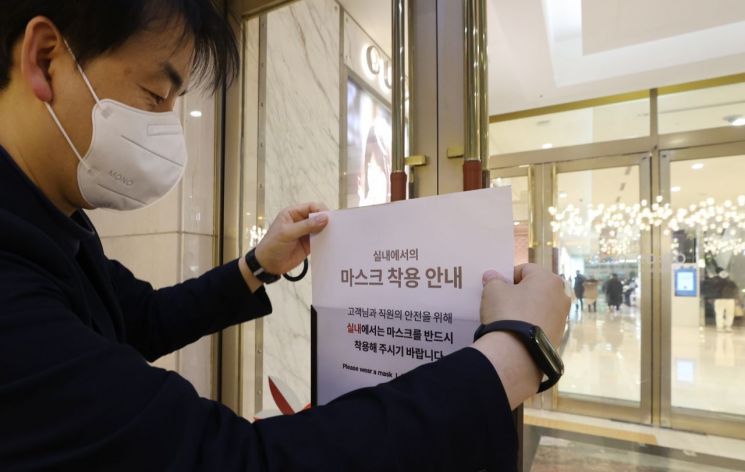
[Asia Economy Reporter Lee Gwanju] Starting from the 30th, the indoor mask-wearing mandate has been adjusted to a 'recommendation' except for certain facilities, marking a significant test for the 'return to normal life' since the COVID-19 pandemic. With the remaining quarantine measure essentially limited to a mandatory 7-day isolation for confirmed cases, if the lifting of the indoor mask mandate proceeds smoothly without major issues, the pace of returning to normal life could accelerate. Conversely, if there is a sharp increase in confirmed cases, severe cases, and deaths, it is expected that the speed of returning to normal life will need to be adjusted.
Slight Rebound in Confirmed Cases Due to Lunar New Year Impact... "Stable Quarantine Situation"
According to the Central Disaster and Safety Countermeasures Headquarters (CDSCH), COVID-19 confirmed cases have shown a slight rebound following the Lunar New Year holiday. On the 26th (35,096 cases) and 27th (31,711 cases), immediately after the holiday, new confirmed cases increased by 5,290 and 4,303 respectively compared to the previous week. On the 28th (23,612 cases), cases decreased by 4,032 compared to the previous week, but on the 29th (18,871 cases), they rose again by 2,254. This is analyzed as a temporary spread due to increased face-to-face contact during the Lunar New Year holiday.
Nevertheless, the quarantine authorities decided to lift the indoor mask mandate based on the assessment that the current quarantine situation is stable. Cho Kyu-hong, the first deputy head of CDSCH (Minister of Health and Welfare), stated, "Other quarantine indicators are generally stable," adding, "The infection reproduction number has been below 1 for three consecutive weeks, dropping to 0.77, and the severe bed occupancy rate is 20.8%, indicating sufficient capacity." In line with this, the number of designated COVID-19 hospital beds will be adjusted from 5,843 to about 3,900 starting from the second week of next month. This scale is capable of responding even if 140,000 cases occur daily, but it is also interpreted as a move to promote the return to normal operations in medical institutions.
Speed of 'Return to Normal Life' Depends on High-Risk Group Management
The key going forward is how well the COVID-19 spread is controlled after lifting the indoor mask mandate. If confirmed cases among high-risk groups increase amid the lingering effects of the Lunar New Year holiday, it could lead to a crisis. The low additional vaccination rate during the winter season for those aged 60 and above is also a variable. As of the 27th, the additional vaccination rate for infection-vulnerable facilities was 62.0%, exceeding the government's target of 60%, but for those aged 60 and above, it was only 34.6%, falling far short of the initial target of 50%.
A low additional vaccination rate among the elderly means that if the number of confirmed cases increases, severe cases may also rise. This is why quarantine authorities and experts repeatedly emphasize that adjusting the indoor mask mandate does not mean "mask-wearing is unnecessary." The authorities strongly recommend mask-wearing in cases such as: suspected COVID-19 symptoms or contact with someone showing such symptoms; being a high-risk individual (aged 60 or older, immunocompromised, with underlying conditions) or contact with high-risk individuals; recent contact with confirmed COVID-19 cases; being in '3Cs' (closed spaces, crowded places, close-contact settings) indoor environments; and situations with many people densely gathered where droplet-generating activities like shouting, singing, or talking occur.
Shin Sang-yeop, Senior Research Fellow at KMI Korea Medical Institute (Infectious Disease Specialist), explained, "The effect of mask-wearing on controlling the COVID-19 epidemic is as strong as the effect of vaccination and has been shown by various studies to be safer than vaccines," adding, "The quarantine authorities, while changing mask-wearing policies, have presented situations where mask-wearing is strongly recommended even in spaces where it is not mandatory, emphasizing the normalization of voluntary mask-wearing as a quarantine rule in daily life."
When Will the '7-Day Isolation for Confirmed Cases' Be Lifted?
Following the phased easing of social distancing and outdoor mask mandates, the only remaining government-level quarantine measure is the mandatory 7-day isolation for confirmed cases. However, experts view the isolation mandate more cautiously than the indoor mask mandate. There is a risk that high-risk groups may not receive proper diagnosis and treatment, and shortening the isolation period could lead to the release of sufficient virus to infect others. Shin stated, "If someone returns to school or work 3 to 5 days after confirmation without sufficient rest and while symptoms remain, it means not only personal suffering but also a risk of transmitting COVID-19 to others," adding, "From a medical standpoint, it is difficult to support reducing the isolation period to 3-5 days or eliminating it altogether."
The quarantine authorities have stated that they will discuss this in line with the World Health Organization (WHO) decision to end the COVID-19 public health emergency. The WHO's termination of the emergency is expected as early as this week or at the latest within the first half of this year. However, independently of this, the authorities must consider the domestic epidemic situation first, so the impact of lifting the indoor mask mandate must be minimal before considering lifting the isolation mandate. Im Suk-young, Situation General Manager of the Central Quarantine Countermeasures Headquarters, said, "Discussions on adjusting the isolation mandate have currently been suspended due to consecutive summer and winter resurgences," adding, "When WHO ends the COVID-19 public health emergency and Korea adjusts its crisis level, the isolation mandate will be comprehensively reviewed."
© The Asia Business Daily(www.asiae.co.kr). All rights reserved.
![Clutching a Stolen Dior Bag, Saying "I Hate Being Poor but Real"... The Grotesque Con of a "Human Knockoff" [Slate]](https://cwcontent.asiae.co.kr/asiaresize/183/2026021902243444107_1771435474.jpg)















