Emphasizing Chinese History and Influence... Forcing the 'China Theory' Abroad
Trauma Embedded Since Qing Dynasty's Fall to Foreign Powers
Highlighted as Korea's External Influence Strengthens
Analysis suggests that the debate over 'Eumryeok Seol' (Lunar New Year) versus 'Chinese New Year' stems from rising nationalism within China and cultural identity conflicts among Asian countries.
On the 28th (local time), the US-based CNN highlighted the recent conflict over the English term for Seol, stating, "Whether it is called Chinese New Year or Lunar New Year depends on whom you ask." The insistence by Chinese netizens on the term 'Chinese New Year' and their opposition to 'Lunar New Year' during the recent Seol holiday was influenced by strengthened nationalist sentiments.
Supporters of the term 'Lunar New Year' acknowledge that the holiday has roots in China but argue that it is a unique festival with distinct rituals, foods, and histories across various Asian countries. The Associated Press (AP), the world's largest news agency headquartered in the US, also recommends using 'Lunar New Year' instead of 'Chinese New Year' in its stylebook.
However, in China, it is argued that Seol is based on the Chinese lunisolar calendar and that the term 'Chinese New Year' should be used to emphasize China's historical influence over other East Asian countries. Previously, Chinese netizens flooded Twitter posts by the British Museum and Walt Disney ahead of the Seol holiday, leaving malicious comments insisting, "It is Chinese New Year, not Lunar New Year," sparking controversy.
Chinese Netizens Oppose South Korea's Growing External Influence... "Rising Nationalism"
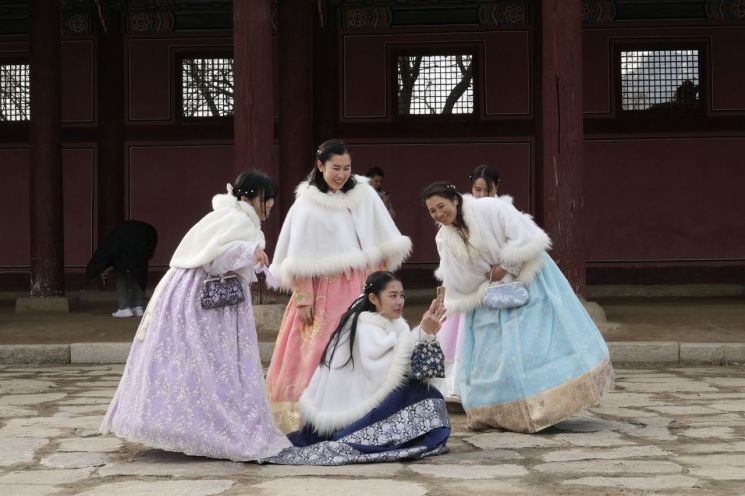 On the 22nd, citizens wearing hanbok celebrated the Lunar New Year at Gyeongbokgung Palace. [Image source=AP Yonhap News]
However, the intensification of this debate appears to be linked to South Korea's expanding cultural influence abroad. The British Museum's post included the phrase 'Korean Lunar New Year' alongside the introduction of Korean-related events. Additionally, the US Central Intelligence Agency (CIA) sparked outrage among Chinese netizens by including "Seollal (Sul Naal), Korea's New Year holiday" in a post on its website introducing holidays around the world on the 21st of last month.
On China's social networking service Weibo, a post stating, "The use of 'Lunar New Year' led by Koreans is a Western ideological attack on Chinese culture," gained significant attention. Other comments expressed sentiments such as, "Is it possible to think of the Chinese Spring Festival as Korean?", "Should Christmas be renamed 'American Christmas' or 'German Christmas'?"
Regarding this, Maggie Ying Zhang, Associate Professor at the University of Western Australia who researches intercultural communication and consumer nationalism, told CNN that "the surge in nationalism over recent years is a potential factor behind the intense reactions." Under President Xi Jinping's administration, nationalism has risen and spread on social media platforms like Weibo, where many intellectuals, scholars, and feminists have faced backlash for being deemed 'unpatriotic.'
Professor Zhang also analyzed that this trend "accelerated due to the COVID-19 pandemic," noting that the "Century of Humiliation," when the Qing Dynasty fell to foreign powers, forms the basis of nationalism deeply rooted in Chinese society. Furthermore, she stated that the 'Seol naming controversy' reflects cultural identity conflicts among Asian countries and the current geopolitical environment, adding that choosing the term 'Lunar New Year' shows that China's neighboring countries are striving to establish their independent cultural identities.
Meanwhile, CNN explained that in recent years, South Korea and China have experienced disputes over the origins of kimchi and hanbok, and that political disagreements, economic retaliation, and reciprocal travel restrictions during the COVID-19 pandemic have worsened bilateral relations, contributing to the conflict.
© The Asia Business Daily(www.asiae.co.kr). All rights reserved.
![Clutching a Stolen Dior Bag, Saying "I Hate Being Poor but Real"... The Grotesque Con of a "Human Knockoff" [Slate]](https://cwcontent.asiae.co.kr/asiaresize/183/2026021902243444107_1771435474.jpg)















