Decline in 40s While Other Age Groups Rise
77.3% in 2021... Ranked 31st Among 38 OECD Countries
Economic Slowdown... Half Are 'Involuntary Retirees'
[Asia Economy Reporter Moon Chaeseok] Over the past five years, only the employment rate of people in their 40s, known as the "economic backbone," has declined. Concerns are rising that jobs for those in their 40s will be the most threatened as some industries undergo restructuring due to this year's global economic downturn.
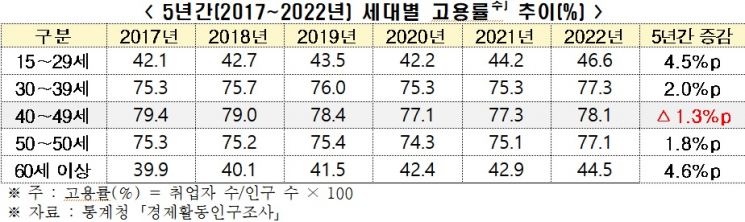
On the 30th, the Federation of Korean Industries (FKI) announced the results of a survey on employment trends by generation from 2017 to last year, based on the Statistics Korea's Economically Active Population Survey. The employment rate for those in their 40s fell by 1.3 percentage points, from 79.4% in 2017 to 78.1% last year.
During the same period, the employment rate for those aged 60 and over rose by 4.6 percentage points, from 39.9% to 44.5%, and for those aged 15 to 29, it increased by 4.5 percentage points, from 42.1% to 46.6%. The employment rate for people in their 30s, who also play an economic backbone role alongside those in their 40s, rose only 2 percentage points, from 75.3% to 77.3%.
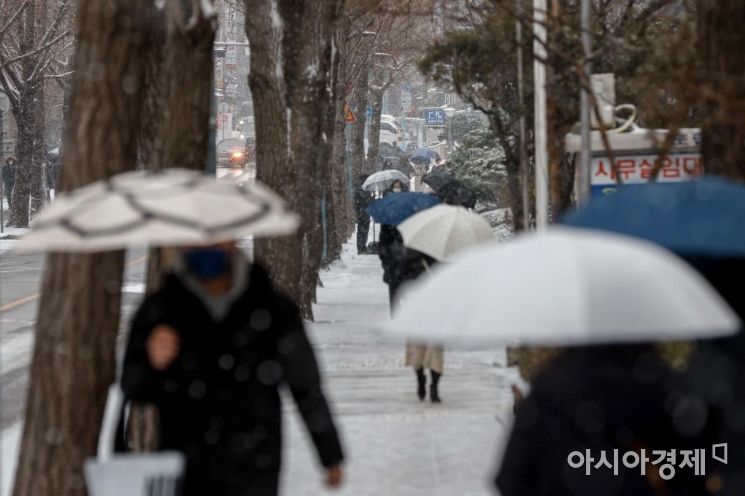 On the 26th, when snow was falling mainly in the central region, office workers were heading to work near the Government Seoul Office in Jongno-gu, Seoul. Photo by Jinhyung Kang aymsdream@
While the total number of employed persons increased by 1,364,000, from 26,725,000 to 28,089,000 during this period, the number of employed people in their 40s decreased by 469,000, from 6,783,000 to 6,314,000. The FKI expressed concern, stating, "More than half (56%) of the population in their 40s are household heads. Threats to their jobs could lead to a vicious cycle of reduced household income, contraction in consumer spending, and deterioration of domestic demand, which could damage the national economy."
The employment rate for those in their 40s was found to be lower than in major countries. As of 2021, South Korea's employment rate for people in their 40s was 77.3%, ranking 31st among 38 OECD countries. This was 5.2 percentage points lower than the average of 82.5%. It lagged behind countries such as Japan (86.5%), Germany (86.3%), the United Kingdom (84.8%), and France (84.2%). Looking at the trend from 2016 to 2021, South Korea's employment rate for those in their 40s decreased by 2 percentage points, ranking 5th in terms of decline among the 38 countries.
By industry, the largest decreases in employment were in wholesale and retail trade (212,000), manufacturing (104,000), accommodation and food services (93,000), education services (82,000), and construction (74,000). The FKI explained, "Over the past five years, sectors such as wholesale and retail, accommodation and food services, and education services have been hit hard due to the sharp rise in the minimum wage and the COVID-19 pandemic." They added, "Manufacturing jobs also declined due to sluggish performance, factory automation, and overseas job relocation," and "the construction industry was affected by the spread of COVID-19, soaring raw material prices, and rising interest rates."
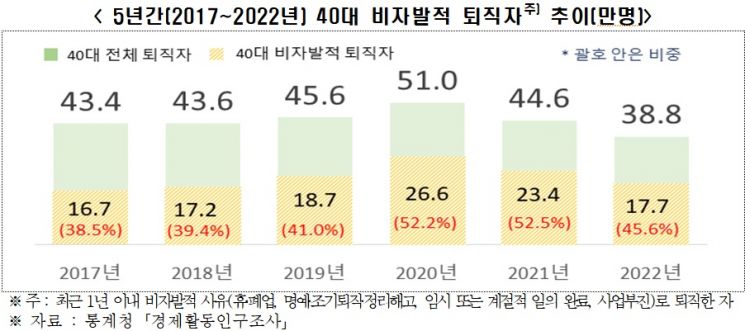
The problem is that if restructuring accelerates due to the recession, employment for those in their 40s is likely to worsen further. Last year, the number of involuntary retirees in their 40s was 177,000, accounting for 45.6% of all retirees in their 40s, totaling 388,000. The number of involuntary retirees in their 40s increased by 6% from 167,000 in 2017 to 177,000 last year. Their share of the total also rose by 7.1 percentage points, from 38.5% to 45.6%. Involuntary retirees refer to those who left their jobs due to business suspension or closure, honorary or early retirement, or layoffs.
The FKI expressed concern, saying, "Due to recent economic slowdown and unstable domestic and international conditions, companies are undertaking successive restructuring, which is expected to increase the number of household heads in their 40s losing their jobs."
Choo Kwang-ho, head of the FKI Economic Headquarters, also emphasized, "This year, restructuring is sweeping through sectors such as finance, construction, and manufacturing, and with the labor market's high employment rigidity, it is very difficult for middle-aged and older workers to find reemployment. The government must continue policies such as strengthening tax support and easing regulations to help companies maintain jobs."
© The Asia Business Daily(www.asiae.co.kr). All rights reserved.
![Clutching a Stolen Dior Bag, Saying "I Hate Being Poor but Real"... The Grotesque Con of a "Human Knockoff" [Slate]](https://cwcontent.asiae.co.kr/asiaresize/183/2026021902243444107_1771435474.jpg)

















