Government Announces Advanced Employment Service Plan
'Wage Support → Counseling and Consulting' Customized Assistance
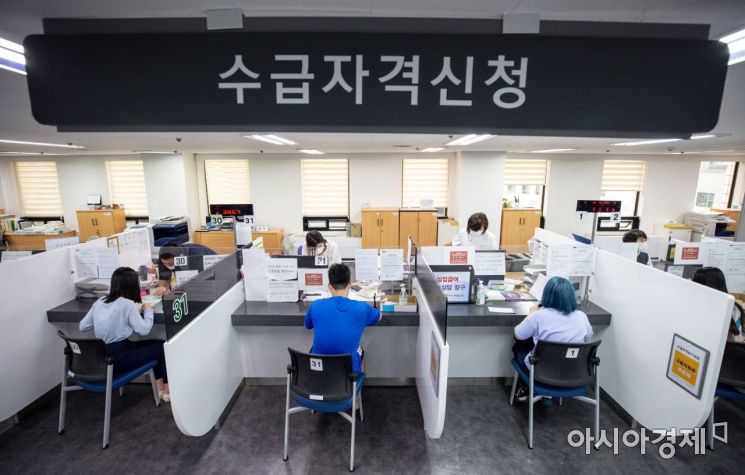 Unemployment benefit recipients are receiving consultations at the Seoul Western Employment Welfare Plus Center in Mapo-gu, Seoul. Photo by Jinhyung Kang aymsdream@
The government will further strengthen the conditions for unemployment benefit support going forward. This is to reduce the 'moral hazard' of receiving unemployment benefits without actively seeking jobs. Employment service policies will also shift from a past focus on benefit support to customized support such as counseling and consulting.
The Ministry of Employment and Labor announced on the 29th that it finalized the "Employment Service Advancement Plan" at the Employment Policy Council held on the 27th. This plan was prepared after gathering broad opinions through meetings involving employment service field officials, youth, academia, and labor and management representatives.
According to the Ministry of Employment and Labor, our employment centers focused on benefit support for the unemployed during the COVID-19 period, which led to neglecting their core duties of connecting job seekers with jobs and providing employment support.
In particular, there have been criticisms that many recipients of unemployment benefits repeatedly receive support payments while engaging in formal job-seeking activities. The number of unemployment benefit recipients increased from 1.2 million in 2017 to 1.78 million in 2021. Last year, it was about 1.63 million.
The Ministry explained, "the OECD has also pointed out that Korea's unemployment benefits, with relatively short contribution periods and high minimum benefit amounts, reduce workers' motivation and incentives for reemployment."
Accordingly, the government decided to strengthen the job-seeking promotion function for unemployment benefit recipients. First, it will actively support parliamentary discussions to pass amendments to the Employment Insurance Act and the Employment and Industrial Accident Insurance Premium Collection Act, which are currently pending in the National Assembly, focusing on reducing job-seeking benefits for repeat recipients and extending waiting periods.
In addition, the strengthened unemployment recognition measures prepared last July will be applied to all recipients starting in May. Accordingly, practical sanctions such as non-payment of job-seeking benefits for formal job-seeking activities like repeated resume submissions, interview no-shows, and job refusals will be strengthened.
Additional unemployment benefit system improvement plans will also be prepared in the first half of the year. Considering minimizing moral hazard, fairness among workers enrolled in employment insurance, and protection of low-income groups comprehensively, improvements in contribution periods, payment levels, payment duration, and methods of job-seeking benefits will be pursued.
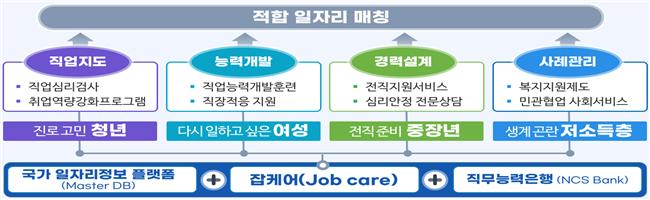
Furthermore, the government supports all citizens in designing their careers according to their labor market life stages and helps them leap to better jobs through vocational training and employment support services based on this.
For example, young people with career concerns will be matched with suitable jobs through career guidance, middle-aged and older workers preparing for career changes will receive career design support, women with interrupted careers will be supported with vocational skill development training, and low-income groups will be connected to welfare support systems.
Employment centers will be reborn as specialized employment service institutions. The proportion of counseling public officials will be gradually increased to provide professional services centered on counseling.
Career counselors will operate a performance-based promotion system. Promotion will be favored by reflecting the achievement of national tasks in evaluations, and a stepwise promotion structure will be established by granting certain authority and responsibilities to senior positions.
The Ministry of Employment and Labor has set performance goals to raise the reemployment rate of unemployment benefit recipients during their benefit period and the employment rate of participants in the National Employment Support System to 30% (currently 26.9%) and 60% (currently 55.6%), respectively, within three years.
Minister of Employment and Labor Lee Jeong-sik emphasized, "For a sustainable labor market for future generations, it is important for job seekers and companies to acquire fundamental capabilities to adapt and grow in the labor market."
© The Asia Business Daily(www.asiae.co.kr). All rights reserved.
![Clutching a Stolen Dior Bag, Saying "I Hate Being Poor but Real"... The Grotesque Con of a "Human Knockoff" [Slate]](https://cwcontent.asiae.co.kr/asiaresize/183/2026021902243444107_1771435474.jpg)

















