[Asia Economy Sejong=Reporter Dongwoo Lee] Amid the reality of this winter's 'heating cost crisis,' it has been revealed that to resolve Korea Gas Corporation's outstanding payments this year, gas rates would need to be increased threefold from the current rates. Since a rate hike in the second quarter of this year is inevitable to address the outstanding payments, the burden of public utility costs on low-income households is expected to increase further.
According to data submitted by the Gas Corporation to the National Assembly on the 29th regarding factors for the rate increase, to fully recover the 9 trillion KRW in outstanding raw material costs for residential city gas accumulated by the end of last year, gas rates must be raised by 39 KRW per MJ (megajoule) starting from April this year.
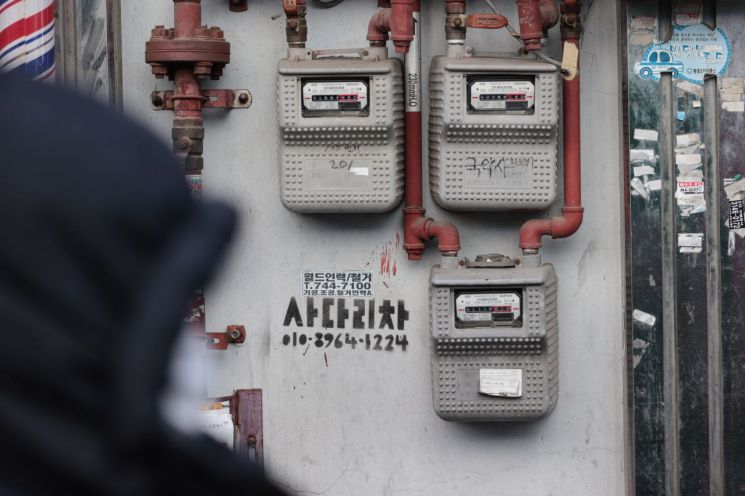
Considering that as of the 1st of this month, the retail gas rate for residential use in Seoul is 19.69 KRW per MJ, this means the rate must be increased to 58.69 KRW per MJ, which is three times the current rate. This is about seven times higher than last year's residential gas rate increase of 5.47 KRW.
The Gas Corporation maintains that since gas is currently supplied at prices lower than the cost of importing natural gas, a rate increase is unavoidable to prevent further accumulation of outstanding payments. However, taking inflationary pressures into account, they plan to establish a phased increase plan through consultations with the government to recover the outstanding payments by 2026.
The Gas Corporation projects that if rates are increased by 8.4 KRW per MJ this year, recovery is possible by 2027, and if increased by 10.4 KRW, the outstanding payments can be resolved by 2026. Considering this, it is highly likely that this year's rate increase will be at least 1.5 to 2 times higher than the current increment.
The Gas Corporation's outstanding payments surged significantly starting last year when the Russia-Ukraine war broke out. Outstanding payments, which were 200 billion KRW at the end of 2020 and 1.8 trillion KRW at the end of 2021, have reached 9 trillion KRW currently after Russia halted liquefied natural gas (LNG) supplies early last year, causing prices to skyrocket.
The government and ruling party argue that heating costs had to rise sharply because the previous Moon Jae-in administration decided to freeze gas rates despite having seven opportunities to adjust rates from March 2021, when LNG prices began to rise, until April last year when the rates were finally increased.
© The Asia Business Daily(www.asiae.co.kr). All rights reserved.
![Clutching a Stolen Dior Bag, Saying "I Hate Being Poor but Real"... The Grotesque Con of a "Human Knockoff" [Slate]](https://cwcontent.asiae.co.kr/asiaresize/183/2026021902243444107_1771435474.jpg)















