Activation of Drug Prevention Activities for Students and Adolescents
Strengthening Drug Recidivism Prevention Education by Delinquency Stage
Minister Han Dong-hoon Declares "Restoration of Drug-Free Nation Status"

[Asia Economy Reporter Choi Seok-jin, Legal Affairs Specialist] The Ministry of Justice has announced a strong response to eradicate the rapidly increasing trend of drug crimes among students and youth by linking crackdowns, treatment, rehabilitation, and prevention.
On the 29th, the Ministry of Justice stated that it will implement systematic drug prevention education and activities targeting students and youth, establish a recidivism prevention system, and provide counseling and rehabilitation support in stages to eradicate drug crimes rapidly spreading among the younger generation.
According to the Ministry of Justice, amid the recent increase in drug offenders, the rise of non-face-to-face transactions on the dark web and other internet platforms has accelerated the spread of drugs among teenagers and people in their twenties without resistance or guilt.
The number of teenage drug offenders, which was only 119 out of 13,906 total drug offenders in 2017, increased nearly fourfold to 450 in 2021 and 454 by November last year. The number of drug offenders in their twenties, which was 2,112 in 2017, also more than doubled to 5,077 in 2021 and 5,335 by November last year.
In particular, it was found that 27.5% of all drug offenders in 2021 consumed drugs out of temptation or curiosity.
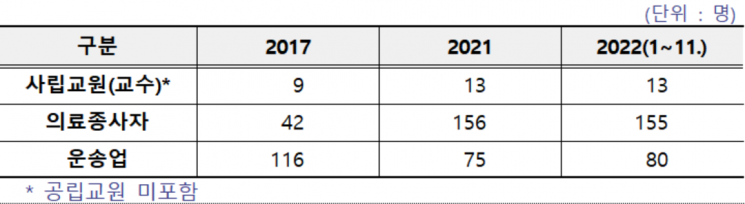
Additionally, drug crimes among public service workers such as school teachers are also increasing. In October last year, a temporary psychotropic drug, isobutyl nitrite (commonly known as 'Rush'), was purchased, sold, inhaled, and possessed by a contract secondary school teacher, who was sentenced by the court to 10 months in prison with a two-year probation.
In response, the Ministry of Justice decided to strengthen measures such as expanding drug prevention education for students and at-risk youth who are highly exposed to drugs and establishing a recidivism prevention education system for juvenile delinquents.
Systematic Prevention Education for Students and Youth and Expansion of Cooperation with Private Specialized Agencies
First, the Ministry of Justice plans to add 'drug prevention education' to the 'visiting legal education lectures' that provide school violence and cybercrime prevention education at middle and high schools and youth welfare facilities nationwide, and expand prevention activities through inter-agency collaboration with the Ministry of Education, Ministry of Gender Equality and Family, and others.
Also, the Ministry of Justice has designated drug-related specialized agencies such as the Korea Anti-Drug Movement Headquarters and the Korea Addiction Management Center Association under the Ministry of Food and Drug Safety as part of the Legal Culture Promotion Center, and plans to strengthen drug prevention capabilities by activating cooperation with private specialized agencies, including expanding the pool of professional drug prevention legal education instructors.
Furthermore, to enhance prevention effects and raise awareness, the Ministry will strengthen online promotion by uploading content reflecting the latest trends on YouTube and the legal education portal, and add 'youth drug prevention' to the activities of the youth and university student volunteer group 'Justice Supporters' that promote the culture of law-abiding behavior, conducting simultaneous online and offline campaigns including public place promotions.
Establishment of a Drug Recidivism Prevention System by Juvenile Delinquency Stage within Ministry of Justice Affiliated Agencies
The Ministry of Justice will add 'drug addiction prevention' to the juvenile training curriculum. Additionally, among juveniles entrusted to the Juvenile Classification Examination Center, those abusing drugs or harmful chemicals will undergo special classification examinations, including psychological tests such as the Minnesota Multiphasic Personality Inventory (MMPI) and the Bender Gestalt Test (BGT), to conduct in-depth diagnosis of delinquency causes.
Considering the recent increase in drug offenders under juvenile probation, which rose from 12 in 2018 to 52 last year, the Ministry plans to mandatorily provide drug prevention education during the probation compliance orientation and strengthen supervision by conducting regular or random drug tests according to classification grades.
Moreover, special compliance measures (such as inspections of mobile phones and computers) will be imposed through chat and social networking services (SNS) to prevent drug purchases and fundamentally block inducements to commit crimes.
Additionally, the Ministry of Justice will operate drug addiction prevention education courses for students in alternative education programs at the Juvenile Delinquency Prevention Center (Youth Dream Center) involving schools, prosecutors, and courts, and for counseling and investigation trainees, thereby strengthening education and counseling support for juveniles in the early stages of delinquency. For juveniles requiring therapeutic intervention due to addiction symptoms, the Ministry will coordinate with specialized agencies to ensure continuous counseling and necessary treatment at local hospitals even after education completion.
Monitoring Drug Use Status and Reflecting in Treatment
The Ministry of Justice will continuously investigate drug use status at all stages of juvenile treatment, including the Juvenile Delinquency Prevention Center, probation offices, Juvenile Classification Examination Center, and juvenile training schools, and closely monitor trends in usage status.
To this end, drug use status, awareness of use among friends and seniors, and usage conditions will be continuously monitored through the Crime Prevention Policy Bureau's education and supervision system during personal investigations and in-depth interviews conducted upon juvenile case reception and facility admission.
The results of drug use status will then be reflected in education and supervision programs and treatment, and information will be shared with related ministries such as the Ministry of Education, Ministry of Health and Welfare, and Ministry of Food and Drug Safety for use as policy data.
The Ministry of Justice stated, "We will devote all efforts across various fields from prevention to counseling and rehabilitation support to eradicate drug crimes rapidly spreading among the younger generation."
Minister Han Dong-hoon: "We Will Restore Our Status as a Drug-Free Nation"
On the previous day, Minister of Justice Han Dong-hoon reported the Ministry's five core task plans for 2023 to President Yoon Seok-yeol during a briefing at the Blue House State Guest House, stating, "We will stop the spread of drugs that are spreading like an epidemic and restore our status as a drug-free nation."
To this end, the Ministry of Justice plans to establish special investigation teams for drug crimes and dedicated dark web investigation teams in the four major regional prosecutors' offices nationwide?Seoul Central, Incheon, Busan, and Gwangju?within the first quarter of this year, and eradicate drug distribution crimes online and offline using the 'automatic search program (e-Robot)'.
Furthermore, for drug offenders among public service workers such as government officials and teachers, even first-time offenders will be actively considered for public trial, and the Ministry will discuss strengthening disciplinary measures with related ministries. At the same time, in cooperation with related ministries such as the Ministry of Food and Drug Safety, the Ministry plans to significantly strengthen treatment and rehabilitation for drug addicts and prevention education for youth.
© The Asia Business Daily(www.asiae.co.kr). All rights reserved.


















