Last Year Sales of 3.0013 Trillion KRW
First Ever in Pharmaceutical and Bio Industry
Nearly 1 Trillion KRW Sales in Q4 Alone
John Lim Tripled Sales in 2 Years Since Inauguration
Increased Production Capacity with Start of 4th Plant
Secured Growth with Epi's Full Subsidiary Integration and New CDO Platform Launch
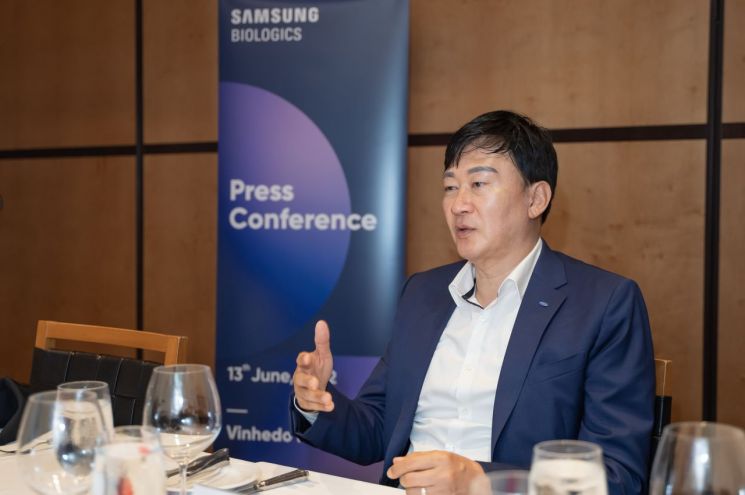
[Asia Economy Reporter Chunhee Lee] Samsung Biologics has become the first company in the pharmaceutical and bio industry to surpass annual sales of 3 trillion KRW.
Samsung Biologics announced on the 27th that its consolidated operating (preliminary) sales for last year amounted to 3.0013 trillion KRW. Following the historic milestone of exceeding 2 trillion KRW in cumulative sales by the third quarter of last year with 2.0358 trillion KRW, the company succeeded in achieving an unprecedented annual sales of 3 trillion KRW in the domestic pharmaceutical and bio industry. Notably, despite securities firms’ forecasts predicting that reaching 3 trillion KRW this year would be difficult with a fourth-quarter sales estimate of around 800 billion KRW, Samsung Biologics recorded nearly 965.5 billion KRW in sales in the fourth quarter alone, demonstrating a strong performance that far exceeded expectations.
This is the first time a company in the pharmaceutical and bio industry has exceeded 3 trillion KRW in annual sales. Although there were expectations that SD Biosensor could surpass 3 trillion KRW in 2021, fueled by the COVID-19 pandemic, it only managed to break the 2 trillion KRW mark with 2.93 trillion KRW and failed to reach 3 trillion KRW.
Since John Rim took office in 2021, he has achieved nearly a threefold increase in sales within two years. Samsung Biologics’ annual sales, which were 1.1648 trillion KRW in 2020, first surpassed 1.5 trillion KRW with 1.568 trillion KRW the following year, and then nearly doubled again last year.
Due to the high operating profit margin characteristic of the CDMO business, operating profit also grew by 83.1% year-on-year to 983.6 billion KRW, with an operating profit margin reaching 32.8%.
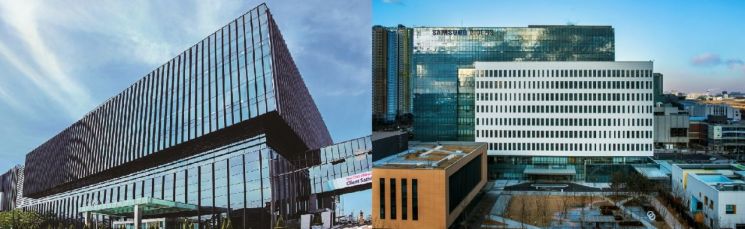 The third plant of Samsung Biologics in Songdo, Incheon, and the new building of Samsung Bioepis (from left in the photo) [Photo provided by Samsung Biologics, Samsung Bioepis]
The biggest driver of Samsung Biologics’ sales growth was undoubtedly the full acquisition of Samsung Bioepis. Previously co-owned with U.S. Biogen, Samsung Biologics acquired 100% of Samsung Bioepis shares, and from May last year, Samsung Bioepis’ performance has been consolidated into Samsung Biologics. Since Samsung Bioepis’ annual performance reached 946.3 billion KRW, the full reflection of its annual results this year is expected to further accelerate the upward trend.
Even considering the effect of the Bioepis merger, Samsung Biologics’ standalone performance alone surpassed 2 trillion KRW in sales for the first time, successfully maintaining growth in its core CDMO business. Standalone sales grew 55% year-on-year to 2.4373 trillion KRW, and operating profit increased 80% to 968.1 billion KRW.
In the CDMO sector, partial operation of the world’s largest fourth plant (240,000 liters) began in October last year, further widening the overwhelming production capacity gap. Once the fourth plant is fully operational this year, Samsung Biologics’ total production capacity will reach 604,000 liters, firmly maintaining its global No. 1 position. Currently, the fourth plant is contract manufacturing (CMO) for 8 clients and 11 products, and discussions are underway for CMO with an additional 26 clients and 34 products.
Additionally, in terms of sales, the strong dollar effect in the second half of last year contributed to growth. Given the high export ratio and the CDMO industry’s characteristic where customers bear raw material costs, a strong dollar acts as a positive factor. In terms of orders, Samsung Biologics currently has 12 of the world’s top 20 global big pharma companies as clients and plans to secure all 18 except Moderna and BioNTech as clients.
In the contract development organization (CDO) field, Samsung Biologics launched the bispecific antibody platform 'S-Dual' and 'Developick,' a new service for analyzing and selecting the safety of new drug candidates, strengthening its business portfolio this year.
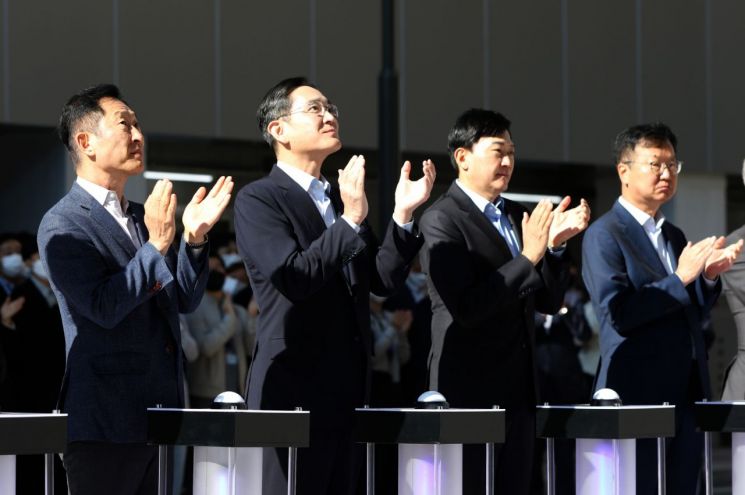 Last October, Lee Jae-yong, Vice Chairman of Samsung Electronics, attended the completion ceremony of Samsung Biologics' Plant 4 and applauded. Ko Han-seung, President of Samsung Bioepis; Vice Chairman Lee Jae-yong; John Rim, President of Samsung Biologics; and Choi Sung-an, President of Samsung Engineering (from left).
 [Photo by Samsung Electronics]
Samsung Biologics is not stopping there; it plans to expand production capacity and secure technological capabilities. Earlier on the 11th, CEO John Rim revealed at the JP Morgan Healthcare Conference 2023, “This year, we will actively pursue orders starting with the fourth plant and also push forward with expanding production capacity through the second bio campus. We plan to expand our CDMO portfolio with next-generation drugs such as antibody-drug conjugates (ADC) and gene therapies, and establish bases in major cities where global clients are concentrated to continue growth.”
With the fourth plant nearing completion, Samsung Biologics has secured a new site of 357,000 square meters near the first bio campus in Songdo, where discussions on building the second bio campus will be intensified starting this year. The plan involves investing a total of 7.5 trillion KRW to build a large-scale biopharmaceutical production facility as well as an open innovation center.
Regarding the portfolio, the company is expanding into next-generation therapies such as ADCs and gene therapies. Work on ADCs has already begun, with production targeted for the first quarter of next year. ADCs, as the name suggests, are drugs that conjugate antibodies and drugs. They have recently become a hot topic in the bio industry due to a series of big deals. ADCs link antibodies that bind to cancer antigens with cytotoxic drugs (payloads) via linkers, effectively delivering toxins specifically to cancer cells like guided missiles, making them a promising next-generation cancer treatment technology.
In terms of geographic bases, Samsung Biologics is continuing its expansion into the U.S. Following the establishment of an R&D center in San Francisco in 2020, it recently set up a sales office in Boston and plans to open another sales office in New Jersey, where major big pharma companies are located. The company intends to further expand its global network by entering additional key locations.
Moreover, Samsung Bioepis, following its U.S. launch last year, introduced the biosimilar 'Amelibu' for the macular degeneration treatment 'Lucentis' domestically this year, and plans to start U.S. sales of the biosimilar 'Hadlima' for the autoimmune disease treatment 'Humira' from July, raising expectations for increased performance.
© The Asia Business Daily(www.asiae.co.kr). All rights reserved.
![Clutching a Stolen Dior Bag, Saying "I Hate Being Poor but Real"... The Grotesque Con of a "Human Knockoff" [Slate]](https://cwcontent.asiae.co.kr/asiaresize/183/2026021902243444107_1771435474.jpg)

















