First Tree Fossil in Korea to Receive National Monument Designation
[Asia Economy Yeongnam News Bureau, Reporter Lee Dongguk] The city of Pohang announced that the Cultural Heritage Administration (Administrator Choi Eungcheon) will designate and officially announce the 'Pohang Geumgwangri Cenozoic Tree Fossil (浦項 金光里 新生代 나무化石, Cenozoic fossil wood from Geumgwangri, Pohang)' as a Nationally Designated Cultural Heritage Natural Monument on January 27, marking the first time a tree fossil in Korea has received such a designation.
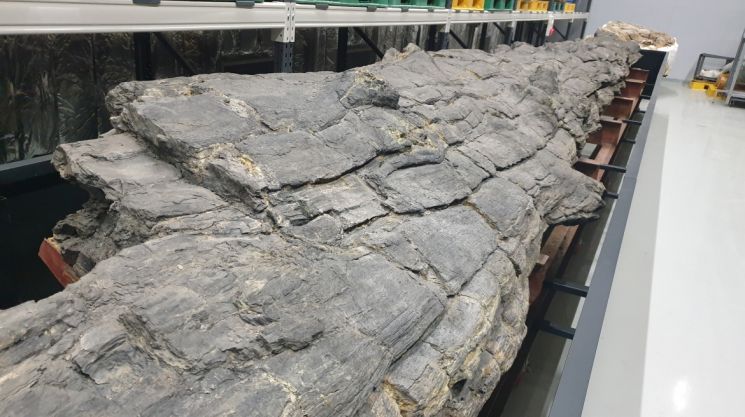
The 'Pohang Geumgwangri Cenozoic Tree Fossil' measures 10.2 meters in height, 0.9 to 1.3 meters in width, and 0.3 meters in thickness, making it the largest tree fossil ever discovered in Korea.
Notably, its height is equivalent to a three-story building, and its immense weight requires three forklifts to lift it simultaneously.
In 2009, during an excavation for road construction in Geumgwangri, Donghae-myeon, Nam-gu, Pohang-an area known as a treasure trove of plant fossils on the Korean Peninsula-a team led by Professor Kim Hangmook of Pusan National University unearthed the fossil. It was then transferred to the National Research Institute of Cultural Heritage in Daejeon, where it underwent preservation treatments such as chemical application and fragment reassembly over a three-year period starting in 2011. The fossil is currently stored in the Natural Monument Center’s repository at the National Research Institute of Cultural Heritage.
The 'Pohang Geumgwangri Cenozoic Tree Fossil' is exceptionally well-preserved, with features such as numerous knots, wood grain, and growth rings remaining nearly intact. This allows for a better understanding of the vegetation and sedimentary environment of the Korean Peninsula approximately 20 million years ago. The degree of fossilization varies from the surface to the core, making it an important specimen for studying the fossilization process of trees.
Anatomical analysis of the wood-including the boundaries and width of growth rings, as well as the arrangement of internal vessels and cells-suggests that the fossil belongs to the Cupressaceae family, which is closely related to modern Metasequoia or Sequoia species.
Large tree fossils are protected as natural heritage in other countries, often designated as natural monuments or included in national parks. The 'Pohang Geumgwangri Cenozoic Tree Fossil' is comparable in size and preservation to similar fossils worldwide. Through its designation as a Nationally Designated Cultural Heritage Natural Monument, the fossil will be preserved and managed as a valuable piece of natural heritage.
The Cultural Heritage Administration plans to allow the public to appreciate the value of the 'Pohang Geumgwangri Cenozoic Tree Fossil' by holding a special exhibition for a limited time in February at the Natural Monument Center of the National Research Institute of Cultural Heritage, open to those who make advance reservations. The administration also intends to establish a long-term preservation and management environment and secure exhibition space so that the general public can access the fossil on a regular basis in the future.
Mayor Lee Kangdeok stated, "The Pohang Geumgwangri Cenozoic Tree Fossil is a representative plant fossil of Korea and a precious natural heritage symbolizing Pohang City. We will work to transfer not only this tree fossil but also various other fossils discovered in the region to Pohang so that citizens can easily access and appreciate them."
© The Asia Business Daily(www.asiae.co.kr). All rights reserved.
![Clutching a Stolen Dior Bag, Saying "I Hate Being Poor but Real"... The Grotesque Con of a "Human Knockoff" [Slate]](https://cwcontent.asiae.co.kr/asiaresize/183/2026021902243444107_1771435474.jpg)















