2009 Pohang Geumgwang-ri Excavation of Cenozoic Tree Fossils
Clue to Unlocking 20 Million-Year-Old Vegetation Secrets of the Korean Peninsula
The rocks distributed in the Pohang area of Gyeongbuk are special. They are not igneous rocks formed by cooling hot magma. Instead, they are mudstones, hardened from accumulated fine mud. During their formation, organisms were deposited together, often appearing as fossils. The 'Pohang Geumgwang-ri Cenozoic Tree Fossil' stored in the National Research Institute of Cultural Heritage's Natural Monument Center warehouse is a representative example. Professor Kim Hangmuk's team from Pusan National University excavated it in 2009 at a national road (Ilwon~Mundeok) construction site in Geumgwang-ri, Donghae-myeon, Nam-gu. It measures 10.2 meters in height, 0.9 to 1.3 meters in width, and 0.3 meters in thickness, making it the largest tree fossil discovered in Korea. Its preservation is so good that it almost gives the illusion of a living tree.
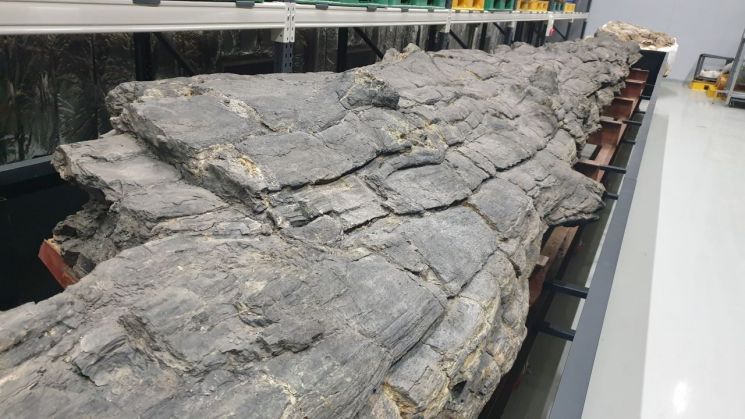
On the 27th, the Cultural Heritage Administration announced the designation of this tree fossil as a national natural monument. Attention was drawn to the preservation state of its surface and cross-section, which are close to their original form and taller than a three-story building. In particular, numerous knots (the base parts of branches embedded in the tree body), wood grain, and growth rings are evaluated as clues to unravel the secrets of the vegetation and sedimentary environment of the Korean Peninsula about 20 million years ago. The preservation state varies from the surface to the center, showing the fossilization process of the wood.
The tree species is presumed to belong to the gymnosperm family Cupressaceae, based on the boundaries and widths of the growth rings and the arrangement characteristics of internal vessels and cells. It is considered to have a similar relationship to present-day Metasequoia or Sequoia. Lee Geunyoung, a Natural Monument officer at the Cultural Heritage Conservation Bureau, stated, "Additional research is needed to reach a precise conclusion."
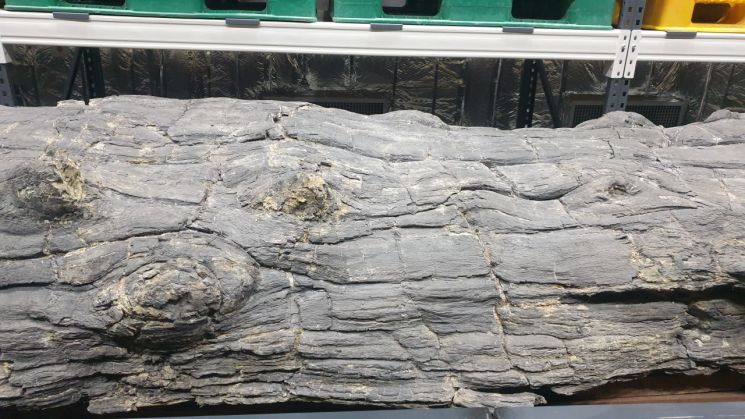
The Pohang Geumgwang-ri Cenozoic Tree Fossil has been managed almost as a natural monument since its discovery. In 2011, the National Research Institute of Cultural Heritage carefully lifted it with three forklifts and transported it in a vibration-free vehicle. Conservation treatment was also carried out for three years in collaboration with the Cultural Heritage Conservation Science Center. Foreign substances were removed, chemicals were applied to prevent cracking, and fragments were meticulously joined together. Next month, an exhibition space will be secured to make it permanently open to the public.
© The Asia Business Daily(www.asiae.co.kr). All rights reserved.
![Clutching a Stolen Dior Bag, Saying "I Hate Being Poor but Real"... The Grotesque Con of a "Human Knockoff" [Slate]](https://cwcontent.asiae.co.kr/asiaresize/183/2026021902243444107_1771435474.jpg)

















