Among 16,805 Jeonse and Monthly Rent Cases in December, 8,277 Cases
Highest Since Related Statistics Released in 2010
Impact of New Lease Law, High Interest Rates, and Jeonse Fraud
[Asia Economy Reporter Onyu Lim] It is the era of monthly rent. The proportion of monthly rent in the Seoul apartment rental market is approaching 50%, nearly catching up to the jeonse (long-term deposit lease) market. In the era of high interest rates, as the burden of interest payments increases and the risk of ‘empty jeonse’ and ‘jeonse fraud’ rises due to falling housing prices, tenants’ preference for monthly rent is strengthening.
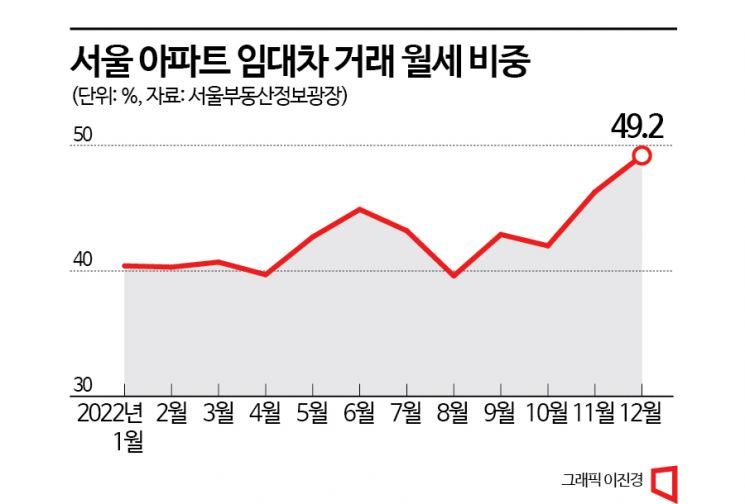
According to the Seoul Real Estate Information Plaza on the 28th, the number of monthly rent transactions for Seoul apartments in December last year totaled 8,277, accounting for 49.25% of the total 16,805 jeonse and monthly rent transactions. This is the highest since related statistics were first released in 2010. The proportion of monthly rent in Seoul apartments was 31.4% in 2020 and 38.5% in 2021. While the monthly rent proportion was only in the 40% range during January to March last year, it rose to 44.9% in June, 46.3% in November, and surpassed 49% in December.
The increase in the proportion of monthly rent in Seoul apartments was fueled by the new rental law implemented in August 2020. As tenants renewed their jeonse contracts and stayed in one home for four years, jeonse listings dried up, forcing some to choose monthly rent.
Moreover, from the second half of last year, the rapid rise in interest rates accelerated the conversion from jeonse to monthly rent. The interest rate on jeonse loans, which had been around 2-3% annually, soared to 7% in the second half of last year, significantly increasing the interest burden on jeonse loans. This made monthly rent more advantageous for tenants.
Recently, large-scale jeonse fraud involving villa owners, developers, and real estate agents has been exposed, further increasing tenants’ aversion to jeonse. As falling housing prices have made empty jeonse more common, anxiety over losing jeonse deposits has grown. In fact, the total amount paid by HUG to tenants on behalf of landlords due to non-return of deposits last year reached 924.1 billion won, which is 16 times higher than the 58.3 billion won in 2017, five years ago.
Yeokyung Hee, a researcher at Real Estate R114, explained, "When the new rental law was implemented, tenants had no choice but to select monthly rent due to the lack of jeonse listings. Now, although listings exist, the high interest rates on jeonse loans and increased anxiety over jeonse fraud and empty jeonse have strengthened tenants’ preference for monthly rent."
© The Asia Business Daily(www.asiae.co.kr). All rights reserved.
![Clutching a Stolen Dior Bag, Saying "I Hate Being Poor but Real"... The Grotesque Con of a "Human Knockoff" [Slate]](https://cwcontent.asiae.co.kr/asiaresize/183/2026021902243444107_1771435474.jpg)















