26th Press Conference by Deputy Prime Minister for Economy Choo Kyung-ho
Heating Cost Support through Windfall Tax is "Not Desirable"
"Will Pass Fiscal Rules, No Plans to Review Supplementary Budget"
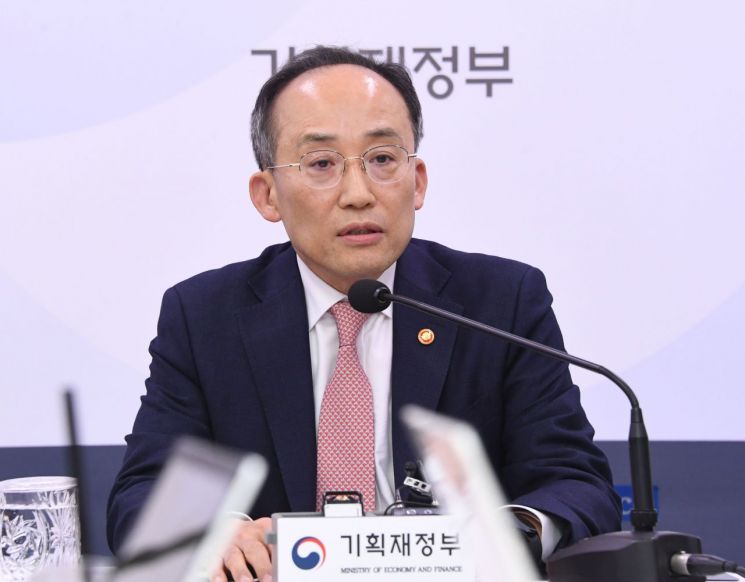 Deputy Prime Minister and Minister of Economy and Finance Choo Kyung-ho is speaking at a press briefing held in Sejong City on the 26th.
[Asia Economy Sejong=Reporter Song Seung-seop] To quell the ‘heating bill bomb’ crisis that has emerged mainly among vulnerable groups, the government is allocating a budget of 180 billion KRW for energy voucher support. However, it stated that it cannot accept the opposition party’s proposal to impose a ‘windfall tax’ to help vulnerable groups.
On the 26th, Deputy Prime Minister and Minister of Economy and Finance Choo Kyung-ho held a press conference and explained, “After consultations with related agencies until this morning, we announced a plan to double the voucher support for vulnerable groups compared to the current level,” adding, “Korea Gas Corporation will also announce additional discount measures.” The budget required for voucher support will be sourced from 100 billion KRW from contingency funds and 80 billion KRW from the existing budget. The budget allocation is planned to be decided immediately at this week’s Cabinet meeting.
The Presidential Office decided to significantly expand support as heating costs for vulnerable groups soared due to the cold wave that morning. Energy voucher support for 1,176,000 people, including basic livelihood security households and elderly patients, will increase from 152,000 KRW to 304,000 KRW this winter. Korea Gas Corporation will expand the discount amount for 1.6 million socially considerate households from 9,000 KRW?36,000 KRW to 18,000 KRW?72,000 KRW.
Deputy Prime Minister Choo said, “There was a strong voice that we should also raise (gas prices) significantly and quickly, reflecting international energy prices,” and explained, “Although there are losses for public enterprises, we have been considering both the burden on people’s livelihoods and households, and have raised energy prices accordingly.” He added, “As the person responsible for policy, this is truly a heavy matter on my heart.”
Regarding the proposal to impose a windfall tax on companies to support vulnerable groups struggling with heating bills, he expressed a stance of non-acceptance. On the same day, Lee Jae-myung, leader of the Democratic Party of Korea, held an ‘Emergency Countermeasure Meeting of Democratic Party Local Governments and Assemblies on the Heating Bill Bomb’ and said, “We intend to propose to the central government to provide about 7.2 trillion KRW in support funds for high energy prices.” He argued that the funding should be raised by imposing a levy on excessive windfall profits and operating profits of energy companies.
Deputy Prime Minister Choo opposed this, saying, “It is not desirable to approach it as a windfall tax just because our companies make profits for a certain period,” and added, “It is healthy for companies to pay corporate tax as prescribed by law when they make profits.” He continued, “There are talks about windfall taxes on some oil refiners in Europe, but the structure is different from Korea,” and refuted, “We are not considering the introduction of a windfall tax at all.”
Choo Kyung-ho: "Will Pass Fiscal Rules, No Review of Supplementary Budget"
When asked if gas prices might be frozen in the second quarter as they were in the first quarter, he was cautious, saying, “It is difficult to say definitively.” Deputy Prime Minister Choo explained, “The accumulated fees and winter season price increases combined create a heavy burden, so despite the factors for increase, we have frozen prices for now,” and added, “There is no way to solve this all at once, so we will review appropriate price adjustments at the right time.”
Regarding concerns about an economic recession, he forecasted, “Positive growth is expected in the first quarter.” Real GDP fell by 0.4% in the fourth quarter of last year, marking a contraction for the first time in two years and six months since the second and fourth quarters of 2020. Deputy Prime Minister Choo said, “The contraction was expected and the result was within a reasonable range,” analyzing, “The economic downturn in major advanced countries is not severe, and there is a possibility of China’s reopening.”
He also pledged to pass the fiscal rules bill pending in the National Assembly. He said, “When the February extraordinary session opens, we will actively work on legislation,” and added, “The biggest economic policy of the Yoon Suk-yeol administration is to firmly establish a sound fiscal policy. We will refrain as much as possible from recklessly increasing fiscal spending through debt.”
Regarding calls for a supplementary budget, Deputy Prime Minister Choo firmly stated, “We are not considering it at all at this time.” He said, “We just finalized a 640 trillion KRW budget the day before yesterday and have just started executing it,” and criticized, “Suggesting a supplementary budget right after passing the main budget implies that the main budget was poorly prepared. Talking about a supplementary budget in January is really not appropriate.”
Meanwhile, Deputy Prime Minister Choo mentioned inflation forecasts, saying, “It will take a little time until January and February, but as we said, inflation for this quarter will be around 5%, and in the second half of the year, around 3%,” and predicted, “For the whole year, inflation is expected to be in the mid-3% range.”
© The Asia Business Daily(www.asiae.co.kr). All rights reserved.

















