Controversy Over Introducing On-Site Spent Nuclear Fuel Storage at Nuclear Plants
Skepticism About Possible Introduction of Permanent Disposal Facility by 2050
[Asia Economy Reporter Naju-seok] Although discussions on the special bill related to high-level nuclear waste have officially begun in the National Assembly, local civic groups are opposing it, arguing that existing nuclear power plants could effectively become permanent on-site storage facilities for spent nuclear fuel. Experts also expressed differing opinions regarding the provision that requires establishing a permanent disposal facility for high-level nuclear waste by 2050.
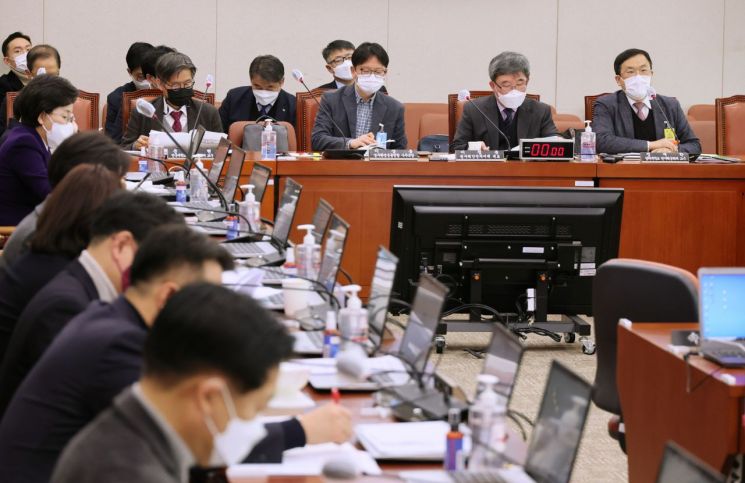
On the 26th, the National Assembly's Industry, Trade, Energy, Small and Medium Enterprises Committee (SanJaWi) held a legislative public hearing on the high-level radioactive waste-related law. Although the meeting aimed to address issues related to spent nuclear fuel and other high-level nuclear waste, it instead highlighted how far the task still is from completion. Currently, three bills related to high-level radioactive waste are pending: one proposed by Kim Seong-hwan of the Democratic Party in September 2021, and two others by Kim Young-sik and Lee In-seon in August 2022.
The biggest issue is the continued storage of spent nuclear fuel on nuclear power plant sites. Lee Sang-hong, Secretary-General of the Gyeongju Environmental Movement Federation, who appeared as a witness at the hearing, argued that "the provisions for installing and operating on-site storage facilities included in all three bills should be deleted." This concern stems from the fear that legally codifying these facilities could lead to them becoming permanent installations.
Currently, spent nuclear fuel is transferred from the reactor building to wet storage facilities (pools) adjacent to the reactor, where residual heat is cooled for 5 to 6 years before being temporarily stored in dry storage facilities. Ultimately, spent nuclear fuel should be moved to a permanent disposal facility capable of storing it safely for over 100,000 years. However, due to safety concerns and the need for local consent, no site has yet been secured. Although these facilities are called temporary storage, if the law establishes the concept of on-site storage for spent nuclear fuel, the situation could change. Regarding this, Lee stated, "There has been no public discussion within the region," and insisted, "The legal nature of on-site storage facilities should be discussed only after public deliberation with local residents."
On the same day, before the public hearing, civic groups held a press conference with Justice Party lawmaker Ryu Ho-jeong, calling for the abolition of the special high-level nuclear waste law. Nationwide civic groups from nuclear power plant regions, including the Ulsan Citizens' Joint Action, stated, "The provision for ‘on-site storage of spent nuclear fuel’ would turn all existing nuclear power plant areas into high-level nuclear waste sites, endanger the safety of local residents, increase accident risks, and impose enormous sacrifices on both the municipalities hosting nuclear power plants and neighboring areas." They strongly urged the abolition of the special bill.
They criticized, "Selecting a site for a high-level nuclear waste disposal facility is one of the most difficult problems worldwide, including in South Korea. Although the bill claims to aim at establishing a disposal site for high-level nuclear waste, in reality, it forces nuclear power plant residents to bear the burden of unresolved nuclear waste management under the guise of ‘temporary storage’ or ‘on-site storage.’"
Professor Moon Joo-hyun of Dankook University's Department of Energy Engineering expressed concerns, saying, "The special law needs to specify the timing for transferring waste to disposal facilities to alleviate local community concerns." He added, "While the special law is not a panacea, it at least represents a minimal mechanism for the government to manage radioactive waste after use," emphasizing the necessity of enacting the special law.
Concerns were also raised about fixing the disposal facility deadline to 2050. Lee Sang-hong stated, "In the case of the bill proposed by Kim Young-sik and others, there is a provision to allow operation of the permanent disposal facility by 2050," and criticized, "Setting 2050 as the deadline for securing a disposal site is a political decision that ignores the realistic site selection process." He argued, "The focus should be on how long on-site storage facilities will be operated. The acceptable amount should be limited according to the design lifespan, and residents should be given decision-making rights when such facilities are established." The government had previously estimated that establishing a permanent disposal facility for high-level radioactive waste would take 37 years.
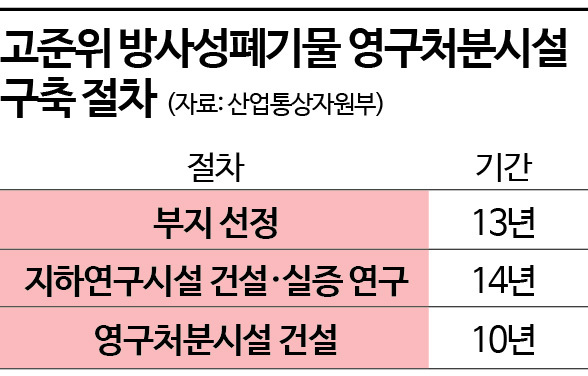
Conversely, Professor Moon Joo-hyun said, "Since the government promises a support system for carbon neutrality, it is desirable to specify the operation timing of the disposal facility," but added, "2050 will be a challenging target." He noted that because the plan aims to proceed faster than the government's estimate, accompanying technological development is necessary.
There was also an opinion that instead of explicitly specifying a particular date, the timing should be presented at a declarative level. Professor Jeong Jae-hak of Kyung Hee University's Department of Nuclear Engineering said, "Directly specifying deadlines for transferring spent nuclear fuel from on-site storage facilities in the law could help secure local acceptance (consent) for on-site storage facilities. However, frequent calls for legal amendments depending on project progress could undermine trust in the management project. Therefore, a declarative approach in the law could be considered."
Despite various concerns, there was strong support for enacting the law. Lawmaker Kim Seong-hwan stated, "By now, we should be breaking ground for the permanent disposal site," and added, "Future issues will include how quickly a permanent disposal site can be found, whether residents can consent, how compensation will be handled, how to secure trust in safety for 100,000 to 200,000 years, and whether to establish separate interim storage facilities."
© The Asia Business Daily(www.asiae.co.kr). All rights reserved.
![Clutching a Stolen Dior Bag, Saying "I Hate Being Poor but Real"... The Grotesque Con of a "Human Knockoff" [Slate]](https://cwcontent.asiae.co.kr/asiaresize/183/2026021902243444107_1771435474.jpg)

















