Total Sales of 3,942,925 Units
Record High Revenue and Operating Profit
[Asia Economy Reporter Yoo Hyun-seok] Hyundai Motor Company announced on the 26th that its operating profit for last year was tentatively estimated at 9.8198 trillion KRW, a 47% increase compared to the previous year. This is the first time operating profit has exceeded 9 trillion KRW. Sales revenue rose 21.2% to 142.5275 trillion KRW. Net profit also increased by 40.2% to 7.9836 trillion KRW. Total sales volume reached 3,942,925 units.
Sales revenue in the fourth quarter of last year was recorded at 38.5236 trillion KRW, a 24.2% increase compared to the same period last year. The increase in sales revenue was driven by expanded sales, an improved sales mix centered on Genesis and Sports Utility Vehicles (SUVs), and favorable exchange rate effects. The average KRW-USD exchange rate in Q4 2022 rose 14.9% year-on-year to 1,359 KRW.
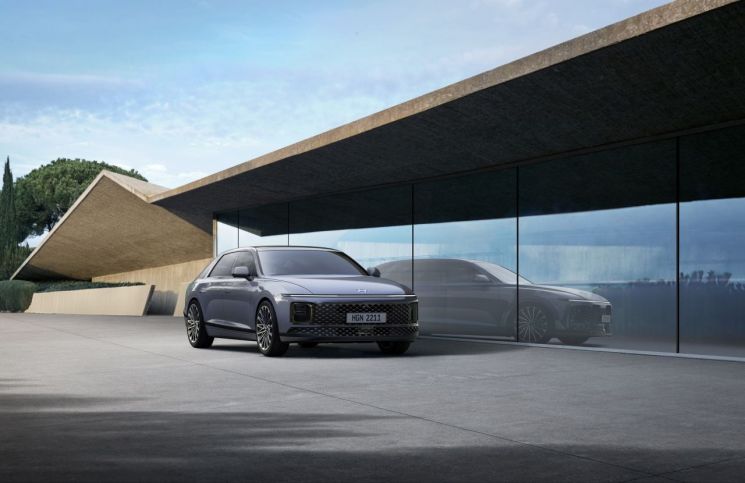
In the fourth quarter of last year, Hyundai sold 1,038,874 units in the global market, an 8.1% increase compared to the same period last year. In the domestic market, high value-added models such as the 7th generation The All-New Grandeur, launched at the end of last year, and the Genesis lineup showed steady sales, resulting in a 3.3% increase to 192,049 units sold compared to the same period last year. In overseas markets, production increased due to improved parts supply, and strong sales of eco-friendly vehicles, including the global full-scale launch of the Ioniq 6, were observed. Sales rose 9.3% year-on-year to 846,825 units.
The cost of sales ratio fell 1.1 percentage points year-on-year to 79.8%. This decline was due to increased operating rates from improved parts supply and favorable exchange rate effects. Selling and administrative expenses increased due to higher marketing costs for new vehicles. However, the ratio of selling and administrative expenses to sales revenue decreased by 2.7 percentage points year-on-year to 11.5%.
Hyundai expects production expansion due to improved operating rates going forward but anticipates a challenging business environment due to ongoing global uncertainties such as geopolitical tensions between countries, inflation expansion, and demand contraction concerns from interest rate hikes. Additionally, it cited increased marketing costs due to exchange rate volatility and intensified competition among manufacturers as burdens on business activities.
The global automobile market is expected to continue strong growth in the eco-friendly vehicle sector, centered on electric vehicles, influenced by stricter environmental regulations in major countries, increased investment in eco-friendly infrastructure, and expanded preference for eco-friendly vehicles.
In this regard, Hyundai plans to focus on ▲ full-scale global sales of the ‘Ioniq 6,’ expansion of electric vehicle sales through the launch of the ‘Ioniq 5 N’ and ‘The All-New Kona EV,’ ▲ maximizing sales through production and sales optimization, and ▲ expanding market share and defending profitability through mix improvement centered on high value-added models such as the global launch of the 5th generation fully redesigned Santa Fe.
A Hyundai official said, “Production is increasing as the semiconductor supply shortage situation improves, but inventory levels in major markets remain low, so waiting demand is expected to be solid,” while also noting, “There are concerns about demand decline due to management uncertainties such as geopolitical risks and interest rate hikes.”
On the same day, Hyundai provided its consolidated annual performance guidance for 2023 and announced its investment plans. To increase the number of mass-produced models, accelerate the construction of the new plant in Georgia, USA, and continuously secure future technologies, Hyundai plans to invest a total of 10.5 trillion KRW this year, including ▲ 4.2 trillion KRW in R&D investment, ▲ 5.6 trillion KRW in capital expenditure (CAPEX), and ▲ 700 billion KRW in strategic investments.
Finally, reflecting strong performance, Hyundai decided to increase the year-end dividend for 2022 by 50% compared to the previous year to 6,000 KRW per share. Accordingly, the total dividend for 2022, including the interim dividend of 1,000 KRW, was set at a record high of 7,000 KRW per share. Additionally, to enhance shareholder value and improve shareholder trust, the company decided to cancel shares equivalent to 1% of the issued shares from its treasury stock holdings.
A Hyundai official emphasized, “Hyundai will continue to actively review and implement various shareholder return policies to enhance shareholder value.”
© The Asia Business Daily(www.asiae.co.kr). All rights reserved.
![Clutching a Stolen Dior Bag, Saying "I Hate Being Poor but Real"... The Grotesque Con of a "Human Knockoff" [Slate]](https://cwcontent.asiae.co.kr/asiaresize/183/2026021902243444107_1771435474.jpg)
















