Negative Growth for the First Time in 2 Years and 6 Months in Q4 Last Year
Continued Weakness in Semiconductor Industry, a Key Export Product
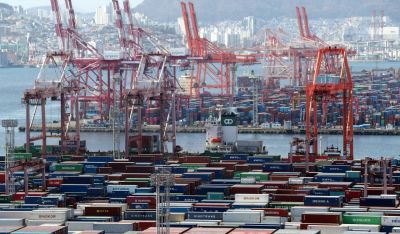
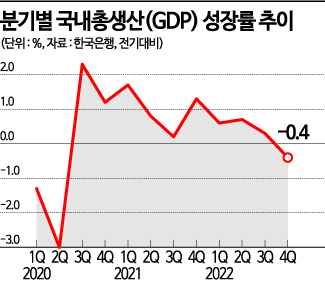
[Asia Economy Reporters Seo So-jung, Moon Je-won, Sejong=Reporter Kim Hye-won] The negative growth rate of South Korea's economy in the fourth quarter of last year, the first in 10 quarters since the second quarter of 2020 (-3.0%) when the impact of COVID-19 intensified, was due to a significant shake in exports, which lead the Korean economy, as well as a decline in private consumption.
Exports of key items such as semiconductors decreased, and private consumption, which had been recovering following the Itaewon tragedy, turned downward again, raising concerns that the Korean economy may fall into a recession trap. Although last year's real Gross Domestic Product (GDP) increased by 2.6% year-on-year, meeting the Bank of Korea's forecast, this year, as the global economic downturn intensifies, the Bank of Korea's November forecast (1.7%) is expected to be revised downward.
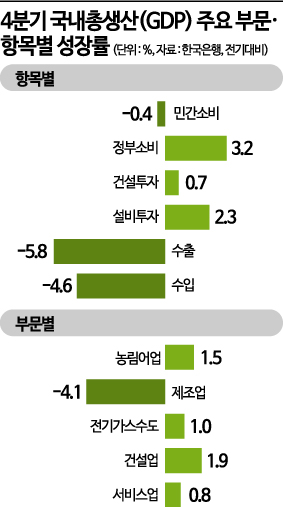
◆ Dragged down by declines in exports and consumption = According to the Bank of Korea on the 26th, the real GDP growth rate in the fourth quarter of last year was -0.4%, showing negative growth mainly due to decreases in exports and private consumption. Private consumption, which had recovered in the second (2.9%) and third quarters (1.7%), returned to a decline (-0.4%) as consumer sentiment weakened due to the aftermath of the Itaewon tragedy and other factors. Consumption of goods such as home appliances, medical products, and footwear, as well as services like accommodation, food, and entertainment, decreased.
Exports fell by 5.8%, centered on semiconductors and chemical products, while imports decreased by 4.6%, due to reductions in crude oil and primary metal products. However, government consumption in the fourth quarter increased by 3.2%, mainly driven by expenditures on goods and health insurance benefits.
Looking at the contribution to the fourth quarter economic growth rate, private consumption accounted for -0.2 percentage points and net exports for -0.6 percentage points. This means that private consumption and net exports pulled down the growth rate by 0.8 percentage points. The private sector's contribution to growth was -1.1 percentage points, while the government contributed 0.8 percentage points, indicating that government consumption helped prevent a further decline in the growth rate.
Hwang Sang-pil, Director of Economic Statistics at the Bank of Korea, explained, "The weakening of private consumption in the fourth quarter reflects an adjustment after pent-up consumption, which had surged following the lifting of social distancing measures last year and had largely recovered in the second and third quarters." He added, "Recently, real estate transactions have contracted, reducing demand for moving and home appliances, leading to a decline in durable goods consumption. Additionally, warmer weather in October and November contributed to a decrease in clothing consumption."
Regarding the possibility of negative growth in the first quarter of this year, Director Hwang said, "Exports continue to decline year-on-year in daily customs clearance exports due to sluggishness in major export items such as semiconductors, but private consumption is increasing, especially in restaurants and entertainment, as reflected in credit card usage. The first quarter's performance will depend on how much exports and pent-up consumption recover."
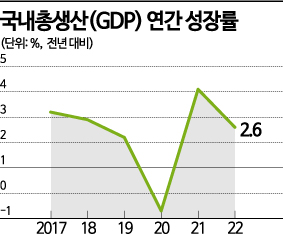
◆ Annual growth forecast of 2.6% met... expected to fall short this year = Despite the negative growth in the fourth quarter, the Korean economy grew by 2.6% for the entire last year. This matches the Bank of Korea's initial forecast and marks two consecutive years of growth following 2021's 4.1%. However, this year, with the global economic recession intensifying and exports to China sharply declining, the existing forecast (1.7%) is expected to be missed. Particularly, concerns are growing as the manufacturing sector, which has supported the economy, has shown negative growth for three consecutive quarters. This is the first time since the foreign exchange crisis period from the third quarter of 1997 to the second quarter of 1998, when manufacturing declined for four consecutive quarters.
Oh Jeong-geun, Professor of Economics at Konkuk University, said, "While the negative growth in the fourth quarter of last year is a problem, the more concerning issue is that the current downward trend in exports and consumption may continue this year." He pointed out, "Trade deficits have remained large this month, and with increased principal and interest repayment burdens due to high interest rates, consumption capacity is weakening. Employment growth is also expected to decline this year, which could further worsen the economy." Regarding the continuous decline in the contribution of exports and manufacturing to growth, Professor Oh emphasized, "Labor costs in Korea have already reached the limit that manufacturing can bear, so there is a need to shift the industrial structure toward high value-added advanced technologies or service industries." Cho Kyung-yeop, Director of Economic Research at the Korea Economic Research Institute, said, "Manufacturing and exports are not functioning normally, and trade deficits are already accumulating this year. While positive signs from the Ukraine war might help recovery, the situation remains difficult."
However, the government expects the Korean economy to return to positive growth in the first quarter of this year. At an emergency economic ministers' meeting held on the same day, Deputy Prime Minister and Minister of Economy and Finance Choo Kyung-ho stated, "Due to base effects and China's economic reopening, positive growth is expected in the first quarter." He added, "Although the Korean economy is expected to face very difficult times in the first half of this year due to global economic contraction, it is anticipated to gradually recover in the second half with improvements in the global economy and semiconductor industry conditions."
© The Asia Business Daily(www.asiae.co.kr). All rights reserved.


















