[Asia Economy Reporter Donghyun Choi] On the 26th, the Ministry of SMEs and Startups announced support measures for exports by small and medium-sized enterprises (SMEs), including the establishment of a dedicated logistics center for aviation export SMEs.
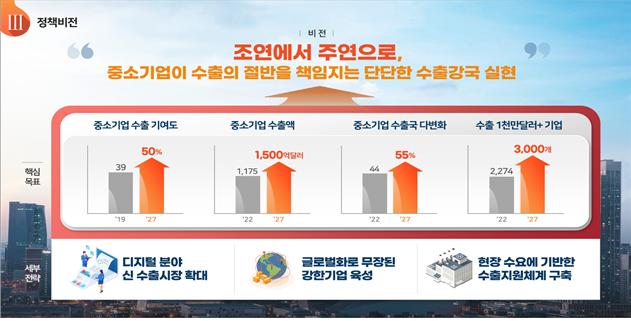
At the emergency economic ministers' meeting held that morning, the Ministry presented three major SME export support strategies: ▲expanding new export markets in the digital sector ▲fostering strong companies equipped for globalization ▲establishing an export support system based on field demand.
First, to expand platform-based online exports, the Ministry will provide up to 100 million KRW in one-stop package support covering all online export processes such as store entry, promotion, logistics, and delivery. It also plans to establish the country's first dedicated logistics center for aviation export SMEs.
The Ministry will support SME participation in overseas exhibitions in new industry sectors such as content, smart factories, and smart city supply technologies. A service export support quota system will be introduced to give preferential treatment to excellent service export companies in export policies. Support for service exports in promising future export sectors such as content and technology will also be significantly strengthened.
Additionally, the Ministry plans to actively support the globalization of ventures and startups by promoting the Global Unicorn Project, establishing venture funds, holding exchange events to facilitate entry into the Middle East and Europe, and expanding collaboration programs with global large corporations.
To promote SME globalization, the export voucher support limit will be doubled for robust SMEs recognized for competitiveness domestically, including indirect export companies, and policy funds will be prioritized. In particular, to ensure that indirect export companies supplying raw and subsidiary materials to large export companies receive proper recognition for their export contributions, the issuance of indirect export confirmation certificates by large companies will be reflected in the win-win growth index evaluation. Related systems will also be revised to treat indirect and direct exports equally in export support policies. A government award will be newly established to recognize the export contributions and importance of indirect export companies.
The dispersed export company designation system will be integrated into the "Global Strong SME" brand, and companies selected as Global Strong SMEs will automatically receive export vouchers. Export companies with export amounts exceeding 5 million USD will be nurtured as leading export companies by concentrating government policy capabilities such as research and development (R&D), policy finance, and smart factories in addition to export vouchers.
A diversification indicator will be newly established at 20% in the export support project evaluation index, and SMEs pursuing diversification will have their self-contribution reduced by 10% when participating in export support policies. Companies that succeed in diversification will be given preferential treatment when selecting policy funds and provided incentives such as interest rate reductions. Furthermore, the necessity for diversification will be analyzed by reflecting export competitiveness advantages and export market conditions by product and country, and necessary information such as recommendations for new export countries will be provided to SMEs seeking diversification.
To establish an export support system based on field demand, export incubators located in major global trade hubs such as New York, Tokyo, and Dubai will be reorganized into "Global Biz Centers" in the form of shared offices so that more SMEs can utilize them. Large-scale exhibitions will be held locally, including the "K-POP with K-BRAND" event that combines K-pop Hallyu performances and export fairs, the "K-Content Expo in Dubai" to pioneer the Middle East market where Hallyu is recently spreading, and the "K-Brand Expo" in collaboration with private distributors. Support for participation in export exhibitions in strategic markets such as the Middle East, EU, and the Americas will also be expanded.
In response to the global expansion of overseas certification requirements, a dedicated response team will operate focusing on six major certifications with high corporate demand, including CE (Europe), NMPA (China), and FDA (USA). A fast track supporting year-round continuous applications and simplified reviews will be newly established. Support limits will also be expanded for ESG (environment, social, governance) and carbon neutrality-related certifications by certification type.
To help SMEs cope with crisis situations such as rapid exchange rate fluctuations, support will be provided for exchange rate fluctuation insurance premiums and export insurance premiums, and export financing worth 17.8 trillion KRW will also be supported.
Minister Lee Young of the Ministry of SMEs and Startups stated, "SMEs have played a foundational role in our economy by contributing 40% of exports directly and indirectly, but in the face of recent difficult external conditions such as the global economic downturn, growth strategies are needed to overcome these challenges and achieve a new leap forward. We will continue to pay close attention to ensure that the policies contained in the export support measures are implemented smoothly on the ground."
© The Asia Business Daily(www.asiae.co.kr). All rights reserved.
![Clutching a Stolen Dior Bag, Saying "I Hate Being Poor but Real"... The Grotesque Con of a "Human Knockoff" [Slate]](https://cwcontent.asiae.co.kr/asiaresize/183/2026021902243444107_1771435474.jpg)















