Google to Launch 'Sparrow' Addressing Chat GPT's Drawbacks
MS Invests 12 Trillion Won in OpenAI... Accelerating Chat GPT Monetization
[Asia Economy Reporter Yuri Choi] As Microsoft (MS) takes bold steps in the artificial intelligence (AI) business by leading with 'Chat GPT,' Google has announced a counterattack. With MS aiming to shake Google's monopoly in the search market, Google has introduced an AI that complements Chat GPT's shortcomings.
On the 27th, major foreign media including the US-based CNET reported that Google DeepMind is set to launch an AI chatbot called 'Sparrow' soon. Google DeepMind is Google's AI research lab that developed 'AlphaGo.'
Unlike Chat GPT, Sparrow features the ability to show the sources of its answers. Chat GPT does not provide sources, making it difficult to verify the authenticity of plausible answers based on incorrect information.
Sparrow emphasizes safe AI. It has been trained not to make insulting or threatening remarks. It refuses to answer questions with high potential for misuse. To strengthen safeguards, tests were conducted in advance to trick Sparrow into breaking rules, similar to cases where Chat GPT’s protections were disabled to reveal self-awareness.
The industry expects Google to soon unveil a search engine integrated with an AI chatbot. The New York Times reported that Google plans to demonstrate a search engine with chatbot functionality this year and reveal more than 20 AI-powered projects.
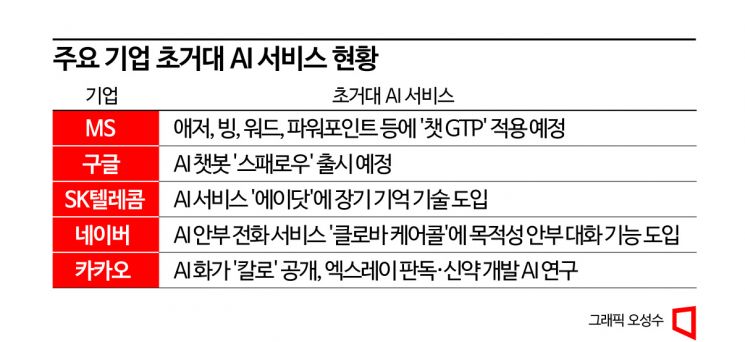
The reason Google, which had been cautious about AI utilization, has become active is because of MS. MS challenged Google's dominance by announcing plans to apply Chat GPT to its search engine 'Bing.' After drawing attention with Chat GPT’s performance, MS launched aggressive investments.
Market research firm Incredtool reported that Chat GPT users have surpassed 500 million, with monthly active users (MAU) reaching 96 million. This is just two months after its release at the end of last November. Having confirmed its potential, MS decided on February 23 to invest $10 billion (about 12 trillion won) in OpenAI, the developer of Chat GPT. The condition is that MS will receive 75% of OpenAI’s revenue until it recovers its initial investment.
Moves toward monetization have already begun. MS announced a Chat GPT professional version that allows users to experience new features or faster search speeds first, with a monthly fee of $42 (about 50,000 won). Additionally, OpenAI technology will be applied to cloud service 'Azure' as well as Office programs such as Word, PowerPoint, Excel, and Outlook. For example, by entering simple commands, AI will automatically create PowerPoint designs and draft emails.
Domestic ICT companies are also rushing to launch large-scale AI services. SK Telecom will apply new technologies such as long-term memory and comprehensive reasoning to its AI service 'A.Dot' in February. For instance, if a user says, "I took the subway for the first time in a while, but transferring is annoying," A.Dot will remember past conversations and respond, "You usually liked taking taxis." Naver added customized conversation features to its AI greeting call service 'Clova Care Call,' which uses the large-scale AI 'Hyper Clova.' This feature reflects weather or disaster situations at the time of the call to inquire about well-being. Kakao is developing AI that reads X-rays and writes diagnostic reports or assists in new drug development.
Nam Hyun-sook, senior researcher at the Software Policy Research Institute, said, "The infinite competition among global companies to develop large-scale AI models will accelerate," and predicted, "This year, the development and utilization of related services will expand across various industrial sectors."
© The Asia Business Daily(www.asiae.co.kr). All rights reserved.
![Clutching a Stolen Dior Bag, Saying "I Hate Being Poor but Real"... The Grotesque Con of a "Human Knockoff" [Slate]](https://cwcontent.asiae.co.kr/asiaresize/183/2026021902243444107_1771435474.jpg)















