Snowstorm Forecast on the 26th... Beware of Icy Roads and Pavement
Public Transportation Advised, Commute Should Be Earlier Than Usual
[Asia Economy Reporter Yoon Seul-gi] The severe cold wave that began at the end of the Lunar New Year holiday is easing, and temperatures are expected to return to normal levels. However, with up to 10 cm of heavy snowfall forecasted, traffic chaos is anticipated on the morning commute on the 26th.
According to the Korea Meteorological Administration, the minimum temperature on the morning of the 26th is expected to range from -13°C to -4°C, and the maximum temperature during the day from -1°C to 6°C, similar to or slightly lower than the average. The continental high pressure system over the western part of Korea, which brought this cold wave, is expected to shift into a mobile high pressure system moving southeast. As the continental high pressure retreats and relatively warm southwesterly winds flow in, temperatures are forecasted to rise from the afternoon of the 25th.
The main concern is snow. The southwesterly winds will carry cold air upward, forming snow cloud bands developing up to about 3 km in altitude. Lee Kwang-yeon, a forecaster and analyst at the Korea Meteorological Administration, explained, "A temperature structure of -20°C to -10°C within the clouds is forming, increasing the likelihood of large snowflakes falling," indicating a high possibility of accumulating snow.
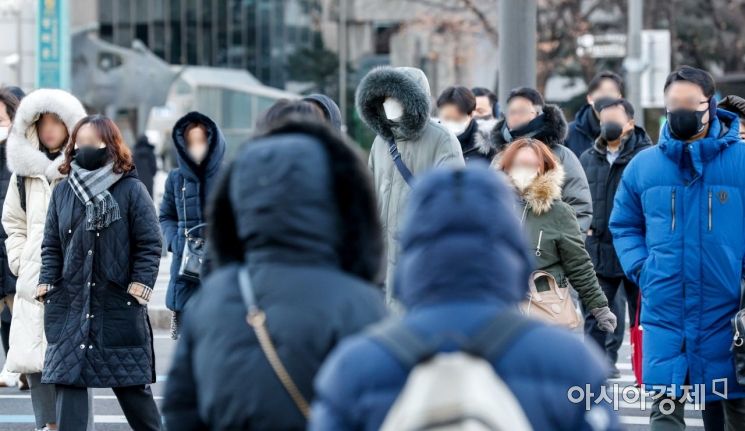 On the 25th, when a cold wave advisory was issued nationwide with the morning low temperature in Seoul dropping to minus 18 degrees Celsius, office workers are heading to work wearing thick coats at the Sejongno intersection in Jongno-gu, Seoul. Photo by Kang Jin-hyung aymsdream@
Snowfall is expected to be concentrated from dawn to morning during the commute hours. The expected snowfall amounts are 2 to 7 cm in central regions including Seoul (excluding Gangwon Yeongdong), northern inland areas of North Gyeongsang Province, and northeastern mountainous areas of North Gyeongsang; 1 to 5 cm in Jeonbuk and Ulleungdo and Dokdo; around 1 cm in Jeonnam, southern Gyeongsang, western inland Gyeongsang, and Jeju. Incheon, the western coast of Gyeonggi Province, and the western coast of Chungnam may see more than 10 cm of snow accumulation.
Most of the snow is expected to stop between the afternoon and evening of the 26th. Snowfall in other regions is expected to continue until the 27th. Snow will cease around 6 a.m. on the 27th in southern Gyeongsang and southern Gyeongbuk regions, around noon in Jeolla Province, and around midnight in Jeju.
If heavy snow falls while the cold persists, the risk of accidents on icy roads will increase. Snow accumulation or ice formation is expected on side roads, alleys, and sloped roads, so caution is necessary. Be aware of icy patches on roads. Drivers should reduce speed and maintain safe distances. Since vehicles may become stranded due to snow, it is important to check traffic conditions in advance and prepare winter equipment when using vehicles.
The Korea Meteorological Administration urged the public to use public transportation as the morning commute traffic conditions are likely to be poor. Since traffic chaos may occur, it is advisable to leave for work earlier than usual.
Meanwhile, with a heavy snow advisory issued for Seoul, the metropolitan area, and the western Chungnam region, the Seoul city government announced it will activate an emergency response system on the 26th. According to the city, the concentrated dispatch period for all subway and city bus lines during the morning and evening commute will be extended by 30 minutes on the 26th. Additionally, 9,405 personnel and 1,394 pieces of equipment will be mobilized for snow removal operations.
© The Asia Business Daily(www.asiae.co.kr). All rights reserved.

















