Burden on Small and Micro Businesses with New Device Introduction
Operating Cost Increase Also Affects... Industry Size Reduced by Half
[Asia Economy Reporter Jeon Jin-young] Once called a "30 trillion yen (approximately 300 trillion won) industry" and said to be immune to recession, the pachinko industry in Japan is now staggering due to the impact of COVID-19. Small and micro businesses are unable to withstand the decline in customers and rising electricity costs, leading to a series of closures. While some view this as an opportunity for business restructuring centered around large stores, others express concerns about the collapse of the industry itself.
According to Tokyo Shoko Research, a Japanese credit research firm, the number of bankruptcies among pachinko parlors, commonly called "pachinko halls," reached 39 last year, a 2.1-fold increase compared to the previous year, marking the highest number in the past decade. The pachinko industry attributes the surge in corporate bankruptcies largely to the prolonged COVID-19 pandemic and rising overall costs.
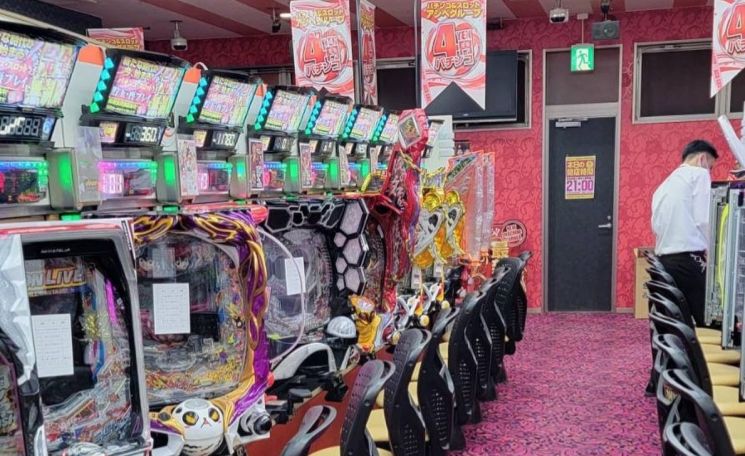
Tokyo Shoko Research analyzed that small businesses faced bankruptcy risks primarily during the introduction of "smart slot machines" aimed at attracting customers during the pandemic. Most existing slot machines required manual operation, which led to a drop in customers due to fears of COVID-19 infection. Although "smart slot machines," which can be operated without physical contact, were introduced later, the investment burden was significant.
Smart slot machines were expected to attract many customers due to their higher gambling appeal compared to traditional machines. However, small and micro businesses lacked the financial capacity to adopt these machines and were reluctant to invest. As a result, the gap in machine operation rates and sales between smart slot machines and older models widened, causing pachinko customers to flock to stores with smart machines, making it difficult for small businesses to operate.
Recent sharp inflation and Japan's declining population have also added to the burden. Coupled with worsening low birth rates and aging demographics, the potential customer base continues to shrink, while operating costs increase year by year due to rising electricity prices. Tokyo Shoko Research stated, "Even with large investments to introduce smart machines, the possibility of recovering customer attraction is uncertain," and analyzed that "the number of businesses facing financial difficulties is expected to continue increasing."
The scale of the pachinko industry itself is also rapidly shrinking. According to the Leisure White Paper by the Japan Productivity Center, a public interest incorporated foundation, the pachinko market size was estimated at 15 trillion yen in 2020. This represents a halving of the industry size compared to its heyday when it exceeded 30 trillion yen. The Japanese government and local authorities regulate the pachinko industry by specifying business rules in laws concerning operating hours, lighting brightness, noise, and advertising, but continuous contraction is expected going forward.
There is also a forecast that the full-scale industrial restructuring will begin now. With the release of new smart pachinko machines scheduled for April, concerns are rising that bankruptcies among small businesses will continue. Tokyo Shoko Research predicted, "Since machine acquisition also requires a large budget, another wave of elimination will begin in the Japanese pachinko industry."
Previously, the pachinko industry experienced a first wave of bankruptcies in the late 1990s and early 2000s due to strengthened gambling regulations. Then, in 2007, a second wave of bankruptcies occurred among small businesses lacking funds during the industry-wide slot machine replacement. Since the Great East Japan Earthquake in 2011, which drastically reduced the population enjoying entertainment, the industry has been in a prolonged slump.
© The Asia Business Daily(www.asiae.co.kr). All rights reserved.
![Clutching a Stolen Dior Bag, Saying "I Hate Being Poor but Real"... The Grotesque Con of a "Human Knockoff" [Slate]](https://cwcontent.asiae.co.kr/asiaresize/183/2026021902243444107_1771435474.jpg)















