Acceptance Rate 96.3%... Local Government Heads Also at Risk
The storage facilities of the National Museum of Korea are facing a saturation crisis. According to data from the Cultural Heritage Administration disclosed on the 24th by Kim Seung-su, a member of the National Assembly's Culture, Sports and Tourism Committee (People Power Party), the occupancy rate has reached 96.3%. This is an increase of 8.5 percentage points from 87.8% in 2020. The National Museum of Korea conducted a mezzanine construction project between 2019 and 2020, reducing the occupancy rate from 102.5% to 87.8%. However, in just two years, it has nearly reached 100%, making a re-evaluation urgent.
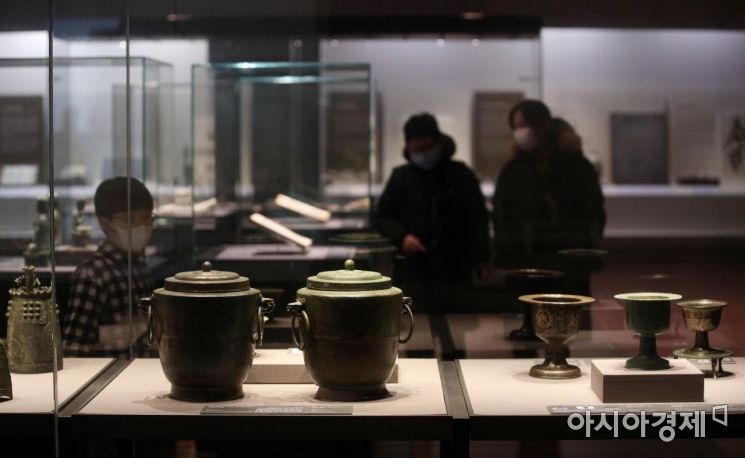 On the 19th, citizens are touring the exhibition hall at the National Museum of Korea in Yongsan-gu, Seoul. The Ministry of Culture, Sports and Tourism announced that it will resume the operation of national cultural and arts facilities located in Seoul, which had been suspended to prevent the spread of the novel coronavirus infection (COVID-19), starting from this day. Photo by Kim Hyun-min kimhyun81@
The situation is not much different for storage facilities managed by local governments. The number of places at risk of saturation with an occupancy rate above 80% increased from seven in 2017 to fifteen last year. In particular, the Namyangju City Museum has already reached full capacity with all 8,001 artifacts it can accommodate.
If the saturation continues, artifacts may be moved to temporary facilities, increasing the risk of damage. Long-term neglect could also lead to loss or deterioration. Representative Kim stated, "Management and supervision of artifacts, which should be carefully preserved for historical research, must be strengthened," and emphasized, "A comprehensive re-evaluation is necessary." As a solution, he mentioned utilizing abandoned tunnels. "This can achieve both the expansion of storage facilities and the establishment of cultural and historical regeneration spaces in local areas," he said, adding, "We will do our best to promote the project to create historical and cultural spaces for excavated artifacts."
© The Asia Business Daily(www.asiae.co.kr). All rights reserved.
![Clutching a Stolen Dior Bag, Saying "I Hate Being Poor but Real"... The Grotesque Con of a "Human Knockoff" [Slate]](https://cwcontent.asiae.co.kr/asiaresize/183/2026021902243444107_1771435474.jpg)















