"Reluctant on Immigration Amid Population Crisis"
Also Points to Male-Dominated Culture and Nationalism
Rupert Wingfield-Hayes, a British BBC correspondent who lived in Japan for 10 years, has drawn attention by criticizing Japanese society as being "trapped in the past."
Wingfield-Hayes worked as a Tokyo correspondent from 1993 until recently, and during his time in Japan, he married a Japanese woman and had three children.
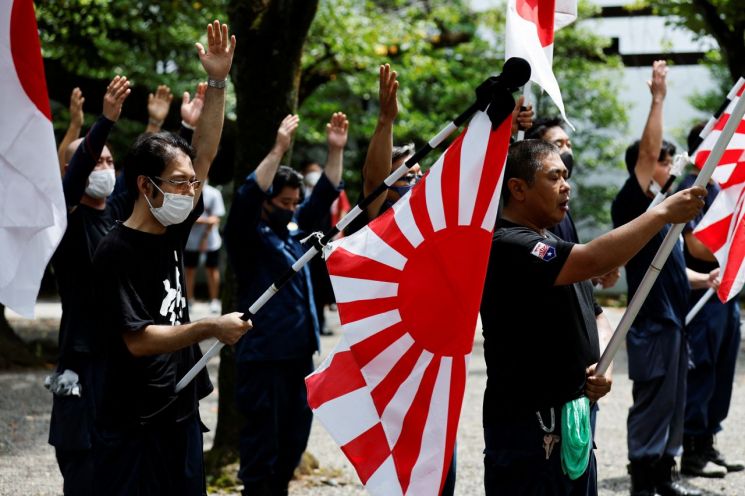 Members of a right-wing group in Japan are shouting "Banzai" after paying respects at Yasukuni Shrine in Tokyo on August 15 last year, marking the 77th anniversary of the defeat in World War II. Yasukuni Shrine is a facility that honors the spirits of those who died in various wars initiated by modern Japan, enshrining approximately 2,466,000 individuals, including 14 Class A war criminals.
 [Photo by Reuters]
On the 21st (local time), he published his final article as a correspondent for BBC Japan News. In this piece, Wingfield-Hayes diagnosed that "just a few decades ago, the US and Europe feared Japan, but now its growth potential is blocked due to aging and population decline."
Despite still being the world's third-largest economy, having a long life expectancy, and a low crime rate, he attributed Japan's economic difficulties to its 'closed culture.'
Wingfield-Hayes pointed out, "Despite population decline, Japan still harbors strong prejudice against foreigners and remains passive about immigration. Although it has been 150 years since Japan was forced to open its doors, it still fears the outside world."
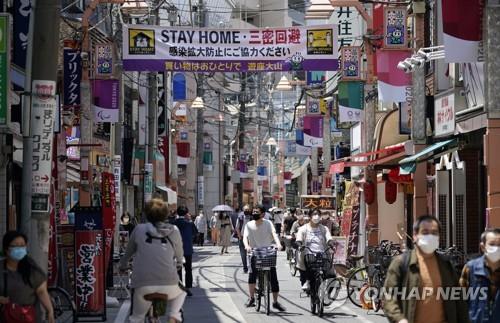
He also saw the outdated political culture, where certain families or vested interests monopolize power, as a factor reducing economic vitality. He stated, "Even after the Meiji Restoration and defeat in World War II, the overwhelming male-dominated elite was armed with nationalism and the conviction that 'Japan is special.' They believe Japan was a victim, not an aggressor, in the war."
However, he also expressed regret, saying, "Despite many frustrations, I have become accustomed to and comfortable with Japan's food, cozy environment, and kind people," and "I will miss Japan when I leave."
He added, "Rationally, I think Japan must embrace change, but at the same time, it pains me to think that this might erase Japan's unique strengths."
© The Asia Business Daily(www.asiae.co.kr). All rights reserved.
![Clutching a Stolen Dior Bag, Saying "I Hate Being Poor but Real"... The Grotesque Con of a "Human Knockoff" [Slate]](https://cwcontent.asiae.co.kr/asiaresize/183/2026021902243444107_1771435474.jpg)
















