Lettuce, Perilla Leaves, and Domestic Kimchi Prices Rise One After Another
Consumers 'Dissatisfied' with Ministry of the Interior's Poor Notification
[Asia Economy Reporter Jang Sehee] "After holding back for so long, I raised the price of Samgyeopsal to 8,000 won."
Kim Heesoon (50), who has been running a meat restaurant in Jayang-dong, Gwangjin-gu, Seoul for 24 years, sighed deeply, saying that the store is struggling due to high inflation. Meeting with the reporter on the last day of the Lunar New Year holiday, the 24th, Kim said, "The price of Samgyeopsal, which was 5,000 won, was raised to 8,000 won in two or three steps," adding, "The price of domestic kimchi has risen so much that I recently switched to Chinese kimchi."
Kim’s restaurant is designated as a ‘Good Price Store’ by the Ministry of the Interior and Safety. Good Price Stores sell items below the regional average price and provide friendly service.
Kim explained that the prices of vegetables grown in vinyl greenhouses, such as lettuce and perilla leaves, are also a burden. He said, "The price of lettuce seems to have more than doubled," adding, "Prices are especially high during the summer rainy season and winter." According to agricultural product distribution information, as of the 24th, the wholesale price of 4 kg of lettuce was 23,660 won, up 2,228 won from 21,432 won a month ago. During the same period, 2 kg of perilla leaves also rose by about 10,000 won, from 32,184 won to 41,640 won. Kim complained that because of the image of being a Good Price Store, he cannot raise prices much. Kim said, "The most expensive item in the store, galbisal (beef rib meat), is 10,000 won," adding, "Sometimes customers say the prices are too cheap and that imported meat elsewhere costs more than 10,000 won."
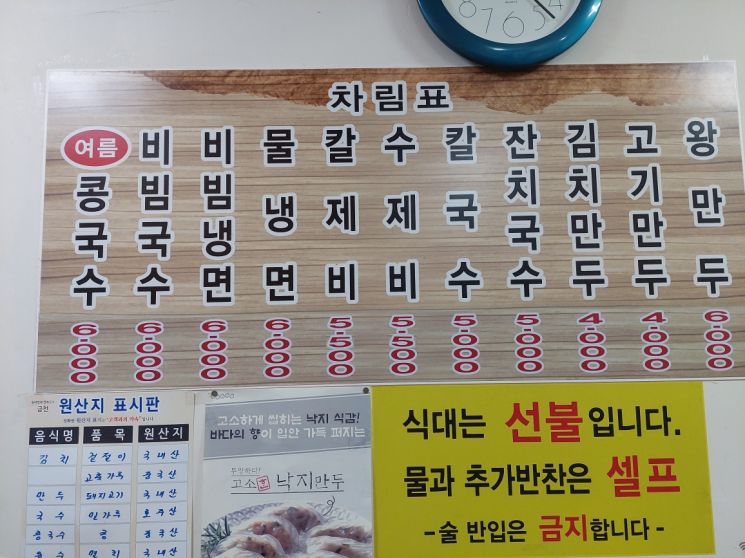
Shin Dongyeol (61), who runs a noodle restaurant in Geumcheon-gu, Seoul, said, "I raised the price of Kalguksu (knife-cut noodles) from 4,000 won to 5,000 won," lamenting, "Nothing has escaped price increases, from anchovies and flour to domestic kimchi." Shin revealed, "The wholesale price of 10 kg of domestic kimchi was 28,000 won, but now it has risen to between 31,000 and 33,000 won." However, since he recently raised prices by 1,000 won, he plans to maintain this price for customers for the time being.
Good Price Stores in the expensive Gangnam area of Seoul have also raised prices simultaneously. A Chinese restaurant in Gangnam-gu raised the price of Jajangmyeon (black bean noodles) from 4,500 won to 5,000 won. The owner, Mr. Lee (42), said, "Not only ingredient costs but also electricity bills and labor costs have all increased," adding, "It’s not just one thing that went up; all food materials have risen." Lee said that since there are many offices around the restaurant, he hasn’t noticed a significant decrease in customers despite the slight price increase. He added, "Because the cost of living in Gangnam is so high, people still say our prices are relatively low compared to other places."
A Korean restaurant in Daechi-dong, Gangnam-gu raised the price of Tongdwaeji Duruchigi (spicy stir-fried whole pork) to 9,000 won. Only one or two items that are really hard to sustain were raised, while dishes like Chadol Doenjang Jjigae (beef brisket soybean paste stew) and Bibimbap remain at 7,000 won as before.
As prices rise sharply, the pain of self-employed business owners is expected to continue. The Bank of Korea also forecasted that the consumer price inflation rate will be around 5% in January and February.
Professor Lee Eunhee of the Department of Consumer Studies at Inha University said, "Small-scale self-employed business owners with low sales are in a very difficult situation due to rising ingredient costs and public utility fees," advising, "The government needs to maintain price stability and actively support measures such as public utility fee reductions."
Meanwhile, consumers have expressed dissatisfaction with the Ministry of the Interior and Safety’s lax management of registered and operating Good Price Stores. Some stores raised food and service prices due to high inflation. There were also cases of closures or business name changes due to management difficulties. For example, a handmade noodle restaurant in Gangdong-gu is still listed as a Good Price Store on the website, but calls to the number are met with a message that the number does not exist. A hair salon in Gwangjin-gu applied service prices only to elderly customers but provided no clear notice.
Regarding this, Professor Lee emphasized, "If government-designated restaurants differ from actual prices, it can be seen as deceiving consumers and may lead to a decline in government credibility," stressing, "Continuous monitoring of designated stores is necessary."
© The Asia Business Daily(www.asiae.co.kr). All rights reserved.
![Clutching a Stolen Dior Bag, Saying "I Hate Being Poor but Real"... The Grotesque Con of a "Human Knockoff" [Slate]](https://cwcontent.asiae.co.kr/asiaresize/183/2026021902243444107_1771435474.jpg)















