First Proposed at the 2013 Davos Forum
SK Group Has Operated the Program Since 2015
[Asia Economy Reporter Choi Seoyoon] Chey Tae-won, chairman of SK Group, proposed and promoted the Social Progress Credits (SPC) program, which received high praise at this year's Davos Forum. Chairman Chey first proposed the Social Progress Credits program, which provides 'cash incentives' proportional to the 'social performance' created by social enterprises, at the Davos Forum 10 years ago.
SK Group announced on the 24th that the World Economic Forum (WEF) Secretariat recently introduced SK's Social Progress Credits and Anheuser-Busch InBev (AB InBev)'s startup and social innovation company funding program as representative success cases in an article titled "How collaboration with social enterprises is becoming a sustainable innovation solution for large corporations" on its website.
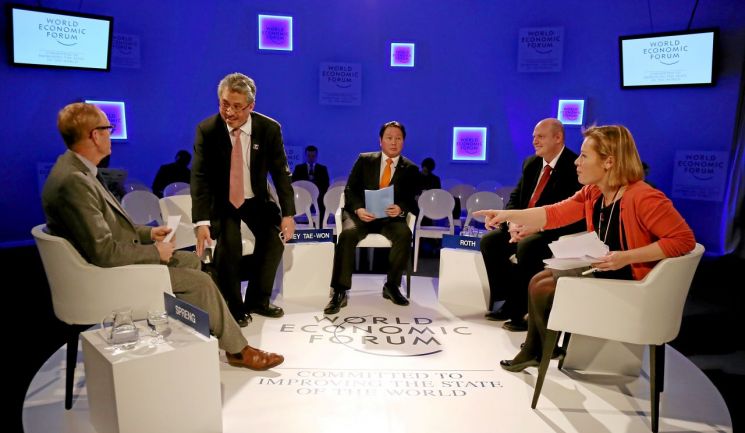 SK Group Chairman Chey Tae-won’s Social Progress Credits (SPC) program, proposed and promoted with original ideas, received high praise at this year’s Davos Forum, SK announced on the 24th. The photo shows Chairman Chey attending the 'Impact Investment' session at the Davos Forum in January 2013, preparing the session with panelists.
 [Photo by SK]
The Secretariat evaluated, "SK has successfully operated an innovative and effective partnership program that provides monetary incentives proportional to the social value created by social enterprises."
It added, "The know-how related to measuring the social value created by social enterprises also helped develop SK's social value measurement methodology," and "As a result of the measurement, SK Group's total social value creation in 2021 increased by 60% compared to the previous year."
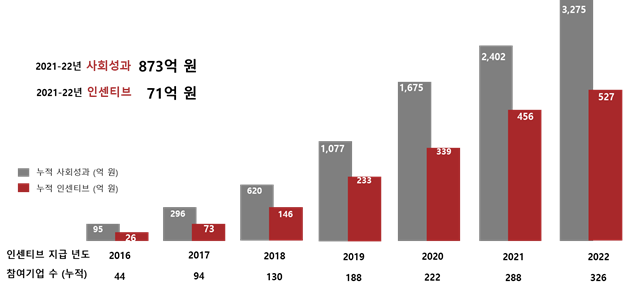
As a result of operating the Social Progress Credits program with 326 social enterprises from 2015 to last year, SK Group found that these social enterprises created a total of 327.5 billion KRW in social performance across four areas: job creation, provision of social services, environmental problem solving, and ecosystem problem solving.
SK Group paid a total of 52.7 billion KRW in incentives to social enterprises. The funds were raised through donations from 'Haengboknarae,' a social enterprise established by SK, and SK member companies. The growth of social enterprises that gained financial stability through incentive payments was remarkable.
Dongbu Care, which provides elderly nursing and care services, and Ecomom Sangol Baby Food, which produces seasonal baby food with employees from vulnerable rural groups, received incentives of 2 billion KRW and 380 million KRW respectively, with their social performance annual growth rates exceeding 30% and 40% respectively.
The international academic management community is also paying attention. The Harvard Business Review (HBR), published by Harvard Business School, featured a case study titled "SK Group: Social Progress Credits (SPC)" in January 2020. A paper on the effectiveness of Social Progress Credits by Professor Jeong Seon-moon of Dongguk University and Professor Shin Jae-yong of Seoul National University was published in October last year in 'Management Science,' the world's most prestigious journal.
Meanwhile, a representative of the Center for Social Value Enhancement Studies (CSES), a nonprofit research foundation established with SK's investment, said, "The Center for Social Value Enhancement Studies is currently promoting a social enterprise support policy cooperation project with Hwaseong City, Gyeonggi Province, and is also making efforts to expand the Social Progress Credits program domestically and internationally."
© The Asia Business Daily(www.asiae.co.kr). All rights reserved.
![Clutching a Stolen Dior Bag, Saying "I Hate Being Poor but Real"... The Grotesque Con of a "Human Knockoff" [Slate]](https://cwcontent.asiae.co.kr/asiaresize/183/2026021902243444107_1771435474.jpg)

















