[Asia Economy Reporter Son Sun-hee] The aviation industry, which experienced a severe downturn following the outbreak of COVID-19, is attempting a rebound this year. Positive forecasts suggest that major global airlines will emerge from operating losses and achieve a turnaround (performance improvement) for the first time in about three years.
According to Mirae Asset Securities on the 23rd, global airline market revenue this year is estimated to reach $779 billion, a 7.1% increase from last year. Although it is still less than the 2019 revenue before the COVID-19 crisis, it is more than double the 2020 revenue ($382 billion), which was the most severely impacted year.
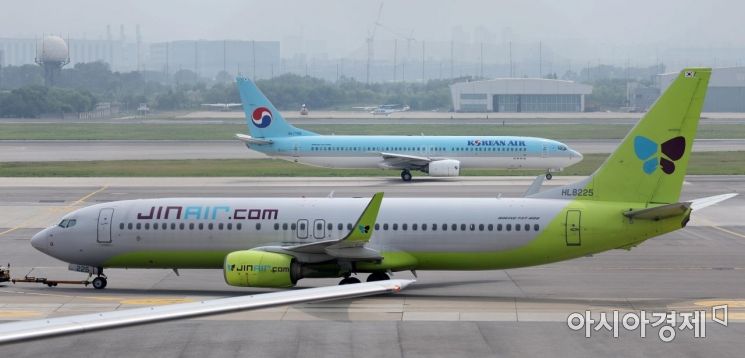
In particular, operating profit this year is estimated at $3.2 billion, marking a successful turnaround after three years since the 2020 deficit (-$110.8 billion). Net profit is also expected to turn positive, reaching $4.7 billion. Despite continued high cost pressures due to sharply rising international oil prices, losses are expected to shrink as oil prices have fallen from their peak toward the end and beginning of the year, and transportation volume has increased.
This year, the global aviation industry is expected to maintain its rebound trend overall, as the reopening effects of economic activities worldwide expand. Jae-hyun Ryu, a researcher at Mirae Asset Securities, said, "Passenger transportation volume will decline compared to 2019 until this year, but it is expected to reach 2019 levels in the second half."
However, the pace of demand recovery varies by region. Researcher Ryu explained, "North America has recovered to a level 3% lower than 2019, showing the fastest recovery speed, while Europe has decreased by 11% due to geopolitical risks, showing a relatively slower recovery pace."
Compared to the US and Europe, air travel demand in the Asia region is still recovering slowly. Researcher Ryu said, "Asia has decreased by 29% compared to 2019," adding, "This is due to lockdown effects in major markets such as China, but with China's rapid recovery in the second half, a full-fledged reopening effect is expected, mainly on short-haul routes."
As evidence, he pointed to the recent recovery in demand for Japan routes at Incheon Airport. Air travel demand for Japan routes has already increased by 7% compared to 2019. This seems to be due to the recent weakness of the yen and the lockdown in China, which relatively concentrated demand. Additionally, Southeast Asian routes are steadily recovering.
Overall, there is ample room for improvement in the aviation industry, but valuations differ by company. Researcher Ryu noted, "Performance differences arise depending on the presence or absence of cargo and long-haul passengers, and differentiation occurs based on risk responses related to foreign exchange and interest expenses," highlighting Korean Air as a noteworthy stock. Korean Air is almost the only company in the industry with a downward-stabilized debt ratio (258% as of Q3 2022) and has eased borrowing burdens compared to the past, minimizing risks during the interest rate hike period.
© The Asia Business Daily(www.asiae.co.kr). All rights reserved.
![Clutching a Stolen Dior Bag, Saying "I Hate Being Poor but Real"... The Grotesque Con of a "Human Knockoff" [Slate]](https://cwcontent.asiae.co.kr/asiaresize/183/2026021902243444107_1771435474.jpg)















