[Asia Economy Sejong=Reporter Dongwoo Lee] Attention is focused on whether the amendment to the Restriction of Special Taxation Act (RSTA), which raises the tax credit rate for investments in national strategic technologies such as semiconductors to a maximum of 25%, will pass at the next extraordinary session of the National Assembly.
According to related ministries on the 23rd, the Ministry of Economy and Finance plans to submit the RSTA amendment bill to the National Assembly soon after the Lunar New Year holiday. If the amendment passes the National Assembly, the tax credit rate for facility investments in national strategic technologies such as semiconductors will increase from the current 8% to 15% for large and medium-sized enterprises, and from 16% to 25% for small and medium-sized enterprises. An additional 10% tax credit will also be applied to the increased investment amount.
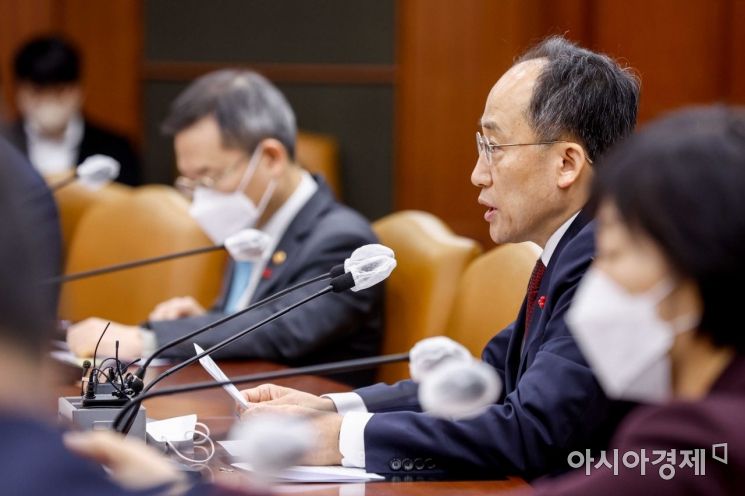 Deputy Prime Minister and Minister of Economy and Finance Choo Kyung-ho is delivering opening remarks at the Emergency Economic Ministers' Meeting held at the Government Seoul Office in Jongno-gu, Seoul, on the 12th. Photo by Kang Jin-hyung aymsdream@
The government is accelerating the RSTA amendment because countries around the world are actively supporting the strengthening of competitiveness in major industries such as semiconductors through tax credits and other measures. According to the Korea International Trade Association, the effective corporate tax rates for global semiconductor companies are 10.0% for TSMC, 8.5% for Intel, and 3.5% for SMIC, but for Samsung Electronics and SK Hynix, they are as high as 25.2% and 28.3%, respectively. The Trade Association emphasized that a competitive environment at least equal to that of the United States, Taiwan, and China must be created.
The key issue is that the consent of the opposition party, the Democratic Party of Korea, is essential for the passage of the amendment. Some opposition members argue that the scope of national strategic technologies under the RSTA should be further expanded beyond the existing semiconductor, battery, and vaccine sectors, as well as the display sector newly added in this amendment. Previously, the opposition also argued for limiting the tax credit rate for large corporations to 10%, citing the rationale of preventing conglomerate privileges. They also stated that the RSTA amendment should be decided while considering overall balance and related factors.
In response, the Korea Semiconductor Industry Association, the Federation of Korean Industries, and the Korea Chamber of Commerce and Industry raised their voices, saying, "Support at the National Assembly level is essential for prompt legislation of the RSTA amendment," and "We hope that the ruling and opposition parties will unite to quickly pass this amendment at the extraordinary session."

Concerns have also been raised about the decrease in tax revenue due to the expansion of tax credits. The decrease in tax revenue from raising the semiconductor facility investment tax credit rate to a maximum of 25% this year is estimated at 3.65 trillion won, and if the amendment passes the National Assembly, the total tax revenue decrease over three years is estimated at 6.39 trillion won.
In response, the Ministry of Economy and Finance plans to fully explain to the opposition the need to increase tax benefits for national strategic technologies. Furthermore, it explained that the decrease in tax revenue will be offset by a virtuous cycle structure in which companies increase investments as tax credit benefits expand, leading to increases in corporate and income tax revenues.
© The Asia Business Daily(www.asiae.co.kr). All rights reserved.
![Clutching a Stolen Dior Bag, Saying "I Hate Being Poor but Real"... The Grotesque Con of a "Human Knockoff" [Slate]](https://cwcontent.asiae.co.kr/asiaresize/183/2026021902243444107_1771435474.jpg)
















