Prejudices and Stereotypes Persist Regarding 'Mother's Surname' Choice When Filling Out Marriage Registration Form
Recently, cases of passing down the mother's surname have been increasing. Chanmi, a member of the girl group AOA, changed her name last year to follow her mother's surname, and former SBS announcer Kim Soo-min recently revealed that she passed her surname to her son, hoping that her family would contribute even a little to a gender-equal world.
Submission of 'Mother's Surname Agreement' When Filling Out Marriage Registration Form
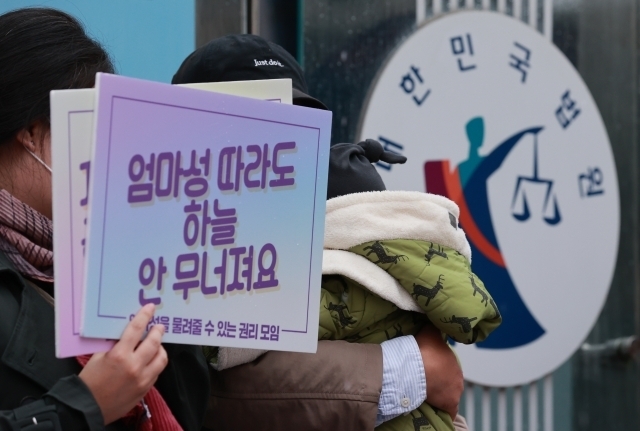 On November 9, 2021, a press conference welcoming the approval decision for the request to change the mother's surname and family name was held at the Seoul Family Court.
 [Photo by Yonhap News]
Korea adopts paternal primacy under civil law. However, the family registry system was abolished following the Constitutional Court's 'unconstitutionality' ruling in February 2005, and since 2008, according to Article 781, Paragraph 1 of the Civil Code, a child's surname and clan name generally follow the father's. But if the parents agree to follow the mother's surname and clan name when registering their marriage, it is stipulated that the child may take the mother's surname and clan name.
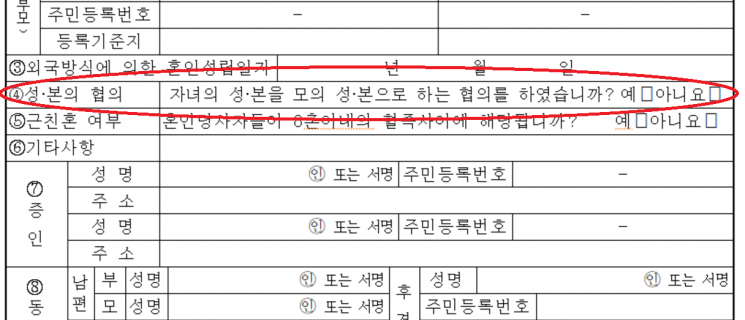
The key premise to note is 'when the parents register their marriage.' When submitting the marriage registration form, the question 'Did you agree on the child's surname and clan name?' must be answered with 'Yes.' Accordingly, the child's surname must be decided in advance at the time of marriage registration, even if the couple does not yet have children. Thoughts about surname and clan name may change after pregnancy and childbirth, but the choice must be made immediately at the time of marriage registration. Usually, many people check 'No' to follow the father's surname, so following the mother's surname is regarded as an exception, which has led to this phenomenon.
If the agreement to follow the mother's surname is not submitted at the time of marriage registration, there are two ways to pass the mother's surname to the child later: either by divorcing and remarrying while giving the child the mother's surname, or by filing a 'child's surname and clan name change' report with the court and undergoing a trial to decide on approval. In this case, if one of the spouses does not attend, a certificate of seal impression and notarized signature must be submitted.
Still Insufficient Awareness of 'Maternity'
In Korea, there is a prejudice that following the mother's surname usually indicates a 'divorced family' or a 'single-parent family.' In fact, the surname and clan name change system was introduced for children growing up in remarried families, so it is difficult to obtain approval for changes without specific reasons such as divorce. Because of this, a fixed stereotype may arise simply because the mother's surname is used.
Although it has been almost 15 years since it became possible to use the mother's surname, awareness of 'maternity' remains unfamiliar. This low awareness is also reflected in statistics. According to data submitted by the Court Administration Office to Justice Party lawmaker Eun-Joo Lee in 2020, the number of applications to have children follow the mother's surname and clan name at the time of marriage registration was ▲234 cases in 2015 ▲198 cases in 2017 ▲379 cases in 2019.
Moreover, as remarried and adoptive families, de facto marriages, and international marriages increase, family forms are becoming more diverse, but there are no laws to support various 'surnames.' Everyone must unify under the father's surname or a single surname simply because they are family members.
Meanwhile, some countries allow free choice of either parent's surname. Germany and Sweden allow choosing the mother's surname at birth registration, and both parents' surnames can be used. In the United States, the surname is decided at birth registration, and some states even allow the use of entirely new surnames. However, in Korea, the clause 'agreeing to set the surname and clan name of all children to the mother's surname and clan name' means that children's surnames cannot be different.
© The Asia Business Daily(www.asiae.co.kr). All rights reserved.
![Clutching a Stolen Dior Bag, Saying "I Hate Being Poor but Real"... The Grotesque Con of a "Human Knockoff" [Slate]](https://cwcontent.asiae.co.kr/asiaresize/183/2026021902243444107_1771435474.jpg)

















